


















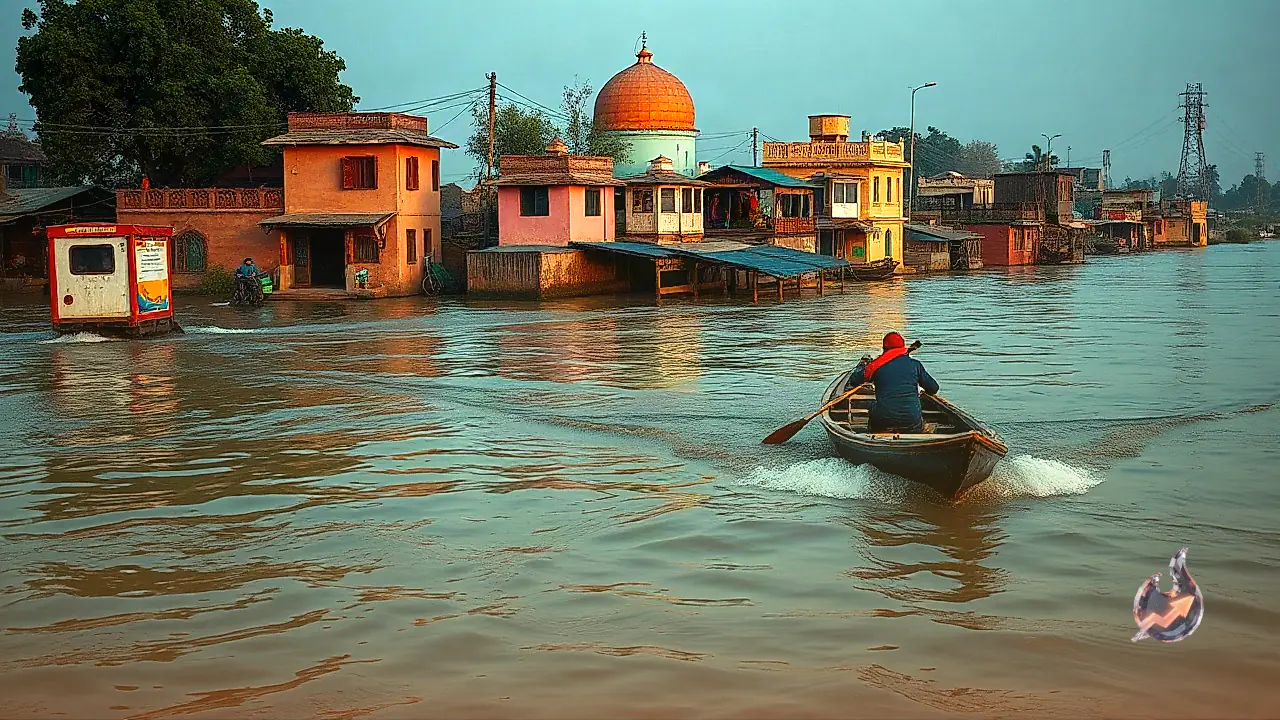

A photograph from Karauli during Rajasthan's ongoing Nikay Chunav has drawn attention for showing just how far election officials went to keep the voting process on track. In Ward No. 48 of Nagar Parishad Karauli, heavy rain on Tuesday left the road to the polling booth completely submerged, yet the polling party still reached its post on time, travelling the final stretch by boat.
Swollen Bhadravati river cuts off the road
Polling booth number 59 in Ward 48 is set up at the Rajkiya Prathmik Vidyalaya in Kalladah. After Tuesday's heavy rain, the nearby Bhadravati river swelled rapidly, and the water level rose fast enough to submerge the usual road leading to the booth. As the polling party prepared to head out early in the day, officials realised the road route was no longer usable.
When the road failed, a boat took over
Once word of the blocked road reached the administration, officials moved quickly. Instead of waiting for the road to clear, they decided to ferry the polling party across the river itself, arranging a boat for the crossing. Election material and staff were loaded onto the boat and taken across the Bhadravati river, with police personnel present throughout to ensure the team's safety. The crossing itself was far from routine, since the rain had pushed the river's flow well above normal.
Home guards and the BLO steer the effort
Home guard personnel and the Booth Level Officer, or BLO, played a central role in the operation, rowing the boat and guiding the polling party safely to the other bank. Every step was taken with extra caution given the swollen water, to avoid any mishap along the way. It was this coordination between the police, the home guards and the BLO that allowed the difficult crossing to go off without incident.
SDM Rakesh Kumar Rawat oversaw the arrangement
The entire operation was carried out under the supervision of SDM Rakesh Kumar Rawat. It was under his direction that officials decided the polling party would be sent across by boat if the road remained blocked. The administration worked to make sure the bad weather and the rising river did not end up disrupting the voting process, with Rawat's oversight ensuring every requirement, big or small, was accounted for in advance so the team would not be delayed in reaching the booth.
Rain could not hold up election day
In municipal elections, every ward's voters get a fixed window to cast their ballot, which means the polling party has to reach the booth on schedule. What happened in Karauli's Ward 48 shows that even an unexpected obstacle like a flooded river does not have to stall the process, as long as officials act quickly with the right alternative in place. The picture of the polling party making its way across the water by boat has come to stand for a broader point: on one side was a river rising by the hour, and on the other was the administration's duty to start voting on time. Rather than waiting for the floodwater to recede or the road to reopen, officials made an on-the-spot call and kept the election process moving without a break. The episode in Ward 48 of Karauli is now being cited as an example of administrative readiness holding up even when nature does not cooperate.