























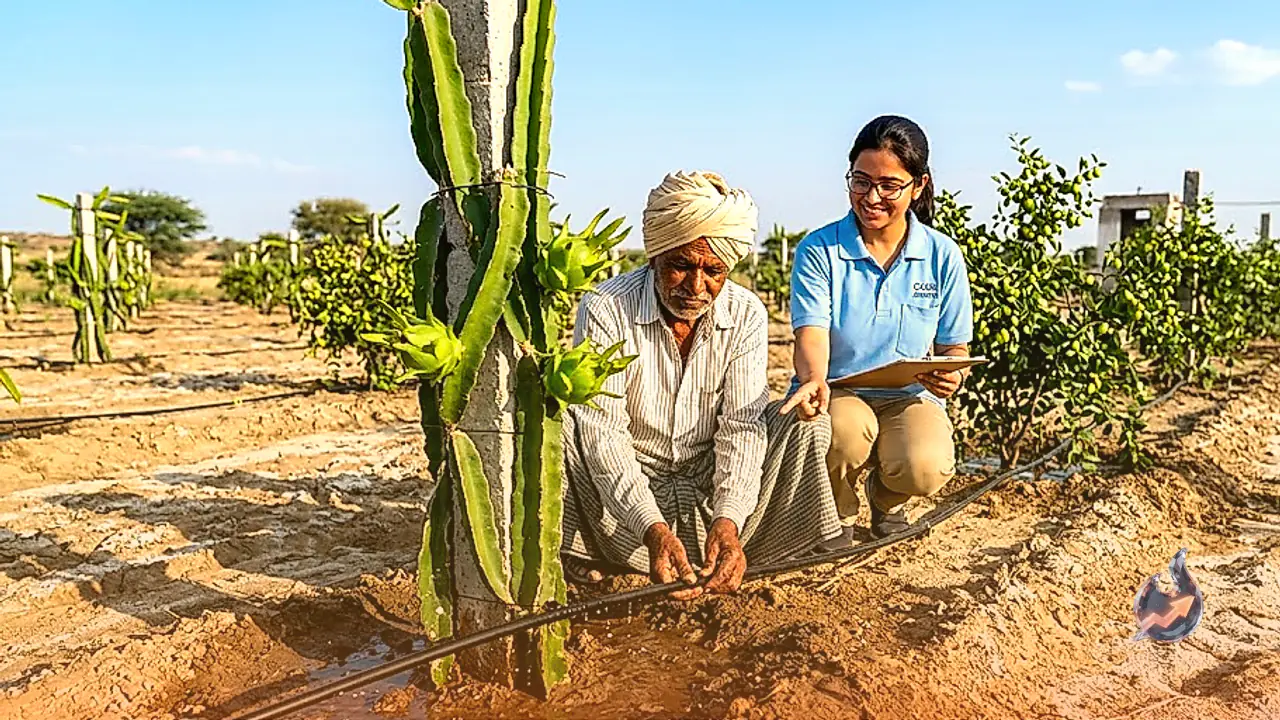

Farmers in the Rohat area of Pali district in Rajasthan have long struggled with the severe challenge of saline water for irrigation. Over the years, the excessive salt content in the underground water rendered large tracts of agricultural land practically unusable, significantly impacting local crop yields. Offering much-needed relief to the farming community, researchers at the Central Arid Zone Research Institute, commonly known as CAZRI, have engineered an innovative agricultural framework designed to cultivate high-value crops using saline water. Through this scientific technique, lands previously deemed unfit for cultivation will now host improved varieties of ber, also known as Indian jujube, alongside dragon fruit. This technological intervention is set to transform agricultural prospects across the Rohat region.
Salinity Challenge and the Drip Irrigation Solution
Elaborating on the science behind managing saline water, Dr. Kamala Choudhary, Senior Scientist at CAZRI, explained the core physiological barrier faced by plants in salty soils. When saline water is applied through traditional flood irrigation methods, surface water rapidly evaporates under heat, leaving behind a dense salt crust on the topsoil. This salt accumulation severely restricts root functions, eventually drying out the vegetation.
To overcome this issue, CAZRI experts implemented drip irrigation technology as a targeted solution. Dr. Kamala Choudhary noted, "Through drip technology, water reaches directly to the roots of the plant, which significantly reduces the impact of salinity in the soil." Alongside controlled drip delivery, researchers introduced a customized nutritional strategy. By supplying a specialized nutrition management protocol of just 50 grams per plant, crops gain the resilience needed to thrive even under hostile environmental conditions. Following this methodology, improved varieties of ber and dragon fruit saplings have been successfully planted in the fields of Rohat.
Crop Diversification to Double or Triple Farm Incomes
Given the widespread presence of saline groundwater across Pali and Rohat, agricultural scientists conducted extensive field trials on multiple fruit-bearing plants. Dr. Vijay Singh, a scientist at CAZRI, highlighted that among all tested crops, dragon fruit delivered the most encouraging and superior results. The crop demonstrated exceptional tolerance to high salinity levels and minimal moisture requirements.
Advocating for a shift away from traditional low-yield cropping patterns, Dr. Vijay Singh emphasized, "Compared to traditional farming, if farmers adopt crop diversification, their income can directly double to triple." Dragon fruit commands strong market demand as a high-value commercial produce. Its ability to endure adverse soil conditions while offering substantial economic returns makes it an ideal choice for farmers in arid, saline belts. Simultaneously, cultivation of improved ber varieties promises steady commercial returns.
From Labs to Fields: CAZRI Ground-Level Training Initiatives
Bridging the gap between laboratory research and actual farming practices, the CAZRI Pali center has launched extensive field training campaigns. The initiative aims to eliminate deep-seated hesitation among local farmers regarding the use of brackish water for agriculture. Scientists are conducting practical workshops to demonstrate the commercial viability of saline water farming.
As part of these training sessions, local cultivators are invited to CAZRI demonstration plots to observe thriving harvests firsthand. By witnessing how drip technology and the 50-gram special plant nutrition plan generate abundant yields, farmers are gaining confidence in the scientific approach. Cultivators in Rohat who once considered their lands unproductive are now actively consulting CAZRI scientists and preparing their fields to set up commercial dragon fruit and ber orchards.