





















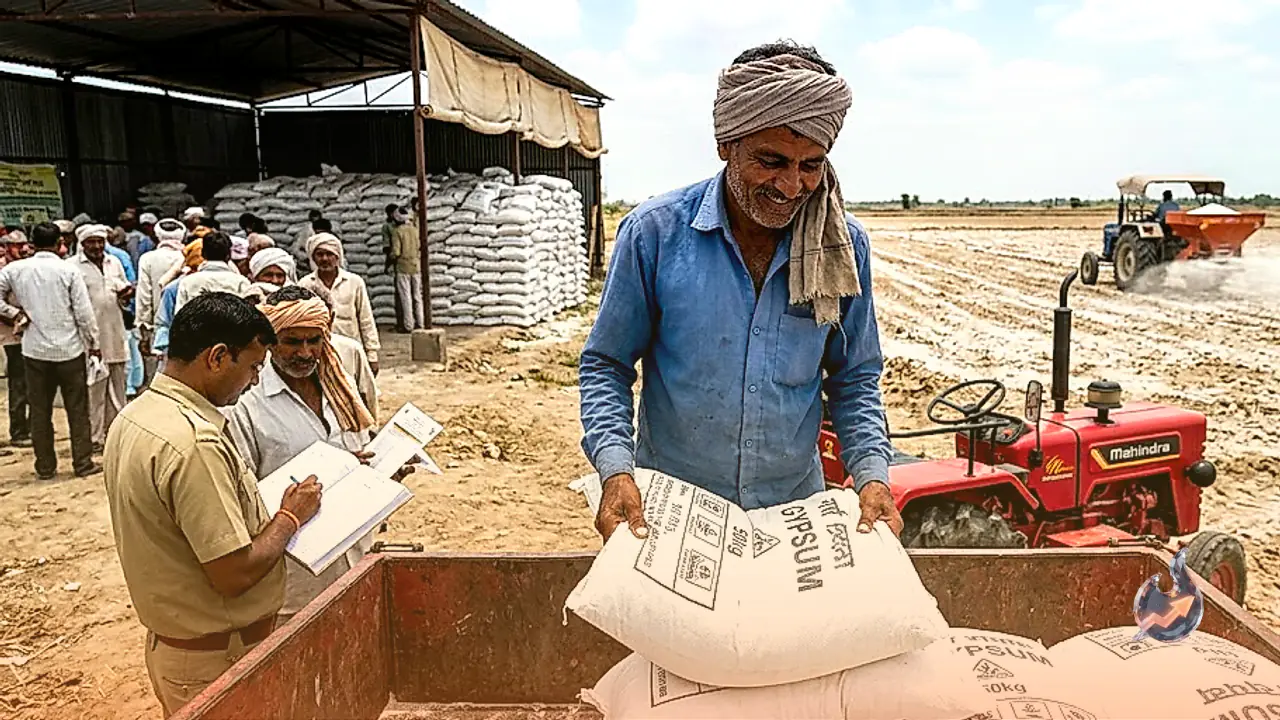

Rising alkalinity in agricultural land has increasingly severely impacted crop yields, posing a major challenge for farmers. To address this soil degradation and restore land fertility, the Agriculture Department has introduced a supportive welfare scheme. Under this initiative, the government is providing a 50 percent financial subsidy on gypsum when used as a soil conditioner. The program aims to reduce the financial burden of land reclamation on farmers while boosting overall agricultural productivity. Each eligible farmer can claim this subsidy benefit for a maximum area of up to 2 hectares.
Scientific Application Based on Soil Testing
A key highlight of this government scheme is that the gypsum subsidy is not granted on random assumptions or general estimates. Instead, financial assistance is strictly tied to an official soil testing report. Following laboratory analysis of the field soil sample, the required amount of gypsum is specified in the report as a Gypsum Requirement value, commonly referred to as the GR Value. Farmers are required to determine the exact quantity of gypsum needed for their land based on this recorded GR Value. This scientific process prevents the excessive or wasteful application of gypsum and ensures systematic, effective soil correction.
Impact of Soil Alkalinity on Crop Growth
Highlighting the technical aspects of soil health, Agriculture Expert Dinesh Jakhar explained that high alkalinity alters soil structure and severely restricts the availability of essential plant nutrients. When crops are unable to absorb necessary nutrients from the soil, their growth and overall development are hindered. In such scenarios, gypsum plays a vital role as an effective soil conditioner to repair soil health. He emphasized that because soil conditions vary from field to field, applying gypsum arbitrarily without prior testing can be ineffective. Following soil test recommendations ensures controlled input costs and optimized crop yields.
Subsidy Rates and Mandatory Eligibility Conditions
Under the guidelines of the scheme, the government will cover 50 percent of the total district wise fixed rate of gypsum. Since the subsidy is capped at a maximum of 2 hectares per farmer, applicants must prepare their paperwork according to their land area and verified soil report findings. Farmers are required to fill out the officially prescribed application form, specifying their gypsum requirement alongside the GR Value detailed in their soil test results. Providing accurate and authentic information in the application is critical, as the official allocation of gypsum is determined directly by the physical condition of the farm.
Contact Information for Farmers and Application Process
This initiative is particularly beneficial for farmers whose agricultural output has suffered due to land alkalinity issues. Agriculture experts advise farmers to strictly adhere to soil test recommendations to maximize the financial and agricultural benefits of the scheme. To apply for the subsidy, complete the required formalities, or seek further clarification regarding eligibility rules, farmers can directly contact their district Joint Director of Agriculture, Assistant Director of Agriculture, or the local Agriculture Supervisor.