





















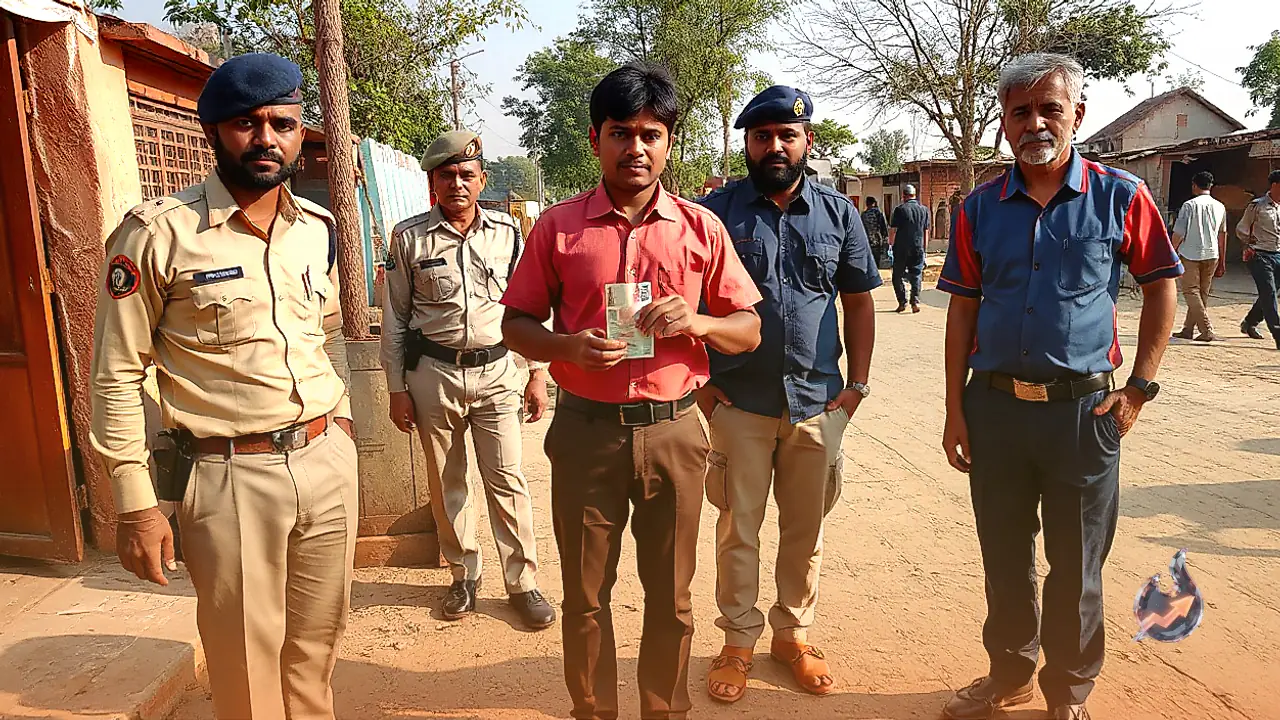

Law enforcement authorities in the Sadulshahar area of Rajasthan's Sri Ganganagar district have intercepted an attempt to inject fake currency into daily commerce. Officers operating in Ward Number 17 apprehended a young man and recovered 206 counterfeit banknotes, all bearing the 100-rupee denomination. The collective face value of the confiscated currency stands at 20,600 rupees. According to investigators, the suspect planned to circulate these forged notes across local retail shops and vegetable stalls, passing them off during regular everyday transactions. The seizure has triggered a broader probe into the origins of the batch and any coordinated syndicate operating behind the individual.
The Tactical Preference for Smaller Denominations
A striking dimension of the seizure is that every single counterfeit note recovered belongs to the 100-rupee denomination. Counterfeit rings have traditionally focused on high-denomination notes, but circulating smaller bills represents a calculated operational shift. The 100-rupee note functions as a staple across community markets, grocery stores, roadside tea stalls, and fuel outlets. Because these small transactions occur rapidly and continuously, traders and customers rarely subject 100-rupee bills to the scrutiny typically reserved for 500-rupee notes.
Cashiers routinely inspect higher-value currency for watermarks, paper texture, and security threads, whereas smaller notes move quickly through bustling checkout counters without a second glance. Counterfeiters exploit this routine lack of vigilance, viewing lower denominations as a lower-risk vehicle to move fraudulent currency without immediately raising alarms. Investigators are working to confirm whether the arrested suspect manufactured the notes independently or obtained them from a specialized printing source.
Concerns Over Market Infiltration and Investigative Priorities
The confiscation of 206 forged bills has prompted concerns among local shopkeepers and street vendors regarding whether similar counterfeit currency has already entered the regional cash stream. Micro-retailers operate on slim margins and seldom possess counterfeit detection tools, leaving them vulnerable to receiving forged notes. While authorities have not officially verified that counterfeit currency from this batch reached the marketplace prior to the arrest, the presence of the notes has heightened community alertness.
Police investigators are now focusing on identifying the geographical chain of supply. Key questions under active inquiry include whether the 206 notes were printed locally within Sadulshahar using basic digital printing equipment, or transported from other regional manufacturing hubs for local distribution. Counterfeiting operations frequently employ tiered networks, dividing manufacturing, transit logistics, and market circulation among different participants to limit operational exposure.
Tracing the Broader Distribution Network
Following the apprehension in Ward Number 17, police officials are analyzing the suspect's background, financial interactions, and communication history. The primary goal is to determine if the individual acted in an isolated capacity or operated as a distribution courier for an organized counterfeiting ring. Similar patterns have been detected elsewhere across Rajasthan; in Jaipur, for instance, authorities previously seized 3.45 lakh rupees in counterfeit notes that were stockpiled to be circulated during Panchayati Raj elections and major festival periods.
At present, the Sadulshahar investigation stands at the arrest of one suspect and the physical recovery of 206 forged notes totaling 20,600 rupees. Investigative teams are pursuing additional leads to identify collaborators and suppliers connected to the seizure, aiming to dismantle the underlying network before further illicit currency can penetrate regional retail markets.