















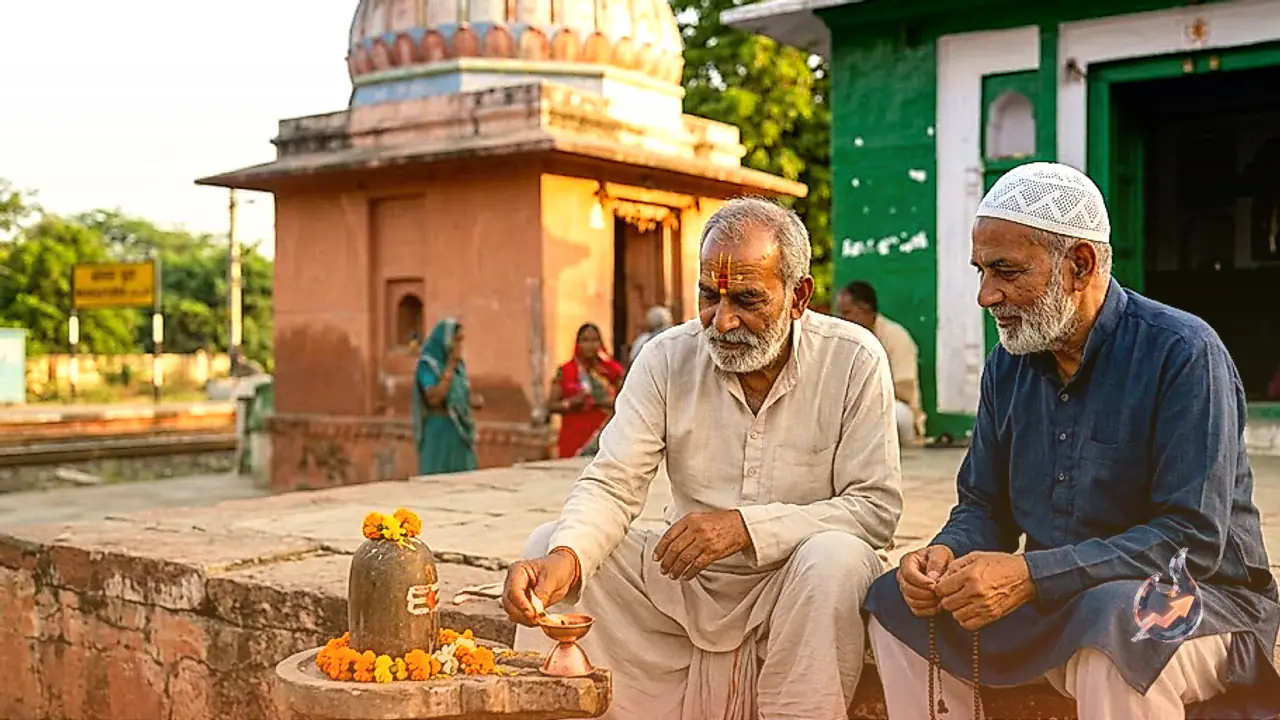

The city of Kota in Rajasthan is globally recognized for its massive education and coaching industry, drawing countless students every year. However, this bustling urban center is currently making headlines for an entirely different and highly uplifting reason. In an era where minor disagreements frequently escalate into major communal tensions, Kota has emerged as a beacon of religious harmony and mutual brotherhood. The Tullapura railway premises in the city hosts a deeply unique religious site where followers of two distinct faiths come together in perfect unison. At this location, the sacred Mansapurna Mahadev temple and the Pathan Sahab mazar stand side by side, sharing not just a single physical wall but also a common entrance path.
A Decades-Old Center Of Shared Faith
For nearly 40 years, this shared compound has served as an epicenter of profound faith for people of both communities. From the early hours of the morning until late in the evening, a steady stream of devotees visits the site every single day. Approximately 200 to 300 visitors arrive daily to offer their prayers, seek blessings, and make personal wishes. The atmosphere is consistently devoid of any conflict, allowing individuals to bow their heads in complete devotion and peace. This enduring setup has become a powerful testament to peaceful coexistence.
Locals Recount The Unique History
The origins of this remarkable place are firmly rooted in local memory, with residents readily sharing its historical timeline. 68-year-old Ramesh Chandra, a longtime local who has spent his entire childhood in the immediate vicinity, provides crucial insights into how the compound evolved. Chandra notes that he has been a regular visitor to the site since the year 1989. According to his detailed account, the foundation of this shared space began around 1985 when a very small Shiva temple was initially constructed on the premises.
The Vision Of Nannu Chacha
Not long after the temple was built, the idea for the mazar was brought to life by a highly respected local figure. During that period, a man affectionately known in the neighborhood as Nannu Chacha was alive, and he harbored a strong desire to foster lasting mutual affection and religious goodwill. To physically manifest this vision of unity, he took the initiative to construct the Pathan Sahab mazar directly behind the existing Mahadev temple. His visionary decision created an unbreakable bond between the two communities that continues to thrive decades later.
Absolute Freedom Without Clerics
Perhaps the most extraordinary and refreshing characteristic of this religious sanctuary is the complete absence of hierarchical religious authority. There is no traditional, permanent pandit assigned to the temple, nor is there a designated maulvi presiding over the mazar. Every single person, whether an ordinary citizen or an affluent individual, holds an exactly equal right to worship. Summing up this egalitarian spirit, locals state, "There is no monopoly of any pandit or maulvi here, rather every man is free." Unpleasant practices like untouchability, social discrimination, or feelings of inferiority are entirely non-existent within the premises.
Cooperative Site Management
The day-to-day administration of both sites further exemplifies this deep-seated spirit of brotherhood. The responsibility for the regular cleaning, maintenance, and upkeep of the mazar remains entirely with Nannu Chacha's family. Specifically, his grandchildren carry forward his legacy, managing the shrine with immense dedication and love. Simultaneously, the management and developmental activities for the Mahadev temple are overseen by a specially formed local executive committee. This group ensures that all administrative tasks are handled smoothly through extensive mutual cooperation and coordination.
Vibrant Celebrations During Festivals
The true vibrancy of this shared compound is most visible during major religious festivals, which transform the area into a lively hub of faith. Every Tuesday and Saturday, large groups from the Hindu community congregate at the temple to collectively chant the Hanuman Chalisa. Furthermore, during the holy month of Sawan, the temple witnesses an extraordinary influx of devotees arriving for Mahadev darshan and to perform Jalabhishek. The crowds are often so massive that devotees must wait in incredibly long queues for their turn, yet the entire process is completed in a highly disciplined and peaceful manner.
Unhindered Muslim Observances
The Muslim community experiences the exact same level of freedom and joy during their religious observances. Whenever a Muslim festival arrives, or during the annual Urs of Pathan Sahab, devotees gather at the mazar to offer their prayers. They freely burn loban and light their traditional dhuni without facing any restrictions or objections from anyone. There is a complete lack of interference from the other side, highlighting the deep mutual respect that exists between the two groups.
A Shining Example Of Unity In Diversity
Local residents firmly claim that this is the sole location in the entirety of Kota city where a temple and a mazar are so intimately connected. It is not just about sharing a common pathway and entrance; the two structures are physically adjacent to each other. Despite the passage of 40 years, there has never been a single reported instance of interference or friction between the two sides. This compound stands as a living, breathing embodiment of India's famous Ganga-Jamuni culture, showcasing unity in diversity that desperately needs to be preserved and showcased to the wider world today.