



















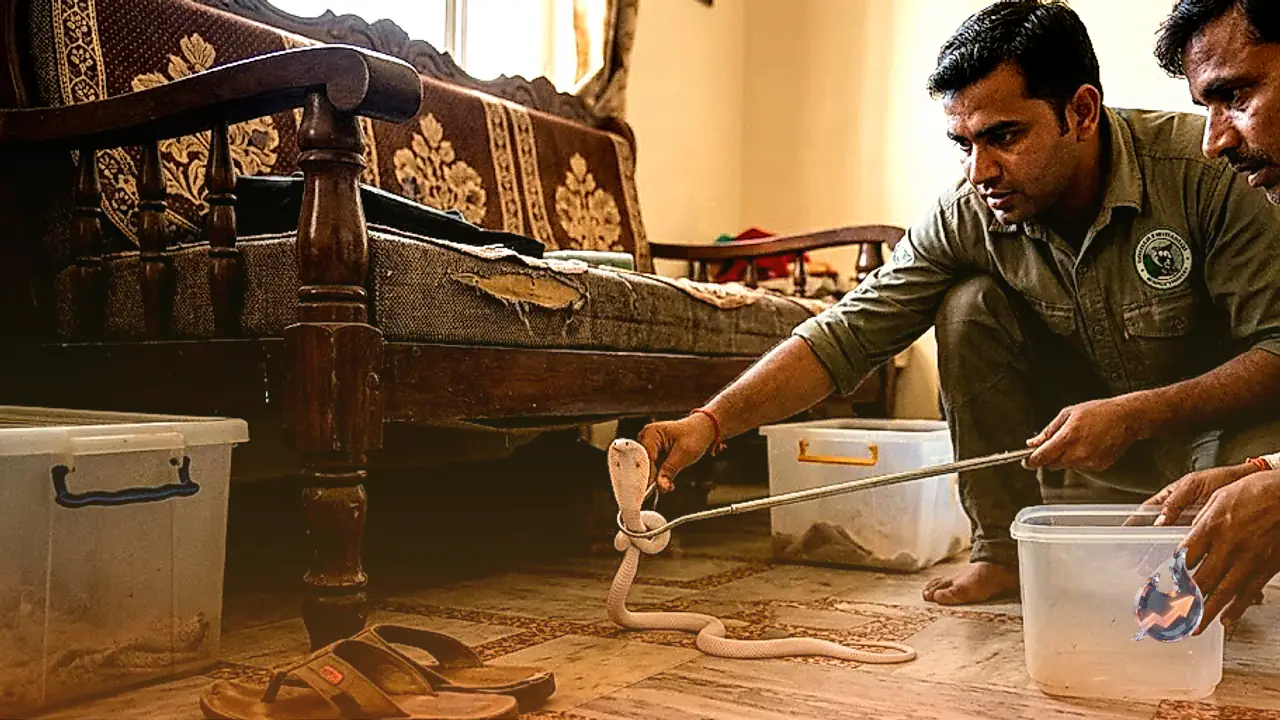

A sudden panic gripped the residents of Ravla Chowk in the Sanganer suburb of Bhilwara, Rajasthan, when an unusual snake was spotted inside a residential house. Upon receiving the urgent call, Kuldeep Singh Ranawat from the Wild Animal Rescue Center arrived at the scene to handle the situation. The reptile had sought shelter in one of the rooms, hiding quietly beneath a sofa.
As the rescue team carefully inspected the hiding spot, they made a surprising discovery. Instead of a typical snake, they found a rare, small white cobra. Ranawat carefully extracted the venomous reptile, ensuring its safety as well as the safety of the household members.
Understanding the Genetics of the White Cobra
Kuldeep Singh Ranawat explained the science behind this unusual coloration. While standard cobras are known for their dark brown or black scales, genetic mutations can sometimes disrupt the normal production of melanin. A lack of this pigment results in a striking white appearance. However, Ranawat clarified that this specific snake is not a complete albino. A true albino snake typically exhibits reddish or pinkish eyes. In contrast, this captured cobra had black eyes, indicating a partial form of albinism or leucism.
Survival in the wild is extremely difficult for such uniquely colored creatures. Because their bright white bodies stand out in natural environments, they lack the camouflage necessary to hide from predators or sneak up on prey. Consequently, their chances of long-term survival in nature are significantly reduced compared to their darker counterparts.
Cultural Beliefs and Wildlife Protection
In India, snakes, particularly cobras, carry deep religious and cultural significance. Many people view the cobra as a sacred symbol associated with Lord Shiva, treating the creature with reverence rather than fear. Following its successful capture, the rare white cobra was transported away from the residential area and safely released back into a secure, natural habitat.
Following the incident, Ranawat urged the public to act responsibly when encountering wild animals in populated areas. He advised against trying to catch, handle, or kill any wild creatures. Instead, citizens should immediately contact the forest department or the local wildlife rescue team in Bhilwara. This ensures that the animals can be safely relocated without causing harm to humans or the wildlife.


