


















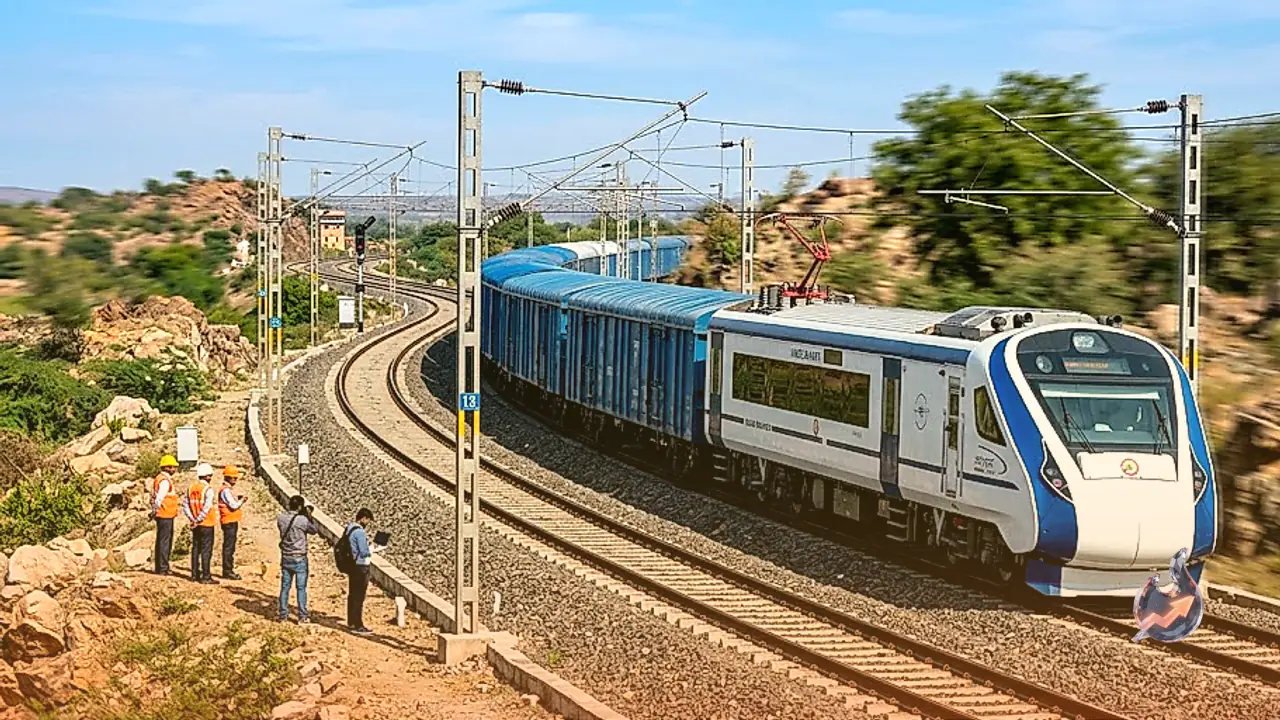

Indian Railways has kicked off the technical trial of the country's first Vande Bharat platform-based Freight EMU, and on its very first day in the Kota division of Rajasthan, the train touched a top speed of 145 kilometres per hour. The trial is being seen as an early glimpse of a faster, more modern era of freight movement on Indian tracks.
Inside the design and capacity of the new freight train
The prototype has been built by the Integral Coach Factory in Chennai and carries a total of 16 coaches, made up of 12 parcel coaches, 2 refrigerated DTC coaches and 2 non-driving trailer coaches. It rides on the same modern bogie system used in the Vande Bharat trains and has an axle load of more than 20 tonnes. Railways say the train's total payload capacity crosses 397 tonnes, meaning it can carry significantly more freight in a single run than earlier rakes.
How the trial run unfolded between Kota and Mahidpur Road
The train left Kota at 6 am for its trial run to Mahidpur Road. It was first tested at a speed of 120 kilometres per hour, before being gradually pushed up to 135 kilometres per hour. On the return leg, the Freight EMU hit its highest recorded speed of 145 kilometres per hour, the standout result of the day's run. Over the next month, the train will undergo at least two round trips daily under a range of different conditions to assess its performance thoroughly.
Every safety and technical parameter under scrutiny
Through the trial, engineers will closely study the train's stability across speeds ranging from 120 to 145 kilometres per hour. Emergency braking response, coupler force, performance on curves and the reliability of the traction system will all be examined. The tests will also cover regenerative energy recovery, signalling behaviour, telecom interference and the safety of the doors. Internal systems such as CCTV, lighting and short-circuit protection are being checked as well.
What it means for e-commerce and time-sensitive cargo
A high-speed Freight EMU like this could turn out to be a gamechanger for e-commerce and express parcel businesses. Faster delivery times are expected to bring major benefits to logistics operators handling time-sensitive shipments. The refrigerated coaches will also make it easier to transport goods that need to be kept cold in transit. In effect, Indian Railways' tracks are set to carry not just faster passengers but faster business too.
What comes next
Indian Railways is working toward freight transport that is faster, more reliable and built on modern technology, and the Vande Bharat Freight EMU is being viewed as a key experiment in that direction. If the trials succeed, such trains could become part of the country's high-speed freight network in the future. This first leap to 145 kilometres per hour has already given real momentum to that mission.