






















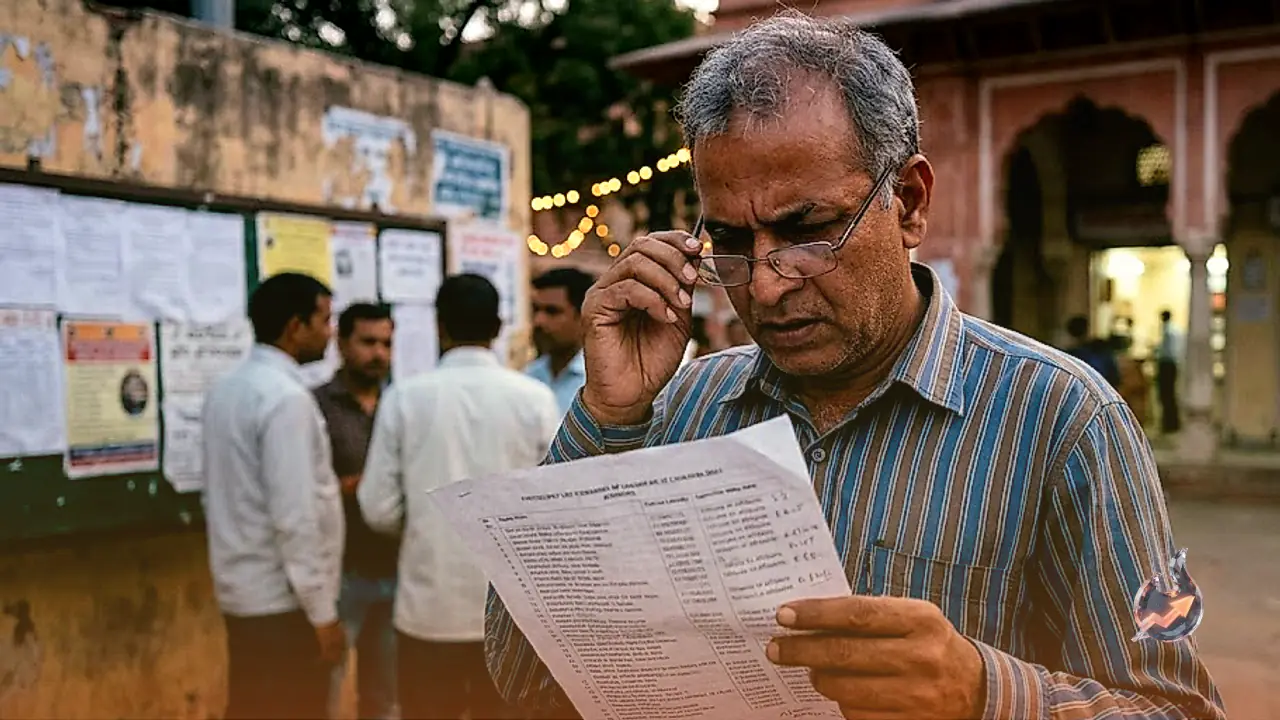

A peculiar and intriguing trend has emerged in the local body elections in Jaipur, where candidates vying for municipal seats have submitted nomination affidavits showing vastly different valuations for gold jewelry. While precious metal rates in the open market remain relatively uniform, political hopefuls have used their own varying yardsticks to calculate their movable assets. This has resulted in a scenario where the declared price of one tola of gold stretches from 1.10 lakh rupees to a staggering 1.60 lakh rupees across different candidates, drawing considerable attention to how wealth declarations are compiled.
Wide Price Gaps in Bharatiya Janata Party Candidate Filings
Affidavits submitted by candidates from the ruling party showcase significant fluctuations in how much they believe gold is worth. Manju Agarwal from Ward 9 declared 20 tolas of gold valued at 32 lakh rupees, translating to 1.60 lakh rupees per tola. Sneh Lata Sabu of Ward 6 listed 5 tolas at 7 lakh rupees, which comes out to 1.40 lakh rupees per tola. Shahnawaz representing Ward 19 noted 3.50 lakh rupees for 2.5 tolas, maintaining a rate of 1.40 lakh rupees per tola. Jyoti Khandelwal from Ward 110 reported 45 tolas of gold worth 65 lakh rupees, averaging around 1.44 lakh rupees per tola. Meanwhile, Ajay Singh Chauhan of Ward 21 logged 2 lakh rupees for 1.5 tolas at 1.33 lakh rupees per tola, and Ashok Rawatani of Ward 42 recorded 5.14 lakh rupees for 3.5 tolas at 1.47 lakh rupees per tola.
Discrepancies Noticed Among Congress Party Nominees
Contenders belonging to the opposition party displayed a similar diversity in their financial declarations. Kavita from Ward 4 listed 2 tolas of gold at 2.20 lakh rupees, bringing the per tola value down to a modest 1.10 lakh rupees. Vandita Sharma of Ward 18 put down 6 lakh rupees for 4 tolas at 1.50 lakh rupees per tola. Sunita Methi from Ward 110 declared the highest quantity of 70 tolas worth 105 lakh rupees, which also calculates to 1.50 lakh rupees per tola. Mahendra Pal from Ward 85 recorded 16.30 lakh rupees for 10 tolas, marking the highest rate at 1.63 lakh rupees per tola. Rajiv Chaudhary of Ward 53 noted 6 lakh rupees for 4.5 tolas at 1.33 lakh rupees, and Ramphool of Ward 60 stated 4 lakh rupees for 2.5 tolas at 1.60 lakh rupees per tola.
Independent Candidates Follow Diverse Valuation Patterns
Candidates contesting without party affiliations also presented a mixed picture regarding precious metal pricing in their legal documents. Pankaj Goyal from Ward 15 showed half a tola of gold valued at 75 thousand rupees, reflecting a rate of 1.50 lakh rupees per tola. Manoj Mudgal from Ward 101 listed 7.50 lakh rupees for 5 tolas at 1.50 lakh rupees per tola, while Rajendra Patel of Ward 54 documented 2.79 lakh rupees for 1.8 tolas, making it 1.55 lakh rupees per tola. These figures demonstrate that market realities were often sidelined in favor of individual estimations by the participants.
Divergence Between Market Rates and Documented Valuations
Around the final filing date of August 31, standard gold in the market traded close to 1.59 lakh rupees per tola, while jewelry gold hovered around 1.45 lakh rupees per tola. Despite these established benchmarks, affidavit figures swung wildly between 1.10 lakh rupees and 1.63 lakh rupees. Financial analysts point out that while candidates are legally obligated to declare accurate market values for their assets, practical execution often relies on rough estimations or outdated figures from previous years.
This distinct variation has turned into a fascinating talking point for both election authorities and ordinary voters. Mandatory affidavits are designed to ensure financial transparency among people seeking public office, yet such wide gaps in a single commodity within the same city raise valid questions. Candidates appear to be taking vastly different routes in their documentation just as they do in the electoral arena. Voters are now scrutinizing these filings more closely to see how accurately their local representatives account for everyday economic realities.