


















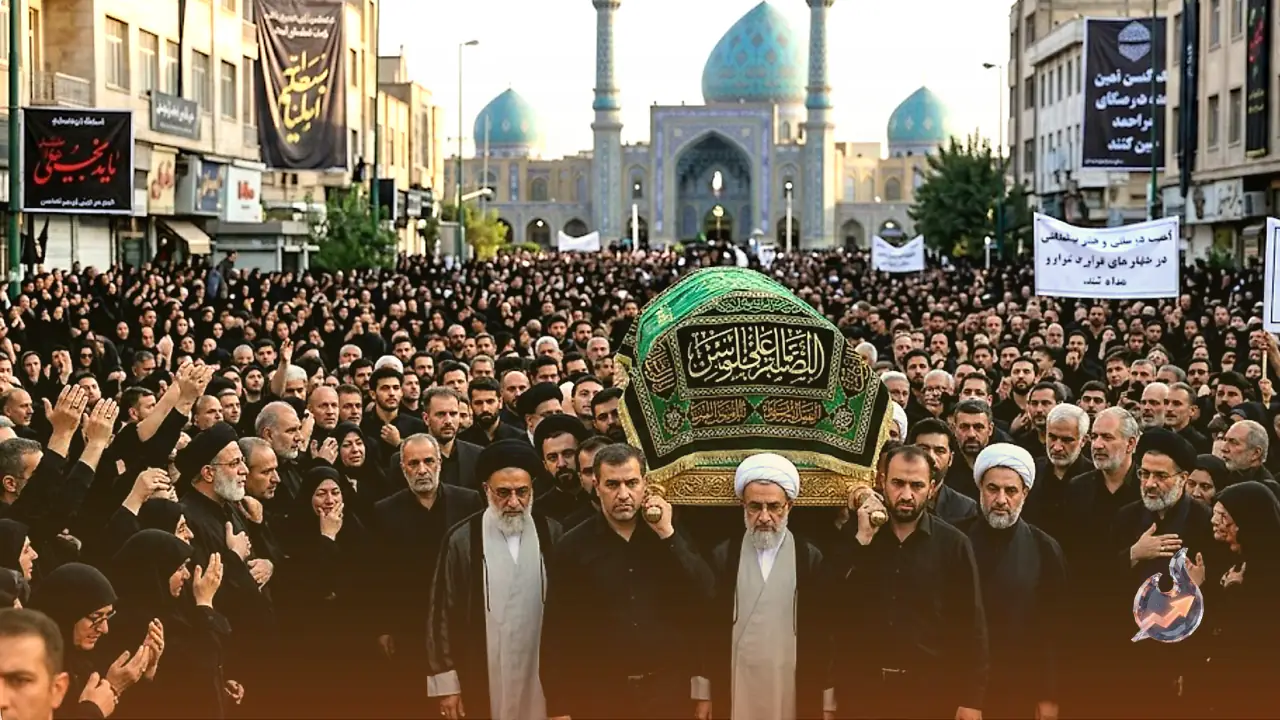

The final rites for Iran's Supreme Leader, the late Ayatollah Ali Khamenei, begin today. The eyes of the world are on Tehran, where millions of people are expected to gather. The Iranian government has announced a multi-day funeral programme that will move across several cities, with different rites performed at each stop.
The funeral procession will travel from Tehran through Qom to Mashhad
The programme begins in Tehran, where the funeral prayer will be offered first. This is also where the public will get a chance for one last look at Ayatollah Ali Khamenei. After the rites in Tehran, the procession will move to Qom, where religious ceremonies will be held. The final stop will be Mashhad, where he will be laid to rest, or supurd-e-khaak, on July 9. Ayatollah Ali Khamenei's passing has become a major event not just for Iran, but for the entire Muslim world. That is why many people are now asking what supurd-e-khaak actually means and how this ritual is carried out in Islam.
What supurd-e-khaak actually means
Supurd-e-khaak is a Persian and Urdu term that literally means handing someone over to the soil. In Islam, the ritual of burying a person's body with full respect and dignity after death is called supurd-e-khaak. It is not treated merely as a final farewell ritual, it is considered a religious duty that every Muslim is expected to fulfil.
The first step is ghusl, the purification of the body
After a Muslim passes away, the first task is to purify the body according to Shariah, a process called ghusl. The entire body is washed with clean water so that the deceased can be presented before Allah in a state of purity. This responsibility is usually carried out by close family members, or by people experienced in performing this task.
The kafan, the same simple cloth for rich and poor alike
Once ghusl is complete, the deceased is wrapped in a plain white cloth known as the kafan. Islam places great emphasis on simplicity, so no decoration or display of any kind is allowed on the kafan. This principle applies equally to the rich and the poor, meaning there is no distinction made at the time of burial based on a person's status.
Salat-ul-Janaza, a prayer with no ruku or sajda
After the kafan, the deceased is taken to a mosque, an eidgah, or an open ground, where Salat-ul-Janaza, the funeral prayer, is offered. This prayer seeks maghfirat, or forgiveness of sins, along with mercy and a high status in paradise for the deceased. The funeral prayer is distinct from other prayers in Islam in one key way, it does not include ruku or sajda, unlike regular prayers.
The final rites at the graveyard and three handfuls of soil
After the funeral prayer, the deceased is taken to the graveyard. In Islam, an effort is made to complete the burial as soon as possible after death. The grave is kept ready in advance. The deceased is usually laid on their right side in such a way that their face points towards the Qibla, meaning Mecca. The grave is then filled with soil. In many places, those present also drop three handfuls of soil into the grave and offer prayers of forgiveness for the deceased. In Islam, keeping the grave simple and unadorned is considered the better practice.
Taziyat, the three days of condolences that follow supurd-e-khaak
Once supurd-e-khaak is complete, family members, relatives and close acquaintances pray for the deceased. This is when taziyat, the process of offering condolences, begins. People visit the family's home to console the ahl-e-khana, or household members, urging them towards patience, and to pray for the forgiveness of the deceased. This period of taziyat typically continues for three days, during which people keep visiting the family in turns.