






















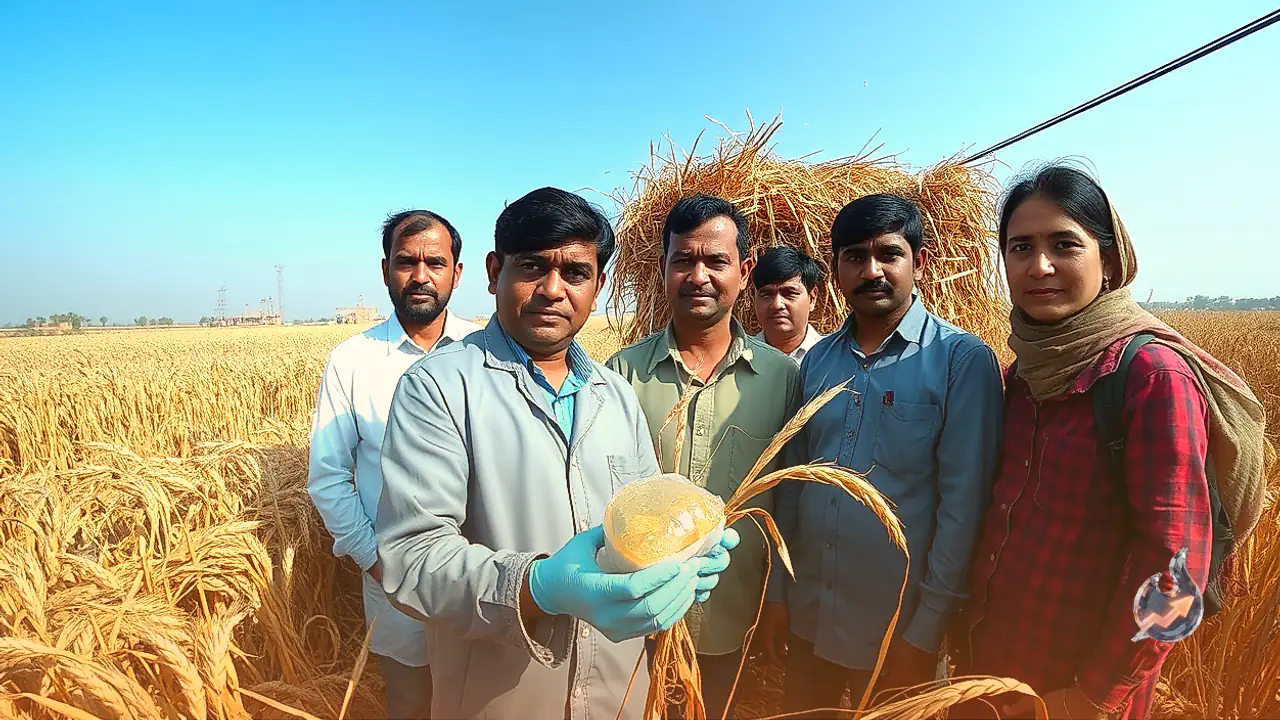

Agricultural residue like wheat straw, which is routinely discarded or burned across farm fields, may soon provide a scientifically backed breakthrough in the clinical management of facial acne. At the School of Life Sciences and Biotechnology within Chhatrapati Shahu Ji Maharaj University in Kanpur, Subrat Pandey, an MSc Biotechnology student, has formulated an innovative topical gel using lignin extracted from leftover wheat straw. Developed under the supervision of Dr. Rakesh Kumar Sharma, the project explores high-tech therapeutic alternatives to mitigate global over-reliance on traditional antibiotics for common skin conditions. Initial laboratory evaluations confirm that the straw-derived biomaterial formulation demonstrates a strong inhibitory effect against the primary bacterial drivers of acne breakouts.
Transforming Wheat Straw Lignin Into Bioactive Nanoparticles
Explaining the technical methodology behind the discovery, Subrat Pandey detailed how natural lignin polymers were first systematically isolated from raw agricultural wheat straw. Through precise bio-nanotechnology protocols, this extracted lignin was synthesized into ultra-fine nanoscale particles. These specialized nanoparticles were subsequently fused with functional postbiotics obtained from the beneficial bacterial strain Lactiplantibacillus plantarum. To deliver the active compounds effectively to the skin surface, the entire mixture was incorporated into a stabilized aloe vera gel matrix.
The investigative team approached the project with two distinct strategic goals. First, they sought to develop sustainable bio-upcycling methods that transform troublesome agricultural waste into high-value functional biomaterials. Second, they aimed to address the growing public health challenge of antibiotic-resistant acne by formulating a targeted non-antibiotic skin therapy that synergizes nanotechnology with natural probiotic derivatives.
Direct Action Against Pathogenic Bacteria and Biofilms
The anti-acne efficacy of the lab-developed gel was systematically benchmarked against Cutibacterium acnes, the principal bacterium responsible for inflammatory acne flare-ups. In rigorous in vitro assays, the active formulation demonstrated a measurable ability to suppress the proliferation and survival of this target pathogen. In addition to direct microbial suppression, the investigators evaluated the compound's impact on bacterial biofilm dynamics.
In microbiology, a biofilm functions as an adhesive, self-secreted cellular matrix wherein bacteria bind together onto tissue surfaces to shield themselves from hostile external factors and standard topical medications. The experimental formulation demonstrated a clear capacity to disrupt and inhibit this biofilm formation pathway. By neutralizing both free bacterial cells and their protective collective structures, the study reveals significant promise for engineering resilient dermatological treatments against chronic acne manifestations.
Bridging Agricultural Upcycling and Modern Dermatology
A standout achievement of this experimental study lies in converting open-field agricultural refuse into functional nanoscale healthcare solutions. Wheat straw, typically viewed as low-value farm waste that creates seasonal disposal and burning challenges, can serve as a sustainable domestic precursor for high-tech biomaterials. This dual-action approach not only outlines a viable waste valorization pathway for agro-economies but also charts a forward-looking direction for combining postbiotic biology with green nanotechnology.
The research team emphasized that the current findings represent an exploratory laboratory phase. Consequently, the synthesized gel is not yet approved or recommended for direct patient administration. Before commercial or clinical use can be considered, extensive safety profiles must be established. Future phases of the research will assess human skin biocompatibility, long-term dermatological tolerability, formulation stability across ambient temperatures, and the transdermal penetration depth of the active lignin nanoparticles. Formal human clinical trials will only commence once these rigorous safety criteria are thoroughly satisfied.
Roadmap for Safety Validation and Clinical Testing
While substantial regulatory and testing milestones remain before pharmacy shelves see a straw-based acne ointment, this breakthrough affirms the feasibility of coupling farm-waste nanoparticles with postbiotics to neutralize harmful cutaneous bacteria. The research team in Kanpur is now advancing toward multi-parametric toxicology profiles and extended stability evaluations, working toward a safe, antibiotic-free topical alternative for dermatology patients worldwide.