























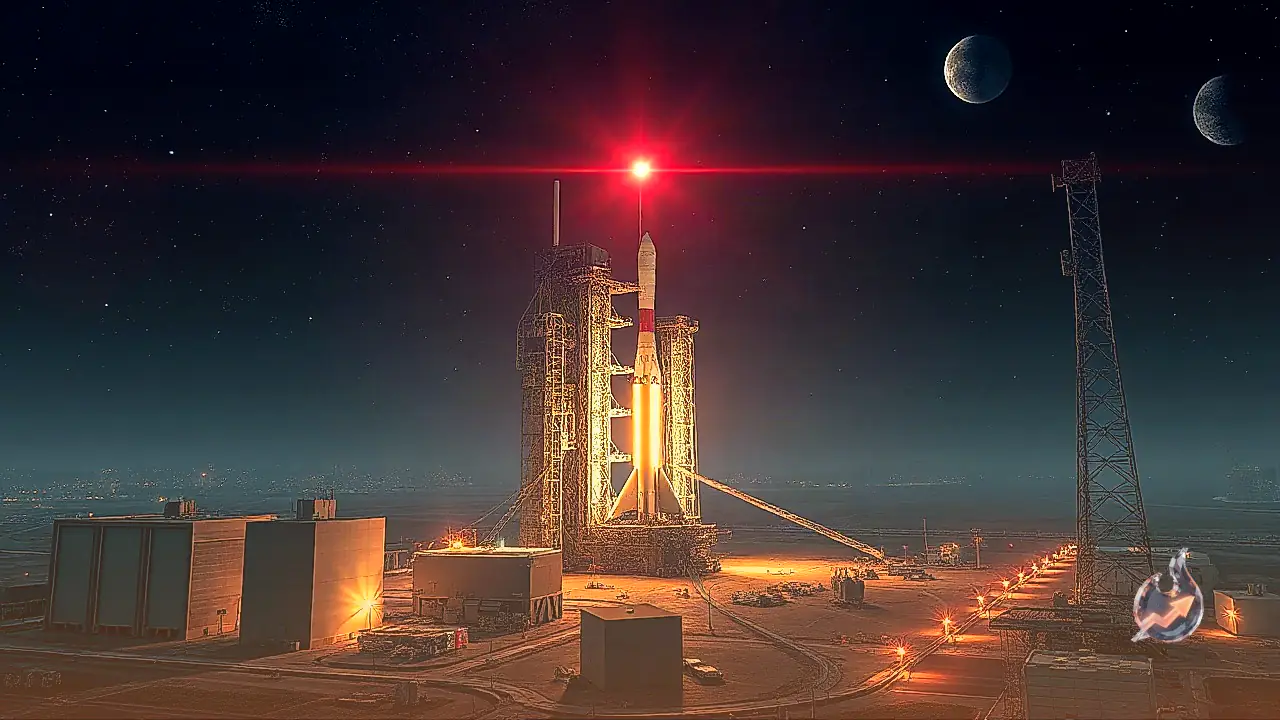

A historic technological demonstration is preparing to take flight as engineers attempt to build the foundational infrastructure for an off-planet power utility. Jacksonville, Florida-based startup Star Catcher is getting ready to launch a prototype satellite on an upcoming SpaceX mission, with the objective of collecting sunlight in orbit, concentrating it, and beaming that energy directly to the solar arrays of another nearby satellite using specialized lasers. The initiative represents an ambitious attempt to prove that orbital assets can be powered remotely without relying solely on their own onboard generation systems.
Should the orbital demonstration succeed, it will establish the world's first verified transmission of laser-beamed energy between two entirely untethered spacecraft moving freely through space. While the experiment itself pushes the technological envelope, the overarching dream of tapping extraterrestrial sunlight is nearly a century old. Science fiction pioneer Isaac Asimov introduced the concept in a 1941 story, and NASA later spent substantial resources examining the physics during the 1970s. For decades, however, exorbitant launch prices made the economics unworkable, as sending heavy machinery into low Earth orbit to generate and direct electricity rarely justified the cost, explains Hanieh Fattahi, a researcher at the Max Planck Institute for the Science of Light. Today, the precipitous drop in launch expenses is finally giving commercial orbital energy ventures real economic viability.
Building a Wireless Utility Network Above Earth
Under the current status quo, every spacecraft launched into orbit must function as a self-sufficient energy island. Star Catcher chief executive officer and cofounder Andrew Rush points out that space currently lacks any semblance of an electrical grid, forcing operators to treat every mission like an isolated camping trip where every watt must be generated and stored on the vessel itself. To replace that inefficient model, Star Catcher has engineered what it designates as power nodes, orbital platforms designed to operate simultaneously as solar power stations and wireless transmission channels.
The engineering process begins by gathering raw solar rays through an intricate array of specialized optical lenses. The gathered light is subsequently converted into targeted wavelengths that company engineers say can yield up to 10 times more electrical output than diffuse, unrefined sunlight. That concentrated photonic energy is then emitted as an intensely focused laser beam, creating what Rush likens to an invisible power cord connecting directly to customer satellites. This sustained delivery promises to raise operational uptime and significantly increase financial profitability for satellite fleets.
Shedding Heavy Batteries to Clear Room for Orbital Computing
In an industry where every single kilogram carried into orbit incurs thousands of dollars in rocket transportation fees, freeing up space and mass yields massive dividends. Eliminating oversized battery packs allows satellite manufacturers to incorporate heavier scientific payloads, specialized surveillance instruments, or powerful GPU arrays for off-planet computational centers. The commercial logic is already finding strong market validation.
Earlier this year, Star Catcher completed a $65 million financing round, augmented by a $30 million development award from the US Space Force. On the commercial front, the firm has secured 40 formal letters of intent alongside 10 signed, binding long-term power purchase agreements with space operators. The growing momentum behind orbital infrastructure is further underscored by the fact that Google is sending its own initial space-based data center experiment on the very same SpaceX flight, showcasing broad corporate enthusiasm for off-planet computing.
Validating the Protostar Hardware in Free Flight
The demonstrator satellite scheduled to ride the Falcon rocket this week is designated Protostar. It serves as a compact, subscale testbed of the larger operational constellations Star Catcher envisions placing into service, which Rush expects to begin delivering viable commercial power distribution services in orbit before the decade concludes. The upcoming flight marks the very first instance where every sub-system, from optical harvesting to precision pointing, operates in unison in the vacuum of space, attempting to beam electricity to a completely separate cubesat lifting off alongside it.
Rush explained that a primary goal of the mission is monitoring the precise amount of energy the cubesat collects as distance grows between it and Protostar, allowing the engineering team to benchmark actual physical measurements against their theoretical modeling. Star Catcher has previously validated its optical tracking hardware on an orbital test, and the venture set a ground transmission record last year by surpassing energy transfer milestones previously established by DARPA.
Overcoming the Physical Realities of Orbital Lasers
During that terrestrial trial, Star Catcher transmitted over 1 kilowatt of electrical power to commercially available, standard solar cells, an output roughly comparable to what is needed to run an everyday microwave oven. Although 1 kilowatt remains far below the massive energy requirements of high-capacity telecommunications spacecraft or compute-heavy space data clusters, Rush emphasizes that the successful ground demonstration proves the fundamental physics are ready for microgravity testing. He describes the company as advancing out of its crawl phase as it systematically learns to walk and eventually run.
Previous military testing has touched on space laser mechanics, though under much more restrictive conditions. In 2023, the Naval Research Laboratory completed a 100-day trial generating electrical power via an orbital laser, but that setup was housed entirely within a single integrated framework where the beam traversed less than 5 feet. That apparatus achieved an energy conversion efficiency of only 11 percent, highlighting a major technical bottleneck that Fattahi notes researchers must resolve. She adds that ensuring long-term financial viability will also require perfecting micro-radian target tracking, managing excess thermal dissipation, and proving that sensitive optical hardware can endure the brutal radiation and deep freeze of orbital vacuum across multi-year operational spans.
Other scientific institutions have concentrated on alternative methods, such as Caltech's successful demonstrations transmitting solar energy down to Earth using microwave beams. While microwaves can haul far greater quantities of raw power, they demand colossal ground-based receiving stations to collect the signal. Lasers, by contrast, concentrate energy into tight diameters that can strike relatively modest collection targets on moving spacecraft. Rush maintains that building this distributed orbital energy network will dramatically reduce the cost of running heavy industrial hardware above the atmosphere, suggesting its transformative impact on the space sector could mirror the commercial revolution sparked by reusable rockets.