






















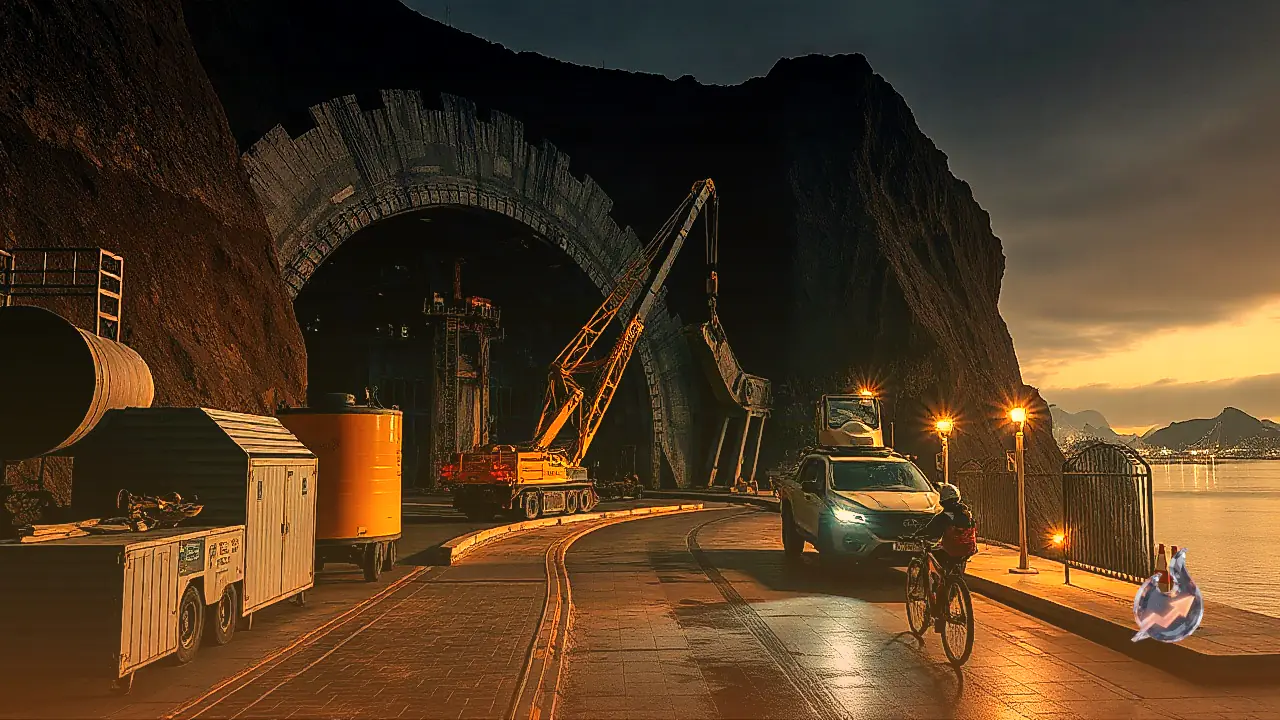

When people think of global infrastructure milestones, China is increasingly pushing the boundaries of what is technically possible in modern engineering. While high-speed rail networks remain an aspirational goal in many nations, the country is currently constructing the world’s longest undersea high-speed railway tunnel deep beneath corrosive saltwater, setting new benchmarks for large-scale tunneling projects.
The Ningbo-Zhoushan Railway Project
According to reports from Global Times, construction on the Jintang undersea tunnel along the Ningbo-Zhoushan high-speed railway in eastern China's Zhejiang province is advancing steadily. Engineers working on the project have achieved a major technical breakthrough by completing the rigorous inspection and replacement of 104 shield cutting tools within a span of 21 days amidst immense water pressure. Industry observers note that this operation constituted the single most difficult phase of the entire high-speed rail tunnel undertaking.
Overcoming Substantial Pressure
This achievement marks a vital milestone for the world's longest undersea high-speed rail tunnel, proving that domestically developed heavy-duty technologies can successfully withstand prolonged, high-pressure real-world environments. The Jintang tunnel spans a total length of 16.18 kilometers, out of which an 11.21-kilometer shield-driven section forms the most critical component. The infrastructure project is designed to link Ningbo city directly with the Zhoushan islands.
Transforming Travel Times
Currently, traveling between Ningbo and Zhoushan via highway or ferry takes roughly one and a half to two hours. Once the railway is operational, the transit time between the two destinations will plummet to a mere 26 minutes. What makes the journey particularly unique is that the entire route will run directly through a tunnel built straight across the middle of the sea.
At present, two super-large diameter shield boring machines are tunneling toward each other from the opposite shores of Ningbo and Zhoushan. The continental-side Yongzhou machine must cover a distance of 4,940 meters, navigating through 24 distinct layers of soft and hard rock. Roughly 70 percent of its entire path cuts through these challenging geological layers.
Geological Challenges and Extreme Depths
The rock formations in the project zone possess exceptional hardness, reaching up to 191 megapascals. At the deepest point, situated 92 meters below the seabed, the combined pressure of water and soil reaches an intensity 8.5 times normal levels. Furthermore, across a stretch of nearly 2,000 meters, the pressure exceeds 6 times normal levels. Replacing cutting tools under such extreme subterranean pressure is widely considered the ultimate test of shield tunneling.
Deep-Sea Space Station and Saturation System
Under traditional atmospheric diving methods, an individual could work for only 40 minutes at a depth restricted to approximately 60 meters. To conquer this hurdle, the construction team spent three years developing deep-sea saturation diving technology, creating China's first domestically built saturation hyperbaric system for shield tunneling, officially termed the deep-sea space station.
This integrated system features living, transfer, and control modules, all designed and manufactured domestically. It can comfortably house nine crew members for extended periods. Workers travel via transfer chambers directly to the workface and can operate for up to eight hours at a time, enabling continuous 24-hour shift operations over a 28-day span. Upon completion of tasks, decompression is conducted in a single controlled procedure, drastically minimizing the health risks associated with frequent pressure fluctuations.
Presently, the Yongzhou machine has advanced 3,936 meters, successfully completing approximately 80 percent of its designated tunneling task. This achievement stands not only as a remarkable technical triumph but also as a powerful demonstration of advanced engineering capabilities on the international stage.