






















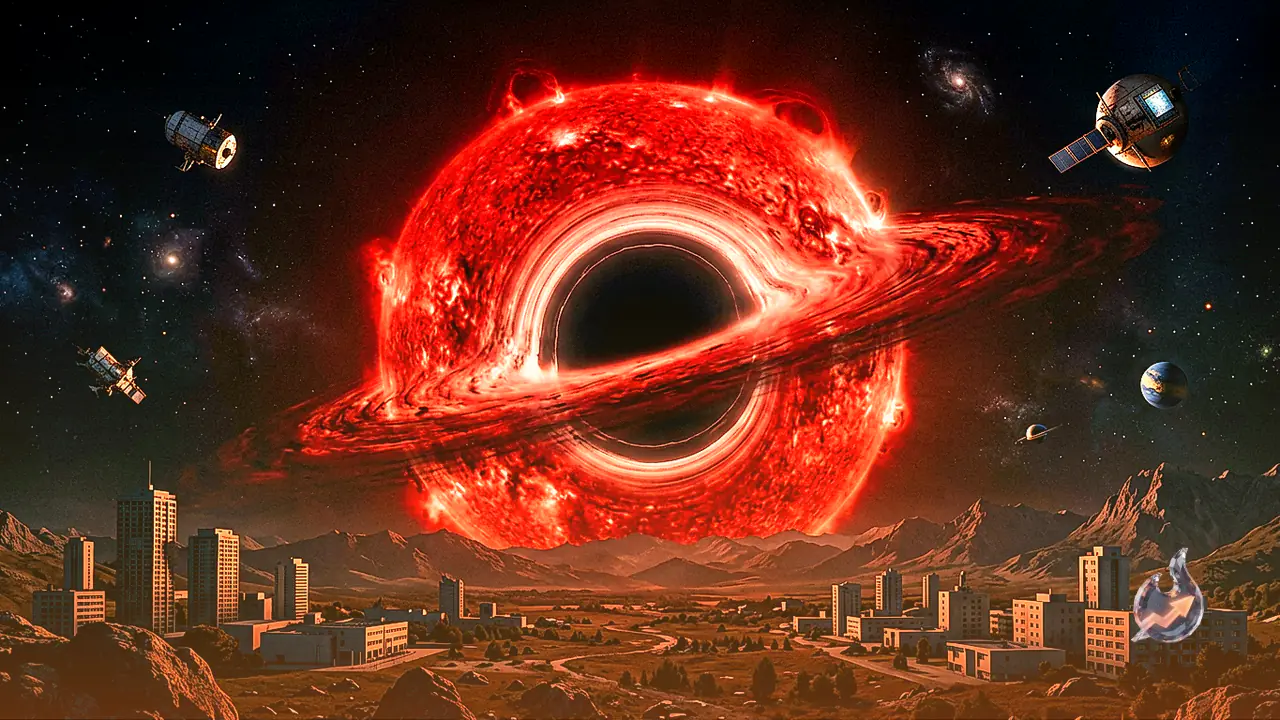

Observational data captured by the James Webb Space Telescope has uncovered a remarkable astronomical phenomenon, identifying a massive celestial object roughly the physical dimensions of our entire solar system that glows bright red across deep space. Detailed in a study published in Nature, researchers have presented compelling evidence for the existence of what is termed a black hole star. Located billions of light-years away, this extraordinary cosmic structure initially appears to be a gigantic star, yet its physical characteristics suggest it is actually a central black hole wrapped within an immensely dense, luminous gas envelope.
Deciphering Light Signals from the Universe's Dawn
The light signal originating from this newly analyzed object, designated as MoM-BH*-1, dates back to an epoch when the universe was merely 660 million years old, a tiny fraction of its current age of nearly 14 billion years. In deep-space images, the object manifests as a vivid reddish dot amidst the ancient cosmic landscape. Despite the vast distance spanning billions of light-years, the energy output of MoM-BH*-1 is staggering. Scientists calculate that it emits approximately 100 billion times more energy than any conventional star could produce through standard nuclear fusion processes, making it exceptionally bright even for the early formation period of the cosmos.
In addition to its raw brightness, the object displays an unusual spectral signature where specific wavelengths of light suddenly vanish. While normal stellar atmospheres can absorb distinct light frequencies, the absorption effect observed in MoM-BH*-1 is far too extreme to stem from typical star behavior. Researchers deduce that an enormous volume of surrounding gas, possessing extreme density, is actively trapping and absorbing those specific light wavelengths before they can escape into space.
The Physical Structure of a Black Hole Star
These distinct observational clues form the core of the black hole star hypothesis. At the center of MoM-BH*-1 sits a monster black hole that continuously devours surrounding matter, producing vast quantities of high-energy radiation. Encasing this central gravitational engine is a colossal gas envelope of immense density. As the raw energy generated by the feeding black hole forces its way outward through this thick gaseous shell, the radiation is modified, emerging into the vacuum of space with optical signatures that closely resemble starlight.
This theoretical framework offers a potential resolution to a lingering cosmological enigma highlighted by recent observations. The space telescope has regularly picked up mysterious small red dots scattered across the early universe, objects that fail to fit neatly into existing classification schemes for deep-space phenomena. Previously proposed explanations for these objects have ranged from ultra-compact galaxies packed with billions of stars to dust-shrouded black holes or entirely novel cosmic structures unknown in the modern universe.
Unraveling Cosmic Anomalies and Host Galaxy Dynamics
The black hole star model provides a fresh mechanism to explain these early cosmic anomalies. Among the numerous red dots cataloged by astronomers, MoM-BH*-1 stands out as a unique candidate because its core engine appears to completely overshadow its environment. Rohan Naidu, the lead author of the study who conducted the research while based at MIT, noted that MoM-BH*-1 is remarkable because the object effectively outshines its host galaxy, allowing observers to detect virtually pure black hole star illumination.
This breakthrough provides astronomers with a fresh perspective on how supermassive black holes and early galaxies grew during the universe's formative era. By demonstrating that massive gas envelopes can disguise feeding black holes as giant stars, the discovery opens new avenues for understanding cosmic evolution in the primordial universe.