






















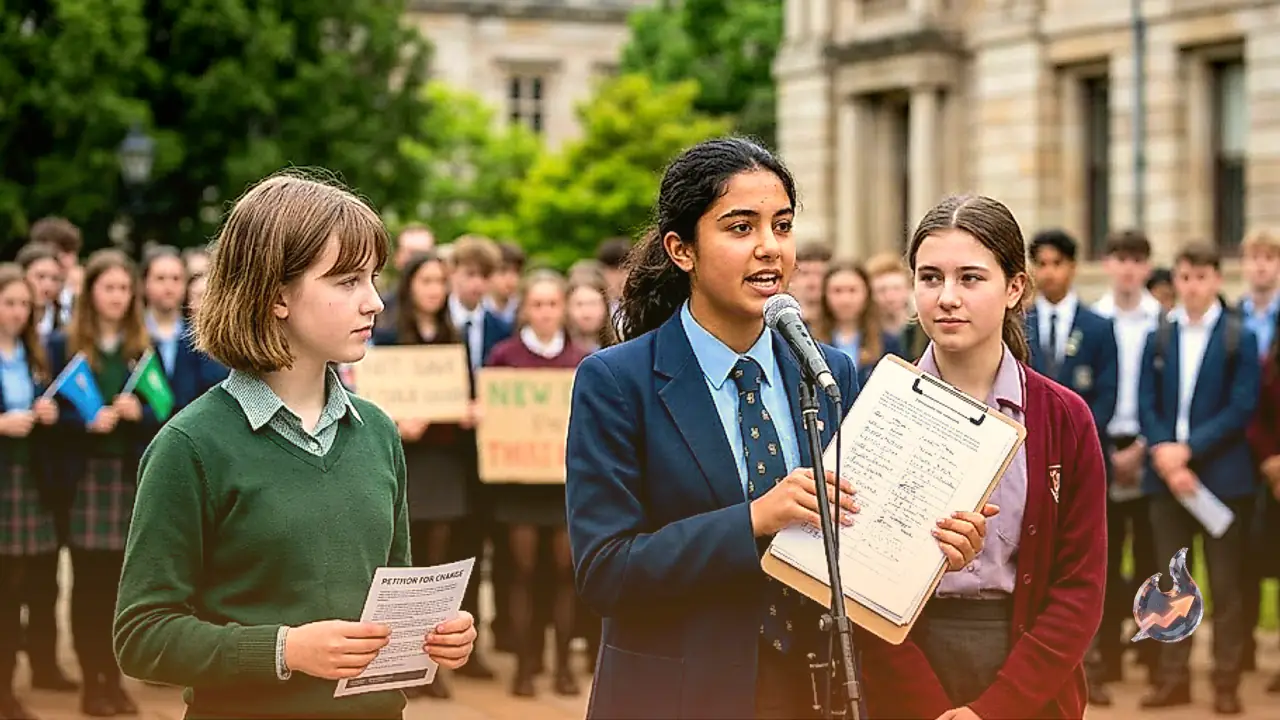

Young female students at The Cooper School in Bicester, Oxfordshire, have launched a bold campaign targeting the adult entertainment industry. Members of the school's Little Feminist Book Club, aged 14 and 15, named Mae, Aylin, Rose, and Willow, are leading an online petition to prohibit the depiction of school uniforms in pornography. The teenagers argue that the hyper-sexualisation of their everyday academic attire directly impacts their personal safety and leads to street harassment in their daily lives.
Student Experiences and Core Demands of the Petition
Shortly after its launch, the online petition gathered over 647 signatures, calling directly on the UK Prime Minister to institute a comprehensive ban. The text of the petition emphasizes that depicting standard educational uniforms in adult material serves explicitly to simulate minors. The campaigners argue that a uniform designed to foster equality and a safe learning environment is instead being transformed into a tool of sexualisation, creating anxiety for students commuting to and from school.
Sharing her personal experience, 15-year-old Rose expressed her intense discomfort while wearing her uniform on her journey home. Rose clarified that the issue is not physical discomfort, but rather the threatening ways in which the outfit is perceived by passersby. She noted that the fear of public sexual harassment has driven her to abandon wearing school skirts altogether, opting exclusively for trousers to avoid unwanted attention.
Online Proliferation and Media Exposure
The depiction of schoolgirl attire is deeply entrenched across various adult websites and social media platforms. Searching the term 'schoolgirl' on X yields top video results consisting of adult content, where adult creators disrobe from school uniforms or wear stylized schoolgirl lingerie. These top search results alone account for well over 50,000 views on the platform.
The issue extends across major discussion platforms as well. On Reddit, at least seven major adult communities are dedicated specifically to schoolgirl-themed content, drawing a collective total of over 306,000 weekly visitors. Furthermore, conventional media has faced criticism over similar themes, such as a Channel 4 documentary featuring adult performer Bonnie Blue alongside adult models dressed in school uniforms within a classroom setting.
Real-World Harassment and Key Survey Statistics
The objectification of school uniforms in digital media translates directly into unsafe conditions for young girls in public spaces. Data published by Plan International reveals that approximately 58 percent of young women and girls aged 14 to 21 in the UK have experienced sexual harassment within or around their educational environments.
Breaking down the specific types of harassment reported in the survey, 26 percent of respondents reported being catcalled or whistled at in public spaces, while 22 percent faced unwanted sexual comments. Furthermore, 12 percent of young girls reported being actively followed on their way home or to school, and 10 percent experienced physical groping or unwanted contact.
Psychological Insights and Legal Boundaries of Consent
Amanda Macdonald, a registered BACP psychotherapist, highlighted the psychological necessity of enforcing a complete ban on school uniforms in adult content. In the United Kingdom, school uniform attire is intrinsically tied to minors who are below the legal age of consent, which is set at 16. While a small fraction of sixth-form colleges permit uniforms for students aged 16 to 18, sexualising that demographic remains equally problematic.
Macdonald emphasized that because school uniforms denote individuals below the age of consent, adults should not be consuming or creating content that sexually pairs adults with minor iconography. She added that adult content creators bear a social responsibility to analyze the real-world consequences and harmful behaviors that their produced material reinforces across society.
Legislative Loopholes and Impending Legal Changes
The UK government is currently enacting legislative updates to penalize adult content that depicts adults pretending to be children under the age of 16 with imprisonment. However, the legal standing of school uniforms remains a grey area. Clare McGlynn, a professor of law at Durham University and a leading expert on pornography law reform, explained that because some UK sixth forms mandate formal dress codes or uniforms, content creators can legally defend their material by claiming it depicts individuals over 16 years of age.
Psychotherapy experts argue that despite potential legal loopholes, an outright prohibition is vital for setting societal boundaries. Allowing uniform pornography to remain legal normalizes the sexualisation of minors, desensitizing viewers and encouraging progression toward more extreme, dangerous material. Experts also stress the need for therapeutic support systems for individuals experiencing inappropriate attractions toward minors, helping them seek medical intervention before committing offenses.
Government Response and Societal Accountability
Alex Davies-Jones, Minister for victims, tackling violence against women and girls and international justice, commended the teenage campaigners for taking action. The Minister affirmed that young women and girls should never have to navigate their daily school routines while seeing their educational attire objectified. The government reiterated its commitment to tightening laws surrounding pornography that simulates underage individuals as part of broader efforts to combat violence against women.
While praising the students' initiative, mental health professionals noted that the burden of advocacy should not rest on 14 and 15-year-old children. While exercising democratic rights through petitions is empowering, society and adult lawmakers must take proactive responsibility to safeguard minors rather than relying on teenagers to demand basic protections.