























In Sanatan Dharma, starting any auspicious event, sacrificial ritual, housewarming, wedding ceremony, or urn installation (Kalash Sthapana) with the offering or breaking of a coconut is an ancient custom practiced for centuries. Far from being a mere fruit, the coconut is deeply revered as a potent symbol of auspiciousness, prosperity, and total surrender to the divine. This explains why it holds such an indispensable place in nearly every Hindu ritual and religious ceremony. Understanding the deep-seated spiritual reasons behind this tradition reveals a fascinating connection with the Holy Trinity (Tridev) and the profound messages it carries for our daily lives.
The Symbol of Inner Purity and Breaking of the Ego
According to ancient scriptures and spiritual beliefs, the coconut is respectfully referred to as "Shrifal," which translates to the fruit that bestows auspicious results and blessings of Goddess Lakshmi. When a devotee offers a coconut to the deity during worship, it represents a profound psychological and spiritual gesture. It symbolizes the absolute surrender of one's ego and negative tendencies. The tough, fibrous, and hard outer shell of the coconut represents the human ego, stubbornness, anger, and worldly attachments. Conversely, once this hard shell is shattered, it reveals the pure, soft, white inner kernel, which signifies mental clarity, truth, and a pristine heart. Therefore, the ritual of breaking a coconut serves as a reminder that to receive divine blessings, one must first break down the hard shell of ego and present a clean, humble mind to the Almighty.
The Three Eyes of Shrifal and Their Sacred Connection to Tridev
In Hindu theological traditions, the coconut is considered a physical manifestation of the Holy Trinity, consisting of Lord Brahma, Lord Vishnu, and Lord Mahesh (Shiva). If you observe a coconut closely, you will find three distinct spot-like indentations or eyes on its top portion. These three eyes are symbolically linked to the three supreme cosmic forces.
- The first eye represents Lord Brahma, the creator of the universe, symbolizing the very origin and creation of life.
- The second eye represents Lord Vishnu, the preserver and protector of the universe, signifying sustenance, righteousness, and order.
- The third eye is associated with Lord Shiva, the destroyer of ignorance and the benefactor of cosmic welfare, representing wisdom and spiritual awakening.
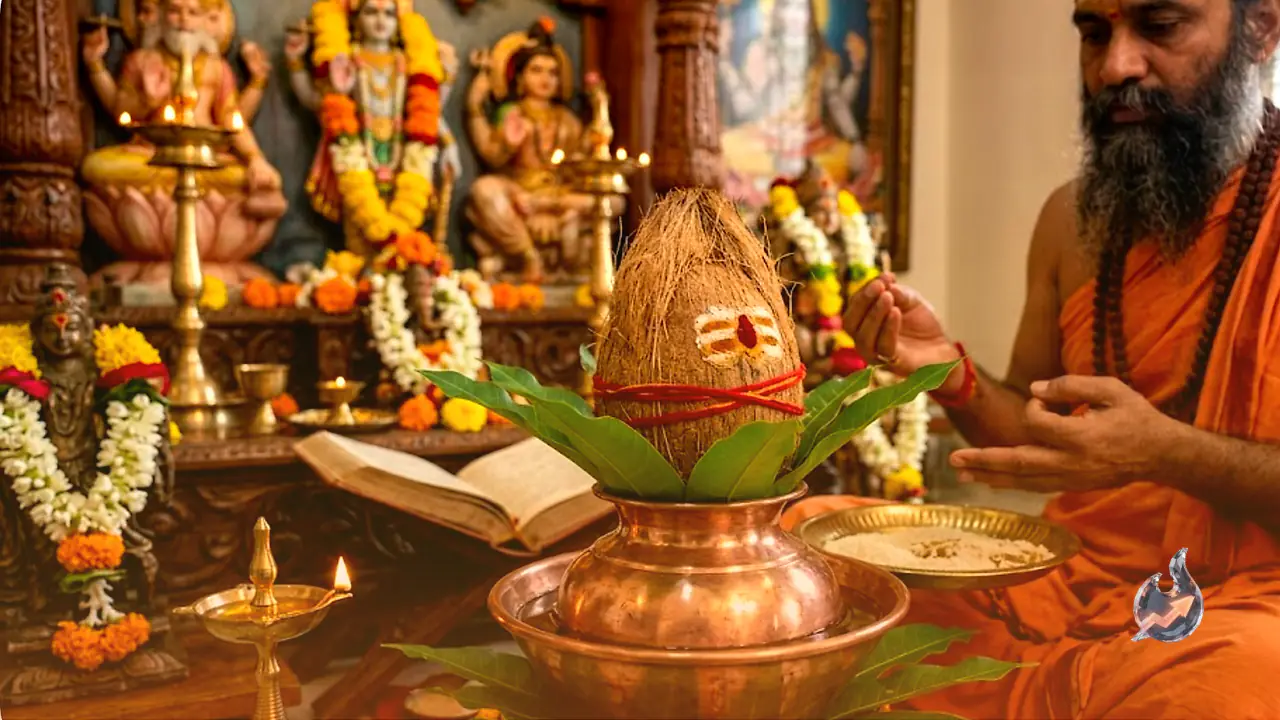
Because of this divine trinity connection, placing a coconut on top of a water-filled metal pot (Kalash) during religious ceremonies is believed to create a vortex of collective positive energies. It symbolizes the unified power of creation, preservation, and welfare, purifying the entire environment.
The Vital Role of Coconut in Kalash Sthapana
During grand festivals like Navratri, housewarming ceremonies, or grand fire rituals (Yagya), the Kalash is established as a sacred seat for all the deities. A coconut placed on top of this pot, nestled among mango leaves, absorbs and radiates positive vibrations. This entire setup is a beautiful representation of the five basic elements (Panchatattva) and the delicate balance of nature. Consequently, any Kalash Sthapana is deemed incomplete and ineffective without the presence of a coconut. It is believed to invite peace, luck, and growth into the household while dispelling negative vibrations.
Spiritual Devotion Backed by Scientific Properties
The act of offering a coconut is not just a blind ritual, but a lesson in humility, kindness, and virtue. Interestingly, this religious significance is also backed by strong scientific reasoning. Scientists point out that the coconut is one of the most resilient fruits, capable of remaining fresh and unspoiled for an exceptionally long period. Its dense outer husk and rock-hard shell prevent any external pollutants, bacteria, or dirt from contaminating the inner content. The sweet water sealed inside is naturally sterile, pure, and rich in essential nutrients, symbolizing vital life energy. This remarkable combination of spiritual depth and natural resilience is why the coconut has earned such a supreme status in Indian culture.