






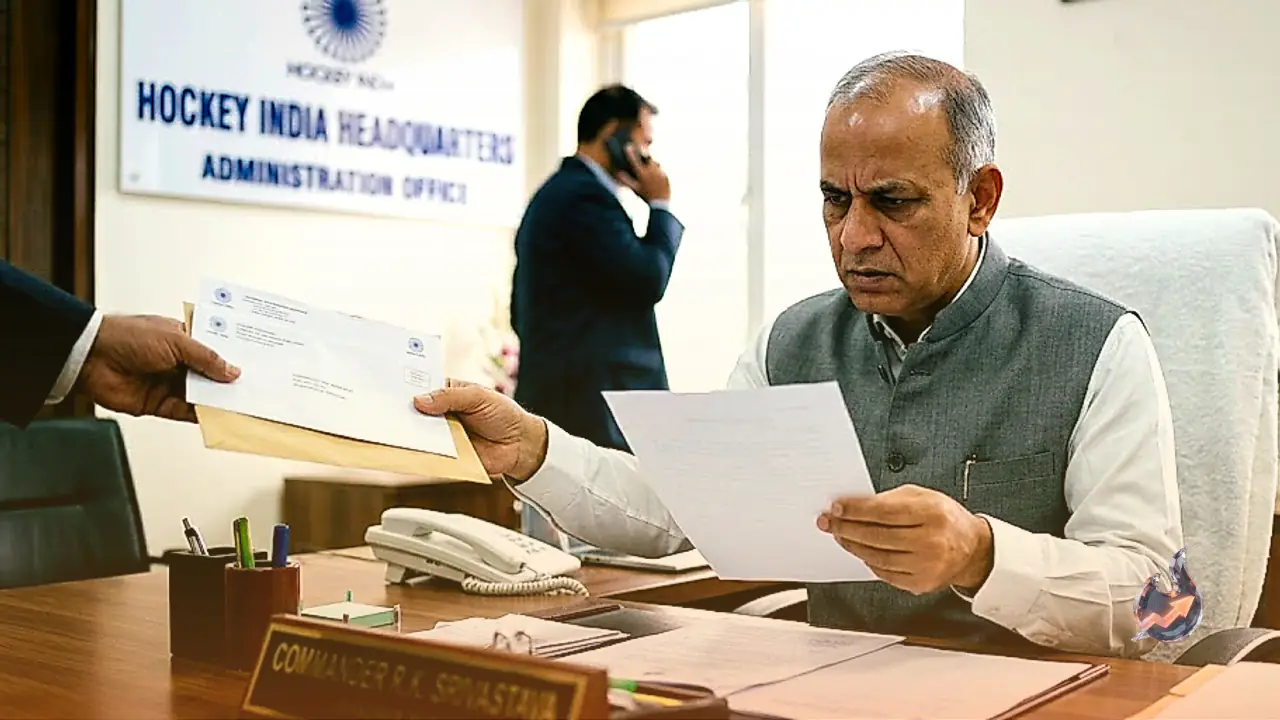















A major administrative storm has hit the apex body of Indian hockey. Hockey India President Dilip Tirkey has issued a detailed show-cause notice to the organization's Director General, Commander R K Srivastava, suspending all his executive powers with immediate effect. This drastic decision highlights a deep internal division within the sports federation. Srivastava faces eight distinct allegations of administrative misconduct, ranging from the highly controversial alteration of the national team's traditional jersey color to direct insubordination concerning overseas travel during a critical planning period.
Immediate Suspension and Four-Week Ultimatum
The directive issued by the President's office has brought a sudden halt to R K Srivastava's administrative career at Hockey India. The show-cause notice states, "All your powers as the Director General of Hockey India are terminated with immediate effect." Consequently, he is barred from exercising any administrative rights or performing any duties on behalf of Hockey India under its bylaws until further notice. Delivered through the legal counsel of President Dilip Tirkey, the notice grants Srivastava a strict four-week window to submit a written explanation. If he fails to respond within this stipulated timeframe, the national federation will proceed with disciplinary actions based solely on the official records currently available.
The Massive Controversy Over National Jersey Alteration
At the center of the controversy is the unilateral decision to change the playing kit of the Indian national teams. The Indian squad has historically competed in its iconic blue uniform. However, this traditional attire was replaced with an orange-dominated design and introduced to the public. According to the official notice, this significant change was implemented without prior consultation or formal approval from either the Hockey India President or the Executive Committee. Despite repeated directives asking for the administrative basis, delegation files, and details of consultations held with players and coaches regarding this transition, Srivastava failed to produce any committee resolutions or written approvals. The shift to orange, which was supposedly done to enhance visibility on field, had sparked widespread criticism within the hockey community.
Insubordination and Unauthorized Travel to Europe
Another major charge against the Director General involves his decision to travel to the Netherlands and Belgium for the World Cup, defying direct executive orders. The President's office had explicitly instructed Srivastava to remain in India to oversee domestic preparations. Specifically, his presence was required to manage the upcoming Hockey India League (HIL) season, including franchise coordination, event planning, and resolving other urgent domestic matters. An official email dispatched on July 30 had clearly outlined these domestic priorities. By ignoring these directives and traveling abroad, Srivastava's actions were characterized as a direct insult to the President's office and a clear case of professional disobedience. The notice stated that he chose to place himself above the individuals specifically designated for the official World Cup delegation.
Six Other Areas of Governance and Administrative Failures
Beyond the jersey dispute and unauthorized travel, the notice lists six other critical governance failures. These include imposing restrictions on the PR agency and media communication during the jersey controversy, which allegedly harmed the organization's public image. Additionally, his handling of alleged player misconduct during the national team's tour of South Africa has been called into question. The notice also references a lack of clarity and proper handling regarding issues related to head coach Craig Fulton. Furthermore, the federation has pointed out failures in maintaining the ICC and POSH (Prevention of Sexual Harassment) records of Vikram Pal. The list of charges is rounded off by the development umpire issue involving Sumit Mohite, and unauthorized external communications sent to the International Hockey Federation (FIH), the Asian Hockey Federation (AHF), and other national federations. Hockey India has clarified that this is an interim administrative measure to restore transparency, accountability, and discipline, and is not a final disciplinary punishment.


