





















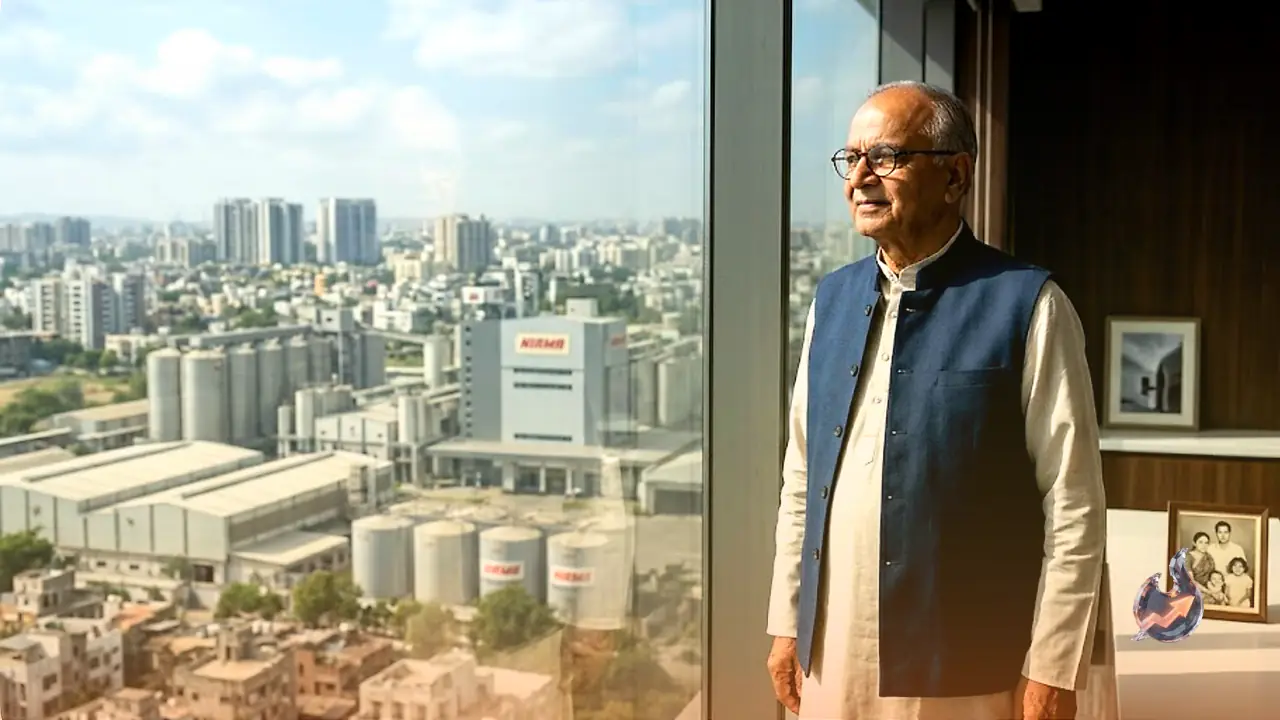

For decades, the nostalgic television jingle featuring four girls twirling to the praise of Nirma remained etched in the minds of millions of Indians. Mention laundry detergent, and most people picture massive state-of-the-art factories. Yet, the story of Nirma, one of India's most iconic consumer brands, did not start in an industrial complex, but rather in a modest backyard experiment.
Nirma is much more than a commercial success story. It represents a father's enduring devotion to his daughter. The man behind this incredible empire is Karsanbhai Patel.
From a Farming Family to a Laboratory Technician
Born in 1945 to a humble farming family in Mehsana, Gujarat, Karsanbhai Patel completed his early schooling locally before pursuing a BSc degree in Chemistry. Although he harbored dreams of running his own business, his family's tight financial situation meant he could not afford to take immediate risks. To support his family, he took a job as a lab technician at the New Cotton Mills in Ahmedabad. Sometime later, he secured a stable government job within the state's Department of Mining and Geology.
The Tragedy That Redefined His Purpose
Life was moving at a comfortable pace with the security of a government job, but a sudden tragedy shattered Karsanbhai's world. His beloved young daughter, who was still in school, lost her life in a tragic accident. Karsanbhai had always dreamed that his daughter would gain national recognition through her education and achievements. Her untimely demise left him devastated.
His daughter's official name was Nirupama, but her family affectionately called her Nirma. Resolving to keep her memory alive forever, Karsanbhai decided to build a brand in her name, paving the way for a business that would soon rewrite corporate history.
1969: The Backyard Experiment Begins
In 1969, Karsanbhai began experimenting in his Ahmedabad backyard, mixing soda ash with other chemicals to formulate a washing powder. After numerous attempts, he successfully developed a yellow, phosphate-free synthetic detergent powder.
During this era, Indian consumers had very few options for washing clothes. The market was heavily dominated by Surf, a premium detergent brand owned by Hindustan Lever Limited, now known as Hindustan Unilever. Surf's premium pricing made it unaffordable for middle-class and low-income families, forcing them to rely on harsh laundry soaps that damaged their hands.
Karsanbhai recognized this massive market gap and turned it into an extraordinary business opportunity.
A Bicycle, Door-to-Door Sales, and a Money-Back Guarantee
After wrapping up his government job each day, Karsanbhai would load packets of his detergent onto his bicycle and set out to sell them door-to-door. He offered customers a complete money-back guarantee if they were not satisfied with the product's quality.
On the pricing front, Nirma completely disrupted the established market dynamics:
- Surf pricing: ₹10 to ₹15 per kilogram
- Nirma pricing: Just ₹3 per kilogram
Karsanbhai's government office was situated 15 kilometers away from his home, and during his daily commute, he easily sold 15 to 20 packets of detergent. Thanks to its low cost and reliable quality, Nirma rapidly became a household staple for middle-class families.
Leaving the Government Job for Global Expansion
Three years into his venture, once he was certain that Nirma had earned the trust of consumers, Karsanbhai resigned from his government post. He set up a small workshop and shop in an Ahmedabad suburb. His persistence paid off, and within its first ten years, Nirma became the highest-selling detergent brand in India.
The Masterstroke Marketing Strategy
Television commercials and the memorable "Sabki Pasand Nirma" jingle played a pivotal role in establishing Nirma nationwide. However, Karsanbhai's most famous marketing strategy remains a classic case study in business management.
When the demand for Nirma was at an all-time high, he made a bold move by recalling nearly 90% of the product stock from the market while keeping the television commercials running constantly.
For an entire month, consumers watched Nirma ads on television but could not find the product on retail shelves. This artificial scarcity created immense consumer demand, forcing retail shopkeepers to plead with Karsanbhai for supply. When Nirma finally returned to the shelves a month later, it wiped out all competitors, securing its position as the number-one washing powder in the country that year.
Diversification from FMCG to Education
By the early 1980s, Karsanbhai had successfully outpaced major multinational brands. By 1985, Nirma was one of India's most popular household detergent brands. The company subsequently scaled new heights:
- 1994: Nirma was listed on the stock market.
- 1995: The Nirma Institute of Technology was established in Ahmedabad.
- 1999: Nirma solidified its place as a massive consumer brand.
- 2003: The Institute of Management and Nirma University were founded.
Stepping onto the Global Stage
Nirma's ambitions went far beyond laundry detergents, expanding into several heavy industries:
- 2007: Acquired Searles Valley Minerals Inc, a raw material company based in the United States, placing Nirma among the top 7 soda ash manufacturers globally.
- 2011: The Patel family delisted Nirma from the stock exchanges, turning it into a private company.
- 2014: Entered the cement manufacturing sector with a dedicated plant in Nimbol.
- 2016: Acquired Lafarge India's cement assets in a major $1.4 billion transaction.
- February 2020: Completed the acquisition of Emami Cement for ₹5,500 crore.
The Modern Nirma Group Portfolio
Headquartered in Ahmedabad, the Nirma Group today produces a wide array of consumer and industrial goods.
Consumer Products: Nirma bath soap, Nima soap, Nirma detergent and bar, pure salt, Nirma Clean dishwash bar, and Nirma kitchen bar.
Industrial Products: Cement, cosmetics, salt, soda ash, LAB, and injectables.
Notably, the group is now the largest producer of soda ash globally. While its shampoo and toothpaste lines did not meet with similar success, Nirma's products continue to enjoy strong sales in neighboring countries.
Honors and National Recognition
Karsanbhai Patel's contribution to Indian industry has earned him several highly respected awards:
- 1990: "Udyog Ratna" award from the Federation of Association of Small Scale Industries of India.
- 2010: Honored with the Padma Shri by the Government of India.
- 2017: Ranked 38th on the Forbes list of India's richest people.
- 2019: Ranked 30th on the same list.
Karsanbhai Patel's net worth was valued at approximately $2.9 billion in the 2021 Forbes list, ranking him 46th among India's wealthiest individuals. Net worth figures and rankings naturally fluctuate over time.
Karsanbhai is also the third industrialist from Ahmedabad to purchase a private helicopter, following in the footsteps of Gautam Adani and Pankaj Patel of the Zydus Group.