





















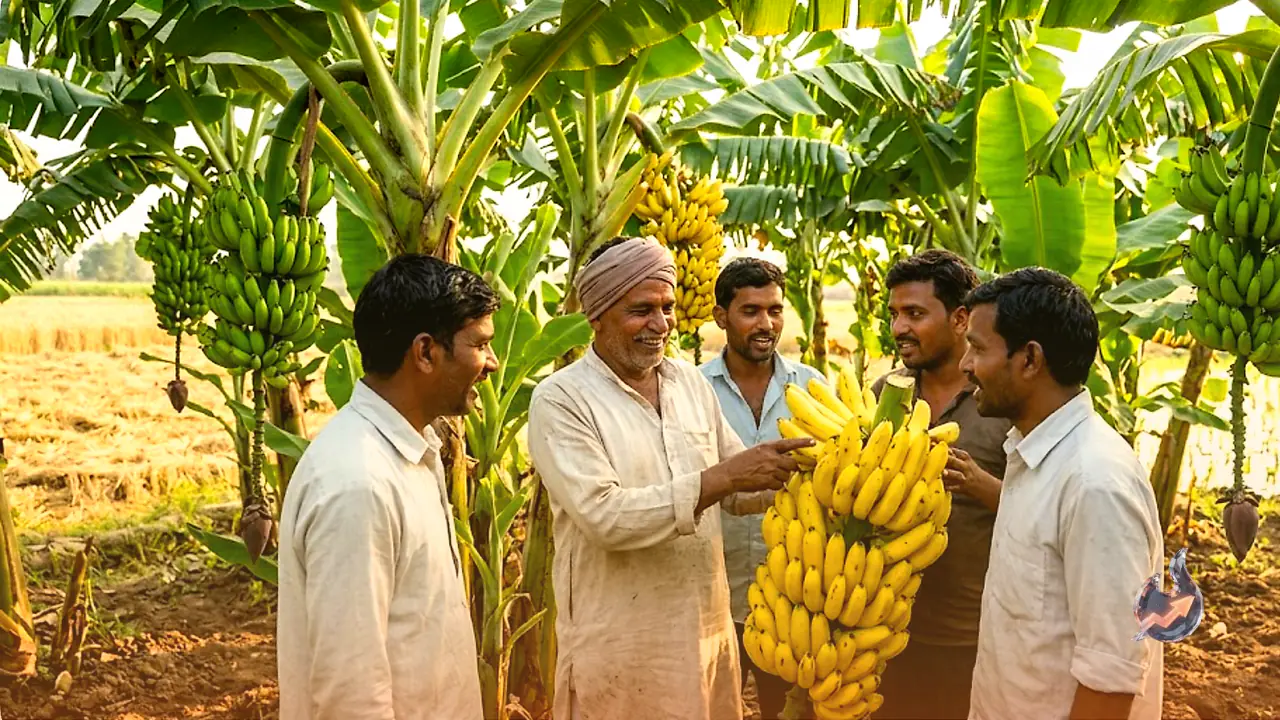

A significant agricultural transformation is currently sweeping through the Sultanpur district of Uttar Pradesh. Progressive local farmers are deliberately moving away from traditional grain cultivation, such as paddy and wheat, to embrace commercial banana farming. The primary driver behind this transition is the promise of higher profit margins combined with lower input costs. These farmers have successfully demonstrated that with structured planning and modern horticultural practices, farming can become a highly lucrative business venture. The individual success stories of five different farmers across various villages in Sultanpur showcase how a shift in crop choice can radically uplift a household's financial standing.
Vimlesh Singh: Transforming Ten Acres into a High-Yield Banana Plantation
Vimlesh Singh, a resident of Terye village under the Lambhua tehsil in Sultanpur, is one of the pioneering figures in this horticultural shift. Recognizing that conventional paddy and wheat farming required immense labor with relatively low returns, he decided to switch to banana cultivation. Singh shares that the transition immediately reduced his operating expenses while substantially boosting his net returns. Consequently, he has dedicated the vast majority of his arable land to bananas. Across approximately 10 acres of land, Vimlesh planted 12,000 banana saplings. The total cultivation and maintenance cost until harvest amounted to 2 lakh rupees, while the final sale of his banana harvest generated 5 lakh rupees in revenue. This successful venture has brought immense financial stability to his household.
Chandraprakash Mishra: Generating Six-Fold Returns from a Half-Hectare Plot
Chandraprakash Mishra, based in the Rampur gram sabha of Sultanpur, has also joined this profitable agricultural trend by leaving behind traditional grain crops. Mishra highlights that banana cultivation requires a fraction of the investment needed for traditional crops, while the revenue generated is far superior. Motivated by these high returns, he has converted most of his active fields into banana orchards. On a modest plot of about half a hectare, he planted 1800 banana saplings. The total expenditure to raise the crop to maturity was 1 lakh rupees, which eventually yielded a substantial market sale of 6 lakh rupees. Such impressive returns from a small landholding have solidified his belief in commercial horticulture.
Daljeet Verma: Mastering Intercropping and Running a Support Nursery
In Haripur Banwa, Sultanpur, farmer Daljeet Verma has integrated advanced multi-cropping techniques into his farming model. Verma maintains a plantation of over 670 banana trees, which brings in consistent earnings. However, he has optimized his land utilization by utilizing the empty ground space beneath the wide banana canopy to establish a vegetable nursery. By employing this technical farming method, he is harvesting double benefits from the same plot of land simultaneously. Alongside his primary banana crop, Verma grows vegetables like cauliflower, chili, bottle gourd, and sponge gourd. Additionally, he runs a vegetable sapling nursery, supplying young plants directly to local markets to secure an extra stream of daily income.
Anupam Yadav: A Young Entrepreneur Guided by Scientific Horticulture
Representing the younger generation of agricultural entrepreneurs, Anupam Yadav from Sultanpur chose commercial farming over conventional career paths. He currently manages more than 5,000 banana plants spread across a plantation of over 2.5 acres. Yadav sourced these high-quality saplings directly from the government's Horticulture Department. He explains that his initial investment in this plantation was a modest 40,000 rupees, but the returns have multiplied his input costs several times over. Throughout his journey, he received valuable technical guidance from Assistant Horticulture Inspector Dinesh Singh. Yadav points out that a banana crop takes approximately 12 months to mature fully. He also shares a vital spacing tip, stating that a distance of about 6 feet must be maintained between individual plants for optimal growth and yield.
Krishna Kumar Singh: Utilizing Government Subsidies for Maximized Output
Krishna Kumar Singh, residing in a village within the Baldirai tehsil of Sultanpur district, is another cultivator who decided to replace traditional wheat and paddy cycles with banana farming. Singh emphasizes that the switch has yielded excellent profits at a very low operational cost, prompting him to allocate the majority of his land to banana plantations. He cultivated 1,100 banana plants on a 1-acre plot, incurring a total expenditure of 1 lakh rupees, and successfully sold the harvested crop for 3 lakh rupees. Singh attributes much of his success to the continuous motivation provided by the District Horticulture Department. Furthermore, the government provides financial subsidies to offset the cost of planting materials. Singh expressed his gratitude to District Horticulture Officer Ranvijay Singh and Assistant Horticulture Inspector Dinesh Singh for their active support and administrative guidance.