





















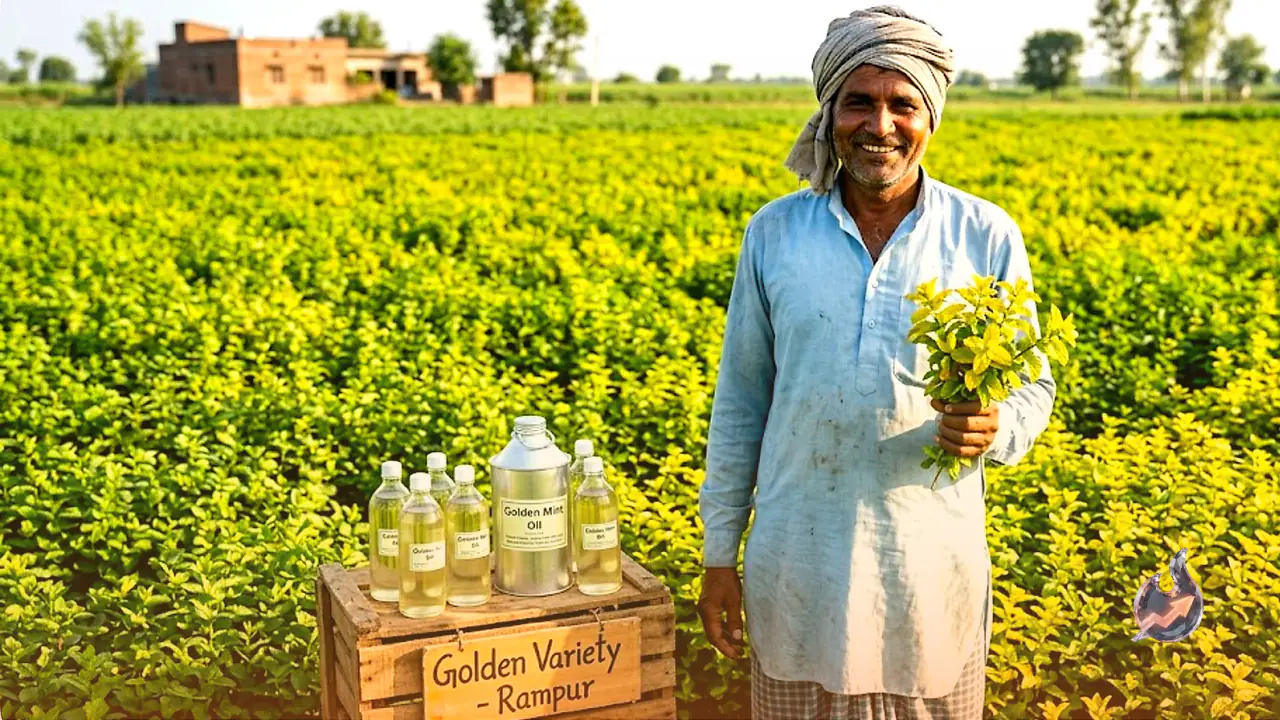

In Uttar Pradesh's Rampur district, the cultivation of mentha, or peppermint, is steadily transforming farmers' lives. One name that stands out is Raghuveer, a local grower who has been farming mentha on a large scale for the past 20 years. For him this crop is nothing new, since his grandfather and father farmed it before him, and growing up in that environment gave him a firm grasp of its finer points from childhood. This year he has planted a special Golden variety of mentha across his 6-acre field, a strain that is rapidly winning favour among farmers.
Why the Golden variety has become the top pick
According to Raghuveer, the real strength of this Golden strain is its remarkable oil output. While other mentha varieties yield only about 5 kg of oil per bigha, the Golden variety easily produces 8 to 9 kg. Nearly doubling the oil directly means double the profit in a farmer's pocket, which is exactly why most growers in the area are now keen to switch to this strain.
Sown in January and February, with no seed hassle
Explaining his method, Raghuveer says mentha sowing begins in the last days of January or the first week of February. The most reassuring part is that it needs no costly seeds from the market. The crop is raised from the leftover roots of the previous harvest, which are planted in the field, and within a few days fresh, healthy plants begin to sprout. Once the roots take hold, the plants grow quickly and the entire seed cost is saved.
Ready to harvest in three to four months
The crop becomes fully ready for cutting in roughly 90 to 120 days, that is three to four months. Depending on the weather and care, the harvest timing can shift a little either way. Once ready, the plants are cut and left to dry in the sun for a while, then sent to a distillation unit to extract the oil. Raghuveer has set up his own unit, which has made the oil extraction even simpler for him.
Tiny cost, manifold returns
On expenses, Raghuveer explains that mentha demands the most attention on irrigation, weeding and fertiliser. Altogether, growing one bigha of mentha costs around 3,000 to 4,000 rupees. Yet the returns against this small outlay are many times higher, which is why large numbers of farmers in Rampur and the surrounding areas are turning to this cash crop.
At present, mentha oil is selling in the market at around 1,000 rupees per kg. However, in this volatile market Raghuveer has also sold his oil at a high of 1,700 rupees per kg. So when the yield is good and prices hold firm, farmers can earn bumper money in a single season. Mentha oil is used by large industries that make medicines, toothpaste, pan masala, cosmetics and a range of products, which keeps its market demand from ever falling.
Even the leftover residue pays off
Another advantage of this crop is that the leaves and stalks left over after the oil is extracted do not go to waste. Farmers dry this residue and use it as fuel in their tank, or spread it directly across the field, where it works as excellent organic manure. This not only saves the heavy cost of chemical fertiliser but also keeps the soil's fertility strong in a natural way.