























Bihar holds a prominent position in India's agricultural landscape, ranking third in national maize production. Cultivation spans multiple districts across the state, with Bhagahar village in the Imamganj block of Gaya district, South Bihar, emerging as a major hub. In this village alone, maize is cultivated across nearly 50 acres of land. Historically, once the crop was harvested, farmers faced the grueling task of separating the grains from the cobs. This traditional manual threshing consumed excessive time and manual labor, but modern affordable machinery is now transforming this dynamic.
An Affordable Maize Threshing Machine to the Rescue
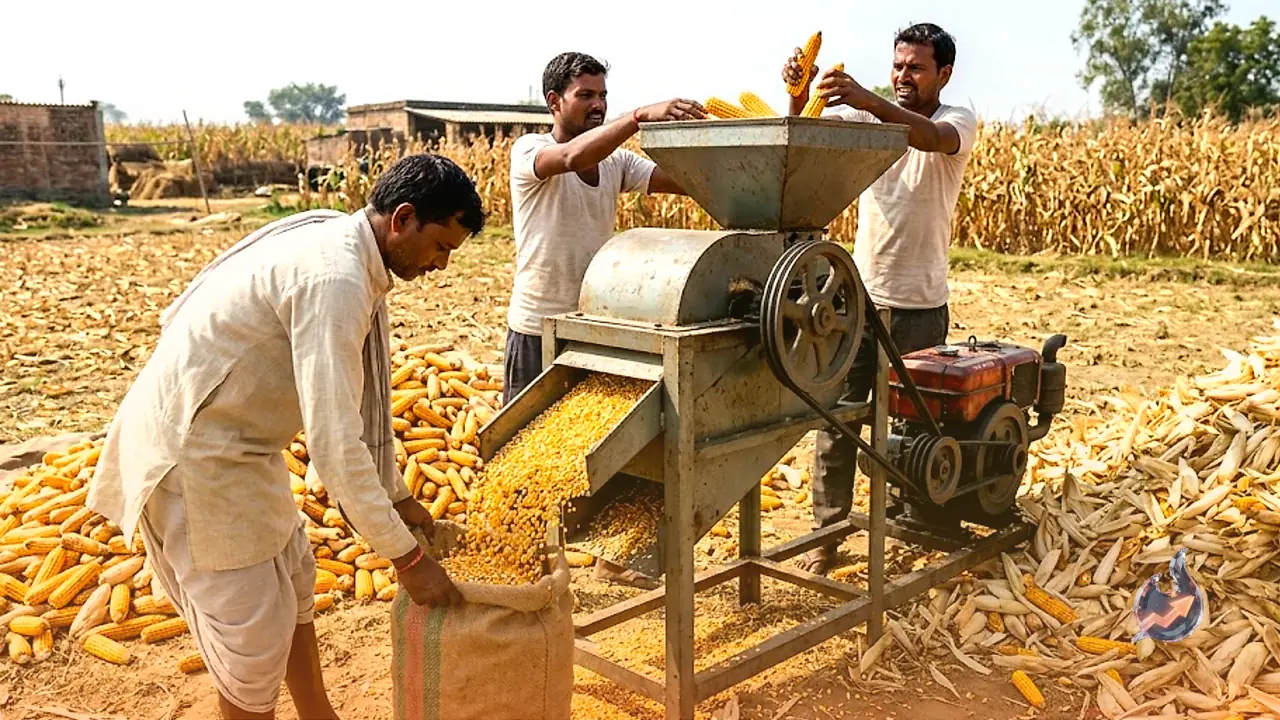
For small-scale and marginal farmers cultivating maize on limited plots of 2, 5, or 10 bighas, investing in large-scale industrial harvesters is economically unviable. Addressing this bottleneck, a compact and highly efficient "Maize Threshing Machine" has hit the market. Priced at approximately Rs 14,000, which is less than the cost of an average smartphone, this machinery is easily accessible to smallholders, allowing them to mechanize their post-harvest operations without a heavy financial burden.
High Efficiency Coupled with Low Power Consumption
The operational capacity of this compact thresher is highly impressive, shelling about 3 to 4 quintals of maize per hour. It typically runs on a 1 HP or 2 HP electric motor, or a small diesel or petrol engine. Ravindra Prasad, a local farmer from Bhagahar village, shared with TrendKia that the machine is exceptionally energy-efficient. Crucially, in regions with unstable power supply, it can even be run using a standard home inverter, ensuring uninterrupted operations.
Eliminating Manual Drudgery and Boosting Profits
Before the arrival of this machinery, manual shelling was a painful chore that often caused blisters on the hands of farmers and workers. Furthermore, hiring laborers for manual extraction was a costly affair, yielding only 3 to 4 quintals of grain per day. In stark contrast, this threshing machine allows farmers to process 15 to 20 quintals of maize daily from the comfort of their homes without paying extra for labor. Consequently, almost every household in Bhagahar village now owns one of these machines, redefining agricultural productivity in the region.