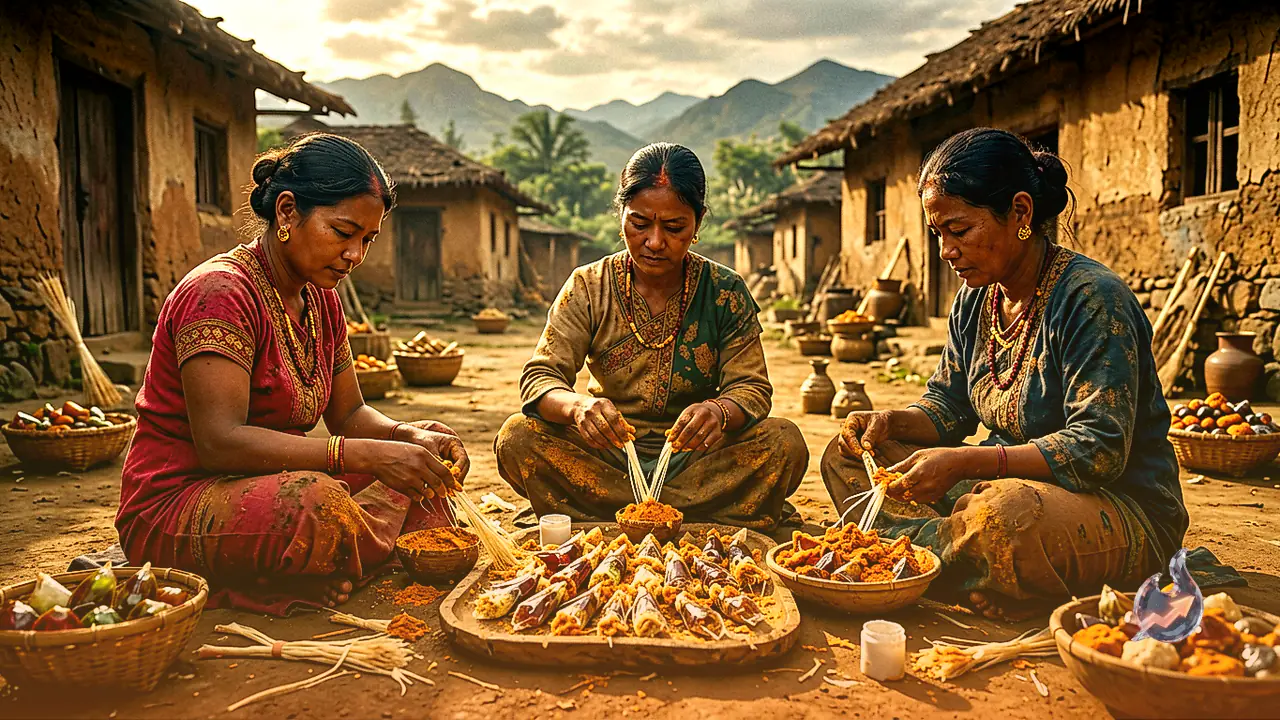
























A group of nine women from rural hamlets across Assam's Karbi Anglong district has taken a significant step toward financial independence by acquiring practical training in hand-crafted tea manufacturing. Rather than selling raw green tea leaves to buyers at minimal rates, these smallholder growers and homestead farmers are learning to produce premium Green Tea and Orthodox Tea directly within their households. Organized to foster sustainable economic self-reliance, the initiative blends local agricultural practices with market-oriented skill building.
Empowering Rural Households Through Value Addition
For small tea growers in Karbi Anglong, selling unprocessed green leaves often yields low profit margins due to fluctuating market demand and transport costs. To address this challenge, biodiversity conservation organization Aaranyak launched a dedicated one-day capacity-building workshop. The program brought together women cultivators from four neighbouring villages: Chandrasing Rongpi, Barking Engti, Sem Engti, and Hemai Lekthe.
The core objective of the initiative is to transition homestead agricultural workers from raw produce suppliers into artisanal tea producers. According to project organizers, processing tea manually requires relatively small initial capital investments while yielding finished specialty products that command significantly higher market prices. By mastering hand-rolling and drying techniques, rural families can retain a larger share of the economic value generated by their agricultural land.
Field Demonstrations and Traditional Processing Steps
The practical training session was conducted under the guidance of Manai Terangpi, an experienced local practitioner of green tea and orthodox tea processing from Chandrasing Rongpi village. Serving as the primary resource person, Terangpi guided the trainees through every phase of the artisanal production chain, beginning right inside a nearby tea garden.
Participants received step-by-step instruction on how to identify, select, and pluck the ideal tender tea leaves needed for high-grade processing. Following the harvest, the women undertook hands-on exercises in preparing hand-rolled green tea. The procedure involved exact methods for blanching or boiling the fresh leaves, carefully rolling them by hand to break cell walls and shape the tea, and sun drying the final batch. Following the green tea module, the workshop covered the distinct processing steps required to produce high-value orthodox tea.
Local Perspectives and Skill Enhancement
The hands-on methodology provided immediate practical insights for the participants, many of whom rely on homestead farming for their livelihoods. Trainees expressed optimism that these refined methods would allow them to command better returns in local and regional markets.
Rebeka Rongpipi, a resident of Chandra Sing Rongpi village, shared that learning these specialized processing techniques has equipped her to produce superior green and orthodox teas, moving away from selling raw leaves at low prices. Similarly, Kusum Teronpi from Sem Engti village noted that the training highlighted how crucial minor details, such as precise leaf selection, plucking discipline, hand rolling, and controlled drying, are in determining the final visual appearance and commercial quality of the tea.
Quality Standards and the PIRBI Enterprise Network
A key focus of the program was training participants to meet commercial quality benchmarks necessary for regular market distribution. Moromi Nath, representing Aaranyak, outlined the quality parameters mandatory for procurement under the local PIRBI initiative. She explained that tea produced by the village women will be evaluated and purchased based on measurable criteria, including leaf size uniformity, rolling consistency, and moisture removal during drying.
Nath urged the trainees to commence production with small experimental batches, advising regular practice to consistently refine their processing quality. Adding further context, Larbeen Teronpi from Aaranyak presented the operational framework of PIRBI, a community-managed business hub and food processing unit established in the region.
Teronpi highlighted that the scope for household value addition extends beyond tea leaves. She encouraged community members to explore processing other locally harvested crops, such as converting raw ginger into powder, milling tapioca into flour, processing moringa leaves into nutrient-dense powder, and packaging indigenous turmeric. Such diversification enables rural families to generate supplementary income using resources already flourishing in their immediate environment.
Preserving Cultural Knowledge and Supporting Conservation
Beyond economic empowerment, the workshop addresses the gradual loss of traditional tea-making knowledge among indigenous communities in Northeast India. As modern livelihood patterns evolve, ancient processing traditions risk disappearing. By helping local women convert these traditional skills into viable commercial activities, organizers aim to safeguard regional heritage while strengthening community bonds with the land.
The capacity-building initiative forms part of Aaranyak's Natural Resource Management Programme, which receives institutional backing from global conservation partners, including IUCN-KfW, the U.S. Fish and Wildlife Service, and the Disney Conservation Fund. Aaranyak reaffirmed its commitment to protecting Northeast India's rich biodiversity by facilitating nature-based solutions and sustainable alternative livelihoods for indigenous groups and local village communities.