
























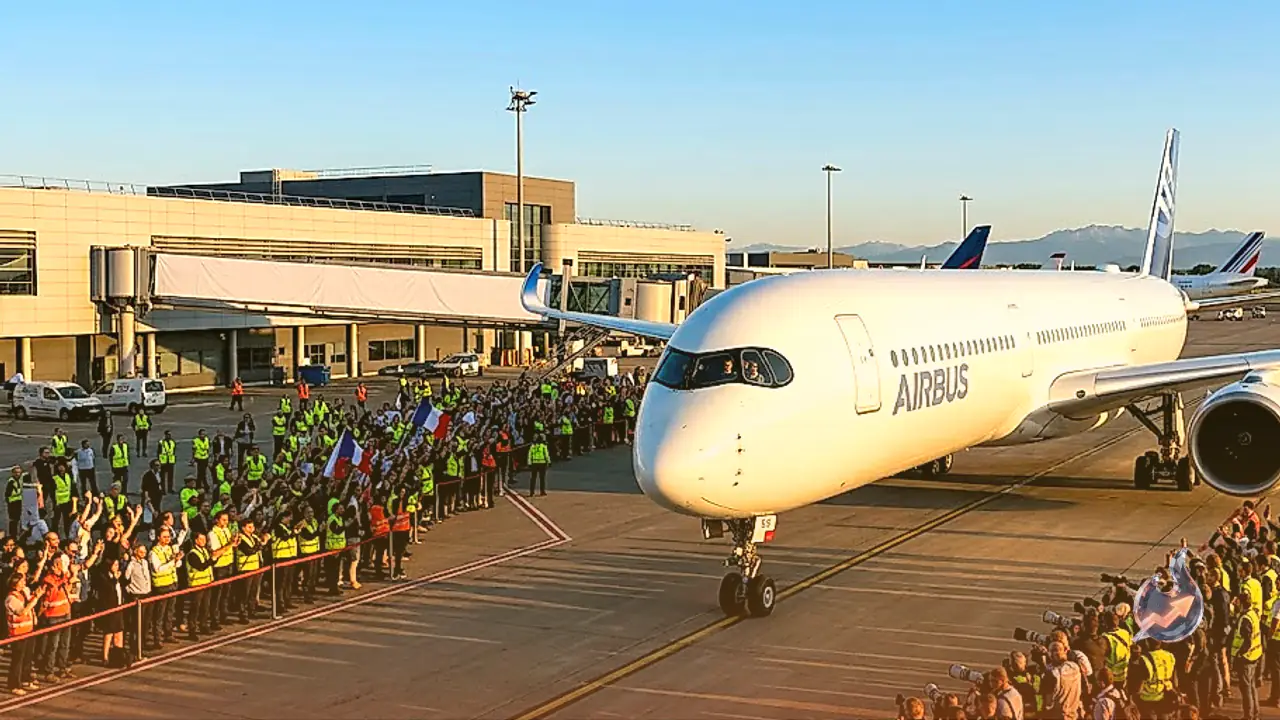

Adding a landmark milestone to global aviation history, an Airbus A350-1000ULR test aircraft has successfully completed the world's longest non-stop flight. The aircraft touched down at Toulouse Airport in France on 28 July 2026 after departing from Melbourne, Australia. Travelling non-stop for 24 hours and 24 minutes, the long-range test jet covered a staggering distance of 23,075 kilometers (approximately 12,460 nautical miles), setting a new benchmark for point-to-point endurance in commercial aircraft technology.
With this extraordinary journey, Airbus surpassed the previous world distance record of 21,601.7 kilometers set in 2005 by a Boeing 777-200LR. The two-leg flight test campaign originally commenced on 23 July 2026, when the first A350-1000ULR flight test aircraft, bearing registration MSN707, flew from Toulouse to Melbourne. The return leg on 28 July proved to be the ultimate endurance demonstration, validating the operational limits of modern ultra-long-range jetliners.
Global Transcontinental Flight Path
During the record-breaking return flight from Melbourne to Toulouse, the aircraft navigated a carefully planned transcontinental route. After taking off from Australia, the plane crossed the Pacific Ocean, flying towards the direction of Los Angeles. It then traversed the airspace over the western United States and eastern Canada before entering the North Atlantic corridor near the southern tip of Greenland. The aircraft subsequently flew over the United Kingdom before commencing its final descent into southern France.
Airbus confirmed that this specific flight path was selected primarily to avoid potential air traffic control complexities while evaluating the jet under varying atmospheric conditions. Over the course of this single continuous 24 hour flight, the crew experienced two sunrises and two sunsets, highlighting the sheer duration of the non-stop journey.
Project Sunrise and Block Time Validation
This long-haul mission forms a core component of Australian carrier Qantas' ambitious Project Sunrise initiative. Project Sunrise aims to introduce the world's first regular commercial non-stop flights connecting Sydney and London starting in 2027. Airbus noted that this flight was conducted as a developmental test rather than a formal airworthiness certification flight, focusing on system performance and operational feasibility.
A major objective of the mission was proving that the A350-1000ULR can seamlessly execute a 23-hour block time mission profile. Block time measures the complete duration from when an aircraft releases its parking brakes at the departure gate to when it sets them upon arrival at its final destination. Demonstrating robust endurance over such an extended block time is crucial for validating future non-stop commercial routes.
Advanced Propulsion and Auxiliary Fuel Architecture
Achieving a non-stop range of over 23,000 kilometers required specialized engineering enhancements. The A350-1000ULR is powered by twin Rolls-Royce Trent XWB-97 engines, optimized for maximum fuel efficiency and reliability over extended oceanic routes. Additionally, the aircraft is equipped with a specialized Rear Center Fuel Tank (RCT) with a capacity of 20,900 liters. This auxiliary fuel tank increases the aircraft's non-stop operating range to nearly 10,000 nautical miles.
Throughout the flight, test engineers performed comprehensive evaluations of the fuel management systems, cabin environmental controls, and air conditioning units. Data collected during the 24 hour flight will help refine fuel consumption models and cabin comfort standards for ultra-long-haul journeys.
Flight Crew Composition and Rest Facility Testing
The mission was piloted and monitored by a highly specialized team of aviators and flight test engineers. The initial outbound flight from Toulouse to Melbourne was captained by test pilot Vincent Sibelle, while the historic return flight was led by Airbus test pilot Xavier Pepin. The return crew also included two senior Qantas captains who possessed extensive experience on the baseline A350 but were operating the ULR variant for the first time. Two test flight engineers and three flight test engineers accompanied the flight to continuously monitor aircraft avionics and systems performance.
The test flight also evaluated the newly integrated Twin Flight Crew Rest Compartment (FCRC), engineered specifically to provide isolated rest areas for pilots on extended shifts. Because ventilation measurement sensors were fitted inside the pilot rest modules for data gathering during this trial, the crew utilized the 8-berth cabin crew rest area located at the rear of the aircraft for their rest cycles during the flight.


