
























A smiling grim reaper relaxing in a doughnut-shaped pool inflatable while flashing a peace sign is hardly what anyone expects to see when unlocking a smartphone screen. Yet beneath that cheerful macabre graphic sits a stark projection: the exact age when one is estimated to draw their final breath. For a forty-year-old user confronting the physical realities of aging alongside recent family bereavements, seeing the number 74 staring back from a device brings a chilling dose of mortality. Lingering discomfort in the neck, spine, and joints serves as a daily physical reminder that biological decay is underway, even if mental vigor remains intact. This universal reckoning with human fragility has fueled an overwhelming desire to uncover whether contemporary algorithms can actually buy more time on Earth.
The Expansion of the Multitrillion-Dollar Longevity Industry
The collective drive to outsmart human mortality has generated an expansive wellness and technology sector projected to hit an astounding $8 trillion by 2030. Prominent influencers like Bryan Johnson have accelerated this movement, framing longevity almost as an existential crusade. Intensified worries regarding planetary crises and artificial intelligence risks have heightened mortality anxiety, precisely as large language models pledge to deliver tailored medical solutions for every conceivable physical malady. The foundational premise of this commercial boom is simple: gather an exhaustive volume of biological data points, feed them into machine learning models, and let computational power manipulate the biological trajectory toward longevity.
This evolving ecosystem is already altering how individuals approach primary care. Platforms like Doctronic operate within federal health data privacy frameworks to function as automated clinical tools, allowing consumers to renew prescriptions without directly consulting a human physician. Simultaneously, subscription programs such as Superpower and Lifeforce provide diagnostic tracking coupled with clinician-reviewed health roadmaps. Another venture, Twin Health, claims to construct an artificial intelligence metabolic replica of an individual. All of these platforms promise to extend life, yet the scientific rigor behind these mechanisms and their financial and emotional tolls remain subjects of intense debate.
How Death Clock Analyzes Health Data and Blood Biomarkers
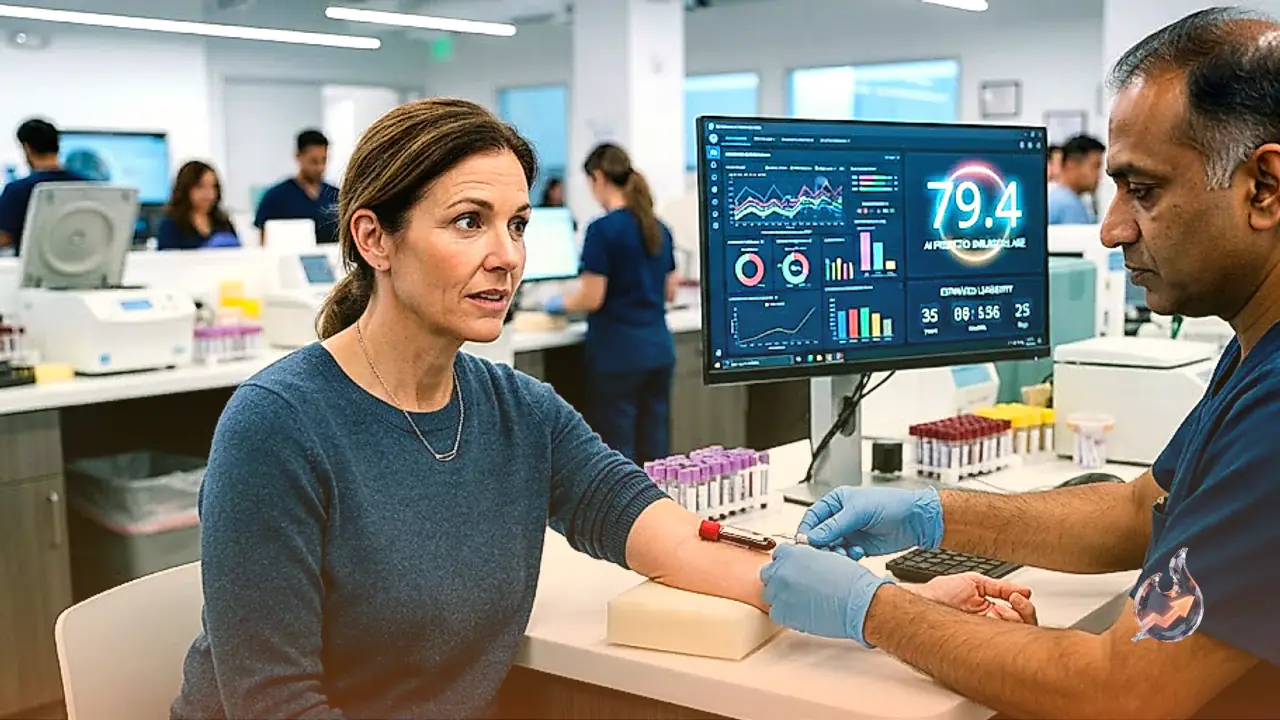
Entering this competitive landscape in 2024, the Death Clock platform positioned itself as an advanced lifestyle and mortality tracking system designed to enhance user survival. In February, the operation expanded by introducing clinical biomarker panels directly through consumer orders. Users who pay a $69 annual membership gain access to an entry-level blood panel that evaluates critical markers, including cholesterol fractions, glycemic regulation, systemic inflammation, vitamin D concentration, as well as general blood and organ function metrics. Beyond this baseline, the platform offers nine specialized diagnostic assessments covering hormonal balances, trace micronutrients, and thyroid profiles, which collectively carry a price tag of $780. An optional stress assessment is also offered for $29.
To differentiate itself from superficial mortality countdown widgets, the makers of Death Clock state that its algorithms are trained on actuarial tables, life insurance empirical data, and 1,200 scientific longevity studies. The system translates personal diagnostic information into an actionable prevention strategy meant to stave off early demise. However, the process can provoke immediate psychological distress. Upon finishing an initial wellness questionnaire, users receive notifications outlining their most probable fatal conditions: cardiovascular complications, sleep-related disorders, or unspecified malignancies. The software informs the individual that more than half of their existence has already elapsed. Furthermore, simply logging a modest family background of diabetes prompts the software to instantly revise the predicted age of passing downward from 74 to 73 years. To process these biological metrics, the company collaborates with Quest Diagnostics and one other commercial testing laboratory.
Corporate Claims Versus the Illusion of Immortality
The philosophical contradictions at the heart of this movement are acknowledged even by industry insiders. Brent Franson, the chief executive officer of Death Clock, cautions against the rhetoric peddled by radical life-extension proponents. Franson noted that figures advocating aggressive anti-aging regimes must exercise extreme care when implying that death can be evaded entirely, particularly when they have commercial merchandise to sell. In his view, claiming that humans can achieve immortality is a perilous position, because death remains an inescapable physical reality for every living being, leaving only the timing uncertain. When confronted with the question of whether continuous biometric tracking is generating genuine wellness or simply cultivating obsessive neurosis, Franson admitted that both trends are occurring, noting an unhealthy obsession with hyper-optimization where people attempt to micromanage every biological signal.
This candid admission highlights an inherent irony within the platform. After reviewing biological panels, the software continuously assigns new corrective duties to the subscriber. Users are instructed to boost vitamin D3 intake, book specialized dual-energy X-ray absorptiometry scans to gauge bone mineral density, and confer with medical specialists regarding prostate-specific antigen screenings. Despite public aspirations expressed by leadership that platforms like Death Clock might eventually substitute standard primary care physicians, the actual operational software repeatedly urges subscribers to consult human practitioners to interpret their diagnostic results.
Scientific Skepticism and Statistical Realities
Academic researchers remain deeply skeptical of claims that algorithmic software can reliably calculate or alter an individual lifespan. Mike Ludkovski, a professor specializing in statistics and applied probability at the University of California Santa Barbara who examines mortality patterns, emphasizes the fundamental limitations of these systems. Ludkovski explains that mortality awareness apps market an illusory belief that human life expectancy progresses along a predictable, linear path that can be manipulated through data adjustments. He stresses that the specific triggers precipitating death on an individual level are inherently random and cannot be accurately predicted by any mathematical model.
This perspective is reinforced by peer-reviewed literature. A 2024 study published in the academic journal Aging Cell emphasized that biological clocks must not be conflated with a comprehensive measurement of an individual's true biological age. The biological mechanisms that govern human decline are shaped by unpredictable cellular events, environmental exposures, and stochastic variations that defy simple quantification. While commercial tools present clean timelines and concrete lifespan extensions, statistical science demonstrates that individual mortality remains impossible to forecast with precision.
The Psychology of Aging and the Trap of Measurement
The mental burden of constant health surveillance can undermine the very vitality it seeks to protect. Gretchen Terry-Leonard, an author who examined attitudes toward getting older in her work titled 'Your Second Prime: Does Aging Suck, or Do We Suck at Aging?', points out a prevalent modern fallacy: the assumption that any metric that can be recorded can also be controlled. Because human mortality does not operate under direct managerial control, tracking metrics often transforms into a psychological mechanism designed to soothe internal anxiety rather than enhance physical longevity.
As the co-founder of the Center for Deeply Human Leadership, which investigates how synthetic intelligence interacts with cognitive health, Terry-Leonard remains doubtful that consumer apps can spark lasting healthy behaviors. She observes that presenting raw clinical data rarely alters human conduct, as people frequently engage in choices they recognize as detrimental. Historically, reflecting on death has been a foundational practice across cultures, but its health value depends on whether an individual possesses the practical agency and socioeconomic resources to implement meaningful life adjustments. When those resources are missing, the resulting stress is redirected toward defending one's emotional self-worth rather than making tangible health improvements. Crucially, Terry-Leonard's research revealed that older adults who maintained an optimistic view of their own aging lived an average of seven and a half years longer than peers with negative outlooks. Consequently, an interface that incessantly frames aging as a countdown to loss risks actively degrading the very lifespan it claims to expand.
Escaping the Surveillance Loop for Real Human Connection
Submitting to comprehensive biometric surveillance often transforms daily living into a grueling auditing exercise. Managing daily habits begins to mimic the frantic calculations of an accountant racing against tax deadlines. Checking off thirty minutes of strength workouts, strictly avoiding alcoholic beverages, flossing and brushing teeth, maintaining rigid sleep schedules, sitting in a sauna, and consuming more than eight glasses of water might allow an algorithm to credit an extra 5.8 years of projected existence in a single day. Yet despite these performative statistical gains, the digital clock continues its relentless downward progression, converting personal time into an ongoing optimization task.
The impulse to dominate biology ultimately feeds on the very terror it attempts to neutralize. The pursuit of total bodily control becomes addictive, yet rather than resolving questions surrounding human finitude, digital prediction tools tend to magnify existential dread. A fulfilling life is ultimately defined not by computational projections or obsessive metric tracking, but by the shared experiences cultivated with others. Recognizing that existence cannot be reduced to algorithmic outputs enables people to disengage from automated notifications, step away from the anxiety of digital countdowns, and invest their finite days into spontaneous gatherings and authentic community relationships.