























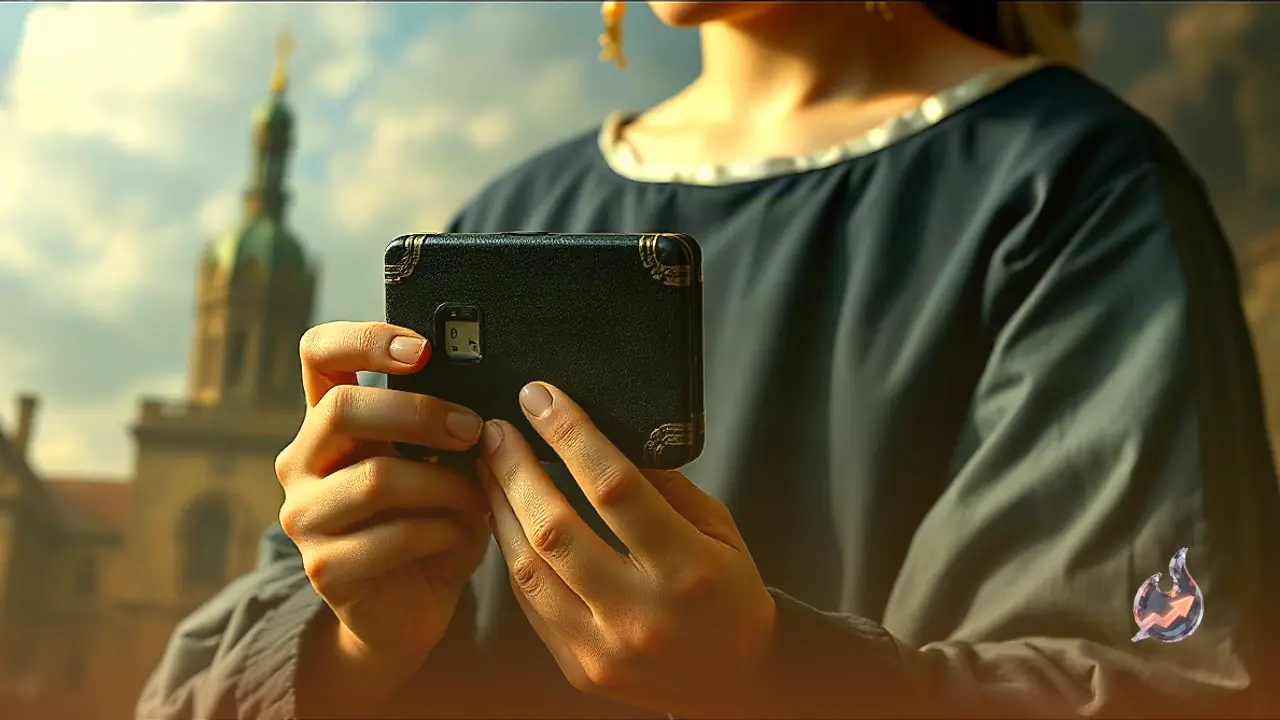

A 160-year-old masterpiece hanging in a German museum has captured the attention of art lovers and internet sleuths alike, giving rise to wild theories about time travel. The artwork features a young woman strolling down a picturesque countryside path, her eyes intently fixed on a small, rectangular object held in both hands. To a modern observer, her posture and thumb placement look indistinguishable from someone texting or browsing on a mobile device. However, historical context reveals a far more conventional explanation behind this intriguing visual coincidence.
The Painting That Triggered Internet Debates
Titled The Expected One, the famous painting was crafted by the renowned Austrian artist Ferdinand Georg Waldmüller in the mid-19th century. Currently displayed at the Neue Pinakothek museum in Munich, Germany, the artwork presents a charming rural landscape filled with lush greenery, distant hills, and wild foliage. As the young woman walks along the dirt track, a young suitor hides behind nearby bushes, holding a flower and eagerly awaiting her arrival. Despite the romantic setting, the central figure remains completely oblivious to her admirer, absorbed entirely in the object in her hands.
Around 2017, high-resolution images of the painting circulated widely across social media platforms, sparking intense discussion among online users. Observers were baffled by how closely the woman's stance matched modern habit: head tilted downward, elbows drawn close, and thumbs resting on the edges of a palm-sized block. The uncanny resemblance led many imaginative commentators to question whether the artist had somehow caught a glimpse of 21st-century handheld technology long before its creation.
How Time and Context Change Our Perception
The stark difference in interpretation highlights how cultural context shapes human perception. Peter Russell, a former employee from Glasgow, brought widespread attention to this optical illusion by explaining that an observer's era dictates what they see. When a person in the 21st century views the painting, their brain instantly associates the woman's posture with a smartphone. Conversely, anyone viewing the same canvas when it was painted in the 1850s or 1860s would have immediately recognized the item as a small hymnbook or devotional prayer book.
Art historians confirm that carrying pocket-sized religious texts during countryside walks was a common practice for young women in 19th-century Europe. The small leather-bound volume was a standard personal belonging rather than a device from the distant future. The woman in Waldmüller's scene was simply reading her devotional book while walking, completely unaware that her posture would one day confuse viewers living generations later.
Putting the Historical Timeline in Perspective
The viral debate surrounding the canvas underscores the massive gap between the painting's creation and the advent of mobile technology. Apple introduced the groundbreaking iPhone in 2007, while early mobile devices such as the Nokia 9000 Communicator emerged in the late 1990s. Waldmüller created his artwork approximately 160 years prior to these developments, meaning that if the object were truly a smartphone, it would predate actual mobile technology by nearly a century and a half.
This fascinating occurrence is not unique. Similar viral claims surfaced around 2016 when observers spotted objects resembling modern gadgets in other historical paintings and ancient artifacts. Experts refer to this phenomenon as confirmation bias or anachronistic interpretation, where modern minds automatically map familiar current tools onto historical imagery. Ultimately, Waldmüller's painting remains a testament to timeless art and a fascinating demonstration of how technology reshapes the way we interpret the past.