

















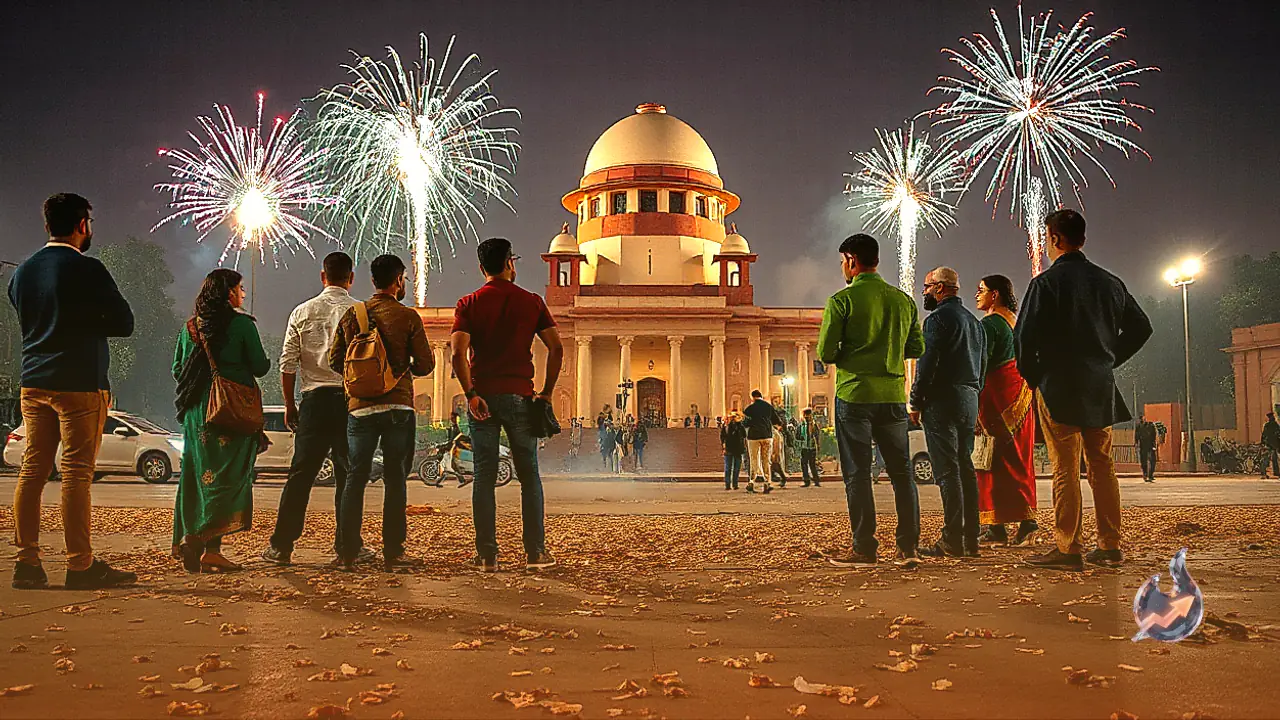

The Supreme Court has delivered a major ruling regarding firecracker regulations across the Delhi NCR region ahead of Diwali celebrations. Under strictly monitored conditions and a tightly controlled schedule, the court has permitted the bursting of certified green crackers exclusively on November 7 and November 8. According to the judicial directive, residents will be allowed to use these crackers only between 6:00 AM and 7:00 AM in the morning and from 8:00 PM to 10:00 PM at night, capping permissible firecracker use at three designated hours each day.
A bench comprising Justice MM Sundresh and Justice Prasanna B. Varale, in its order dated October 29, 2026, underlined that tackling toxic air pollution is paramount, yet experience has shown that blanket prohibitions alone have failed to eliminate the issue on the ground. The bench pointed out that despite previous total bans, the illicit sale, smuggling, and uncontrolled bursting of conventional firecrackers continued largely unchecked. In light of these ground realities, the judiciary opted to introduce a regulated window allowing certified green crackers under stringent oversight rather than maintaining an unworkable blanket embargo.
Strict Buffer Zones Around Sensitive Facilities and Silence Zones
To safeguard vulnerable populations and preserve tranquility where medical care is administered, the Supreme Court mandated that no firecrackers may be burst within 300 meters of sensitive establishments. This exclusion zone applies strictly to all hospitals, nursing homes, specialized health centers, care facilities for senior citizens, and officially demarcated silence zones.
The identical 300-meter buffer requirement has been imposed around schools, colleges, and other educational institutions across the region. Local authorities must formally notify these surroundings as non-cracker zones. The bench emphasized that festive enthusiasm must not compromise the well-being of sick individuals, as toxic smoke inflicts severe distress on young children, elderly citizens, and patients managing chronic respiratory or cardiac conditions, making rigid field enforcement non-negotiable.
Certified Manufacturing, QR Verification, and Crackers Garland Ban
To guarantee that only genuine low-emission formulations enter the marketplace, the court established rigorous manufacturing compliance protocols. Only green crackers holding prior technical approvals from CSIR-NEERI and PESO are permitted to be produced. Compliant manufacturers have been granted a production window between November 2 and November 6, strictly adhering to authorized chemical formulas.
To prevent the adulteration of approved packages with prohibited fireworks, all cracker boxes must be securely sealed at the production facility. Every box is legally required to display a unique QR code. When scanned by enforcement squads or consumers, this digital identifier must instantly provide verified data regarding the manufacturer, official registration, operating license, and relevant laboratory compliance certifications.
Furthermore, the court maintained a complete ban on the manufacture, sale, and use of joined firecracker chains or garlands, widely known as laris. Any fireworks containing hazardous barium compounds or lacking formal statutory approvals remain prohibited without exception.
Designated Retail Outlets and Total Online Sale Embargo
To contain commercial distribution and facilitate effective policing, local administrative bodies in Delhi NCR have been tasked with identifying and demarcating specific physical retail zones. Firecracker sales outside these officially notified clusters are entirely forbidden. In addition, the court imposed a complete ban on the sale and home delivery of firecrackers through online platforms and e-commerce services.
Traders whose vending licenses had previously been revoked may be granted temporary, conditional authorizations to sell certified inventory between November 4 and November 6. However, the bench cautioned that any shopkeeper found distributing unauthorized stock or violating safety protocols will face immediate and irrevocable cancellation of their trading license.
To stop illicit fireworks from penetrating the National Capital Region, law enforcement and transport agencies have been ordered to conduct stringent vehicular inspections at inter-state border checkpoints. These checks aim to intercept unauthorized commercial consignments and prevent banned traditional crackers manufactured in neighboring areas from reaching local markets.
Air Quality Monitoring Regimes and Public Health Tracking
To evaluate the direct ecological consequences of the conditional relief, the Supreme Court instructed the Central Pollution Control Board and respective State Pollution Control Boards to implement a three-tiered air quality monitoring program. Environmental data will be recorded across three specific intervals to chart contamination trajectories accurately.
The initial monitoring phase spans November 2 to November 6 to establish baseline ambient air quality measurements prior to the festivities. The second targeted phase covers November 7 and November 8 to measure pollution levels during the permitted bursting window. The final post-festive tracking phase extends from November 9 through November 30 to observe atmospheric recovery and pollutant dispersion patterns.
Beyond atmospheric metrics, the judicial directives require health departments to record empirical medical data. Hospitals and health centers must log any surge in patient admissions linked to worsening air quality, such as respiratory distress or acute allergic reactions. This epidemiological data will enable regulators to assess the tangible health burden of festive emissions systematically.
Reimposition of Complete Prohibition on November 9
The Supreme Court made it unequivocally clear that the concessions granted for green crackers are strictly transitory. Starting November 9, 2026, the complete ban on all categories of firecrackers will automatically come back into force across Delhi NCR without requiring any fresh notification.
Administrative authorities across the capital region must submit detailed compliance affidavits alongside comprehensive air monitoring findings to the court by December 14. The bench issued an explicit warning to executive officers, noting that failure to execute these directions or laxity in monitoring will invite immediate contempt of court proceedings against responsible personnel.
Judicial Appeal to Citizens and Prominent Personalities
Addressing the broader societal context, the court appealed to the conscience of citizens, observing that while Diwali is a festival of joy, illumination, and collective celebration, endangering community health through excessive smoke contradicts the foundational ethos of the occasion. The bench invited film actors, prominent athletes, and public figures to leverage their reach to educate people about eco-conscious celebrations.
The judges reiterated that mitigating air pollution cannot be achieved merely through penal mandates and court rulings. Lasting improvement demands coordinated accountability and active cooperation among municipal bodies, police authorities, commercial vendors, and everyday citizens working together to protect shared air quality.