













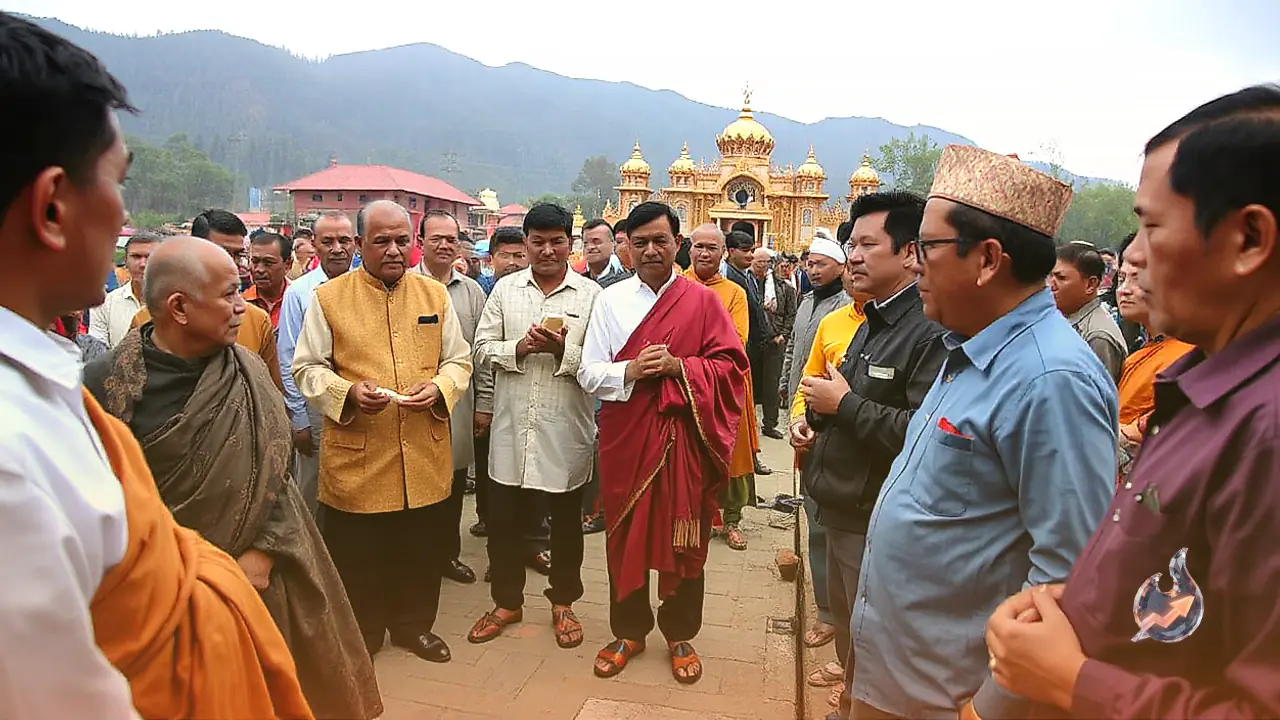

The sacred bone relics associated with Lord Buddha, excavated from the renowned archaeological site of Piprahwa in Uttar Pradesh, have arrived in Arunachal Pradesh, marking the beginning of an extensive spiritual exposition across the northeastern state. Following their ceremonial arrival in Tawang on Saturday, October 31, 2026, both Prime Minister Narendra Modi and the Tibetan spiritual leader, the Dalai Lama, conveyed their official messages to mark the occasion. Both leaders emphasized the enduring value of Buddhist heritage and urged devotees to draw inspiration from the core teachings of non-violence, peace, and universal compassion. For practitioners and historians alike, the public exposition offers a solemn opportunity to connect directly with physical remains deeply revered within Buddhist traditions.
The Historical Geography of Piprahwa and Its Ties to Kapilavastu
Piprahwa is situated in the present-day Siddharthnagar district of Uttar Pradesh. In Buddhist historiography and traditional accounts, this geographical area is intimately linked to ancient Kapilavastu and the ancestral Shakya clan into which Gautama Buddha was born. Because of this connection, the location occupies a vital position in the academic study of early Buddhism. The ancient stupa, structural complexes, inscribed containers, and domestic artifacts unearthed at the site have provided crucial material evidence for reconstructing the beliefs, monastic architecture, and communal practices of early followers. The importance of an ancient site is measured not merely by the physical artifacts recovered from its soil, but by the light those discoveries shed on the living faith, social organization, and worldview of contemporary society. Piprahwa stands as a pivotal junction where archaeological exploration meets millennia of religious reverence.
The 1898 Excavation and the Discovery of Inscribed Vessels
The modern archaeological history of Piprahwa commenced in the late nineteenth century. In 1898, William Claxton Peppe initiated the excavation of a massive brick stupa mound at the site. As the digging penetrated deep into the structure, workers uncovered a large sandstone coffer embedded within the core masonry. Inside this heavy stone chest were smaller receptacles containing bone fragments, ashes, beads, and an array of precious ornamental offerings. Crucially, one of the retrieved steatite urns bore an inscription incised in ancient Brahmi script. The text on the vessel made explicit reference connecting the deposited relics to the Buddha and his Shakya kin. While modern epigraphists and linguistic scholars have offered differing readings and interpretations regarding the exact phrasing and grammatical construction of the text, the discovery solidified Piprahwa as a primary candidate for Kapilavastu. Understanding these findings requires balancing the enduring veneration of faith communities with rigorous material and epigraphic analysis.
Subsequent ASI Excavations and the Recovery of 22 Bone Fragments
Decades after the initial finds by Peppe, the Archaeological Survey of India undertook fresh, systematic investigations to clarify the chronology and stratigraphy of the stupa complex. Under the leadership and supervision of archaeologist K. M. Srivastava between 1971 and 1977, excavations resumed at deeper strata. During this systematic dig, the team unearthed two additional small earthen relic caskets containing a total of 22 bone fragments. The larger casket held 12 bone pieces, while the smaller container held 10 pieces. In accordance with national preservation protocols, 20 of these 22 sacred bone fragments are permanently housed and safeguarded at the National Museum in New Delhi, while the remaining two fragments are conserved at the Indian Museum in Kolkata. Within Buddhist devotional practice, these physical fragments are revered as the genuine corporeal remains of Lord Buddha. For the special spiritual gathering in Arunachal Pradesh, the relics were transported directly from the secure custody of the National Museum.
The Significance of Corporeal Relics in Buddhist Devotion
In Buddhist tradition, the practice of revering corporeal remains emerged following the Mahaparinirvana of Lord Buddha, the term used to describe his final passing and release from the physical realm. Historical accounts record that after his cremation, his bodily relics were divided into portions among various regional principalities, each of which erected monumental earthen and brick stupas over their share. Over successive centuries, these architectural monuments evolved into focal points for pilgrimage, ritual circumambulation, and philosophical study. The reverence paid to bone relics today represents an unbroken continuation of this ancient devotional custom. When pilgrims bow before these physical remains, they seek to align their personal lives with the virtues exemplified by the teacher, especially universal kindness, non-harm, and inner composure.
Message from Prime Minister Narendra Modi
Prime Minister Narendra Modi characterized the exposition in Arunachal Pradesh as a moment of profound spiritual and cultural significance. In his formal communication, he noted that the Buddha's timeless principles of peace and empathy remain urgently needed in the contemporary world. He highlighted that the planned public viewings across Tawang, Bomdila, and Namsai provide citizens with an extraordinary occasion to pay homage to the profound legacy of Lord Buddha. The Prime Minister also pointed to broader initiatives aimed at preserving sacred Buddhist heritage and methodically upgrading infrastructure across recognized pilgrimage circuits. He underlined that the shared custody and celebration of this civilizational legacy serve to consolidate enduring bonds between India and Buddhist communities across the globe.
The Dalai Lama on Everyday Ethical Conduct
The Dalai Lama expressed deep satisfaction that devotees in the region have been granted the rare opportunity to encounter the sacred relics of Buddha Shakyamuni. In his reflection, the spiritual leader voiced hope that visitors would not stop at external sight-seeing, but would use the occasion to deepen their understanding through focused study, careful reflection, and consistent daily practice. He encapsulated the core of Buddhist ethical philosophy in simple, actionable terms: individuals should actively help others whenever circumstance allows, and if direct assistance is beyond their capacity, they must strictly refrain from causing harm to anyone. It is worth noting that the letter shared during the event was originally written on October 19, meaning it reflects an official correspondence prepared in advance rather than an address delivered extemporaneously on October 31.
Official Schedule for Public Viewing Across Arunachal Pradesh
According to the official itinerary announced for the exposition, the public viewing of the sacred relics has been organized across three prominent monastic centres. Devotees in Tawang will be able to visit and pay homage at the Tawang Monastery from November 1 through November 7. Following this opening phase, the relics will be transferred to Bomdila in West Kameng, where they will rest for veneration at the TGL Monastery, locally known as Lower Gompa, from November 8 to November 13. In the third phase of the journey, the relics will proceed eastward to Namsai, where public veneration will take place at the Golden Pagoda from November 14 through November 20. Following the conclusion of public viewings, the relics are scheduled to return under protocol to the National Museum on November 21. While public access concludes on November 20, the overall operational calendar of the mission spans from arrival on October 31 through return on November 21.
Educational Exhibition Showcasing Piprahwa's Excavation History
Alongside the spiritual ceremonies, authorities have mounted a specialized educational exhibition dedicated to the archaeological story of Piprahwa. The display is designed to guide attendees through the historical sequence of excavations, the anatomical and physical characteristics of the caskets, and the context of early Buddhist material culture. A featured section of the historical presentation details the repatriation story of the Piprahwa gem collection, which was returned to India in 2025. By pairing physical veneration with scholarly exposition, the event aims to offer the public a holistic appreciation of ancient history alongside spiritual devotion.