

















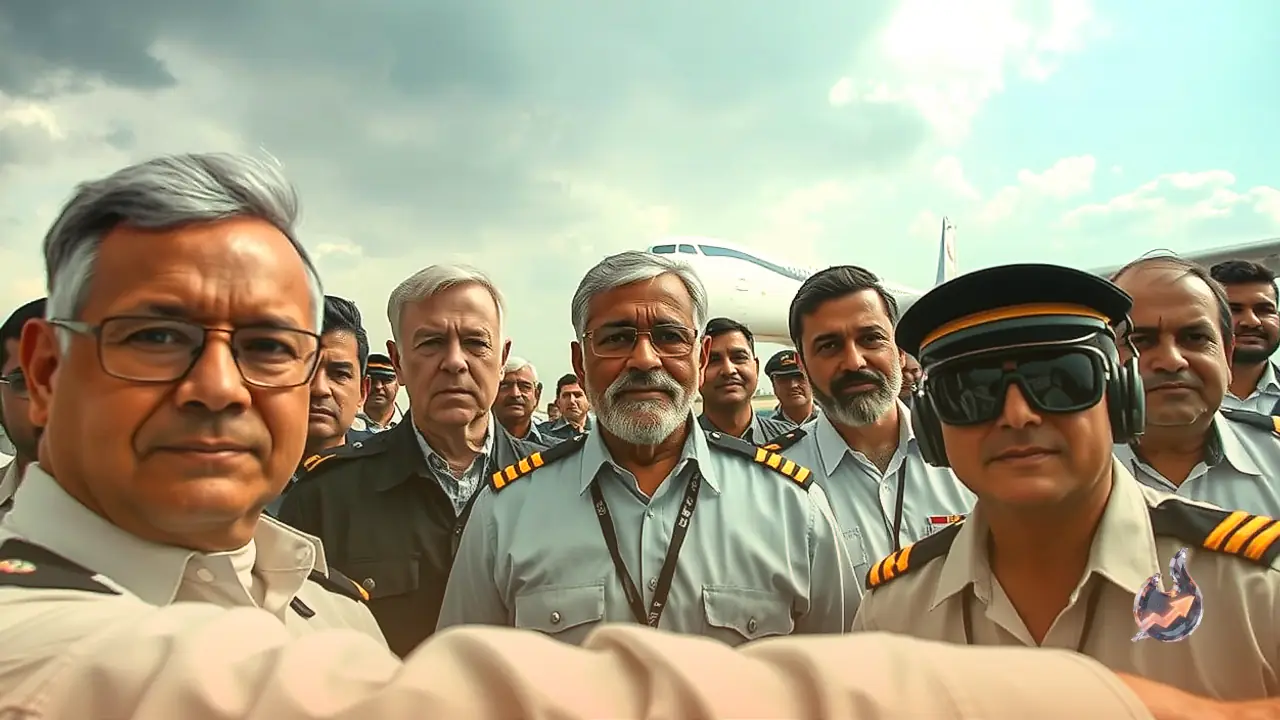

A harrowing mid-air emergency aboard a Flydubai flight from Dubai to Israel has turned into a major talking point within Indian political circles. Captain Smit Machchhar, an Indian pilot who managed to save 180 passengers despite suffering serious injuries during a sudden attack by his co-pilot, has earned worldwide admiration for his exceptional presence of mind and courage. Global leaders, including Prime Minister Narendra Modi, US President Donald Trump, and Israeli Prime Minister Benjamin Netanyahu, have openly lauded his valor. However, within India, this remarkable act of bravery has quickly become the focal point of a sharp ideological clash, with political parties testing narratives that could echo all the way to the 2027 Uttar Pradesh Assembly elections.
Sharp Scrutiny Over Responses from Key Figures
The controversy gained significant momentum on October 4 when Bharatiya Janata Party spokesperson Sudhanshu Trivedi publicly questioned the silence of the top Congress leadership regarding the pilot's heroics. Trivedi pointedly asked why Rahul Gandhi, Sonia Gandhi, and Priyanka Gandhi Vadra had not issued public statements or social media posts honoring Captain Smit. Political critics highlighted that while prominent Congress figures frequently issue statements and social media posts regarding international conflicts such as Gaza and Palestine, or domestic incidents like Batla House, they appeared entirely hesitant to dedicate even a brief tweet or statement to an Indian captain who risked everything to protect 180 lives.
The Clash of Competing Ideological Narratives
This debate has been framed by critics as a fundamental contest between genuine nationalism and vote-bank appeasement. The argument put forward is that on one side stand courageous individuals who elevate India's standing abroad at great personal risk, while on the other side sits a reluctance driven by electoral calculations that prevents political figures from openly celebrating an Indian hero. Sudhanshu Trivedi expanded this critique beyond basic courtesy, characterizing it as selective empathy. He questioned why the proactive communication routinely seen from Rahul and Priyanka Gandhi on Middle Eastern matters was conspicuously absent when an Indian professional displayed extraordinary heroism in a global aviation crisis.
Congress Rebuttal and Official Statements
In response to these allegations, representatives of the Congress pointed out that the claim of total party silence was factually incorrect. On October 2, Congress General Secretary Jairam Ramesh had issued an official public appreciation praising Captain Smit Machchhar. Ramesh stated that the pilot's courage, quick thinking, and decisive action under extreme pressure would forever remain a source of inspiration. Consequently, party defenders argued that the organization had indeed acknowledged the pilot's bravery. However, critics have maintained that the core issue lies in the absence of personal, direct statements from the Gandhis themselves, shifting the debate toward who spoke and from which level of authority the appreciation originated.
Perspectives from Uttar Pradesh Leadership
The controversy gathered further political significance with remarks from Congress MP Imran Masood, who also serves as the Executive President of the Uttar Pradesh Congress. Masood praised Captain Smit's resilience, noting that despite being grievously wounded, the captain prioritized the survival of everyone on board and prayed for his swift recovery. At the same time, Masood pushed back strongly against opponents, accusing them of trying to turn every grave or heroic event into a political spectacle. Because Masood holds an influential organizational post in Uttar Pradesh, his intervention has been viewed as a key indicator of how the state leadership intends to navigate this narrative challenge.
Electoral Horizons and the Battle of Narratives
Looking ahead toward the 2027 Uttar Pradesh Assembly elections, where major parties such as the Samajwadi Party and the Bharatiya Janata Party are already locked in high-stakes contests in upcoming Legislative Council (MLC) elections, it remains uncertain whether the incident will evolve into a formal campaign pillar. However, political discourse in Uttar Pradesh has historically been heavily shaped by overarching themes of nationalism, national security, counter-terrorism, appeasement, and identity politics.
If this topic continues to feature in public discussions in the coming months, the focus will likely remain fixed on the stark divergence in public messaging between different political camps. The 2027 contest in Uttar Pradesh will not only be fought across assembly constituencies and candidate selections, but also across deeply entrenched ideological narratives. For one side, Captain Smit's ordeal represents a straightforward account of national pride, safety, and resolve in the face of crisis; for the other, the challenge will be to ensure that their respect for national heroes is clearly communicated without allowing the issue to be weaponized into an enduring political disadvantage.