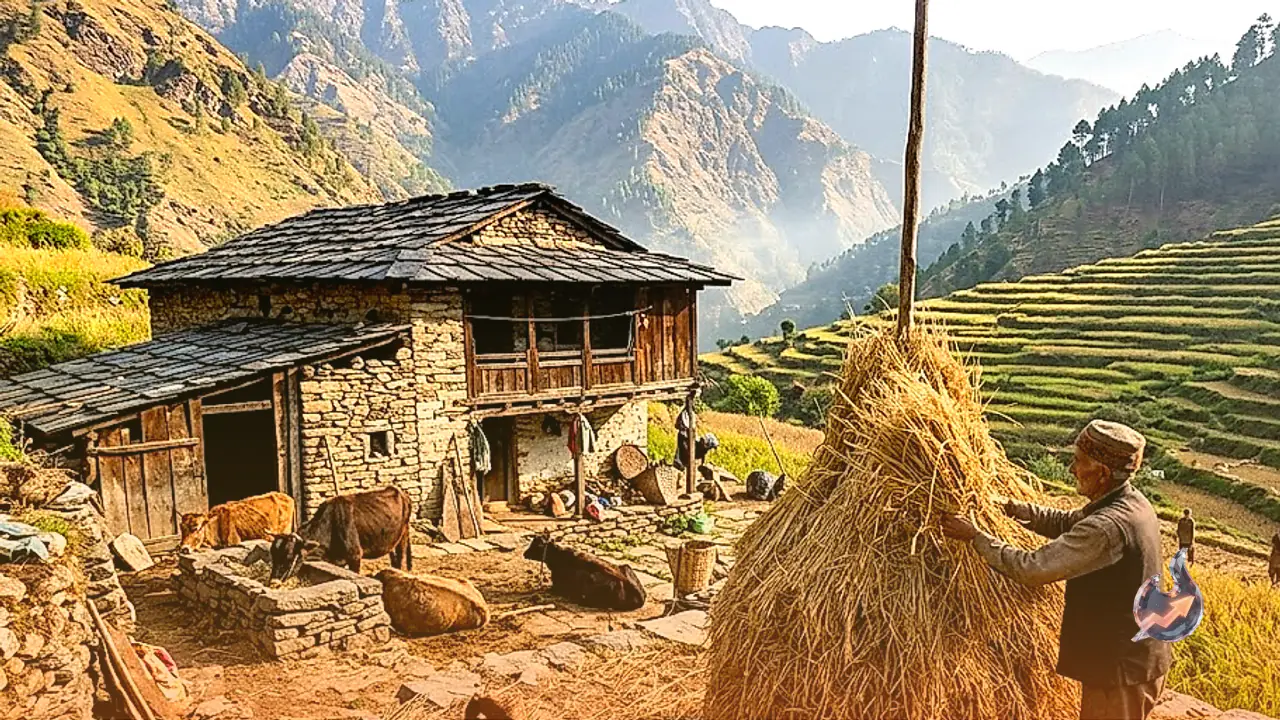

With the arrival of winter in high-altitude mountain settlements, securing nutritious green fodder for livestock emerges as a severe annual difficulty for rural households. Across numerous mountain villages, frosty conditions and low temperatures cause natural green grass to turn scarce during the peak cold months. Rather than treating post-harvest paddy straw as useless refuse, hill farmers preserve leftover crop residue with meticulous care to ensure an uninterrupted feed supply for their domestic cattle. To achieve long-term preservation, cultivators in the hills continue to rely on time-tested traditional techniques passed down through generations, which include drying the straw thoroughly to tie it into firm bundles or stacking it in specialized geometric formations.
In the hilly districts of Uttarakhand, animal husbandry functions alongside regular farming as a foundational pillar of rural livelihoods and daily sustenance. Under these conditions, managing a dependable food supply for domestic animals across all twelve months of the year is an absolute operational necessity. When paddy residue is protected properly instead of being discarded or set on fire, it serves as an excellent reserve of dry fodder. This deliberate conservation turns leftover agricultural residue into a valuable domestic asset while simultaneously resolving cattle maintenance challenges during harsh weather.
Sun-Drying and Bundle Storage in Ventilated Shelters
Weather patterns in mountainous regions can change rapidly, bringing sudden rain showers, heavy morning dew, and constant ground moisture that pose a continuous threat of decay to exposed crop residue. Local farmer Ramesh Krishak Pandey noted that hill conditions require paddy straw to be dried comprehensively under the sun immediately after harvest rather than being moved into storage damp. Once the straw is entirely moisture-free, farmers compress and tie it into secure bundles before shifting it to a dry, well-ventilated enclosure. Rural households typically select tin sheds, covered verandahs, or sheltered spaces where rainfall cannot directly reach the stored material.
To maintain feed quality over time, bundles must never rest straight on bare, damp soil. Instead, cultivators construct raised drying platforms using sturdy wooden planks or dry structural supports that prevent subterranean dampness from seeping upward into the crop residue. If weather turns harsh, the stacks can be shielded with waterproof tarpaulins, provided handlers ensure that trapped condensation does not accumulate beneath the sheets. Should stored straw develop visible fungal mold or signs of rotting, it must never be offered to cattle, as compromised residue can damage animal health.
Conical Stacking Techniques to Divert Rainwater
Another popular indigenous preservation practice observed throughout mountain villages involves crafting conical straw piles known locally as loote. In this method, thoroughly dried paddy residue is stacked systematically in an upward tapering cone. The aerodynamic, steep-angled contour is intentionally engineered so that incoming rainwater runs smoothly down the exterior edges directly onto the ground, leaving the compact core completely dry and protected from internal water seepage.
Farmers deliberately erect these conical formations on elevated ground where rainwater does not pool or accumulate around the base. Safeguarding the bottom layers against rising earth dampness remains equally essential during the stacking process. When constructed with care, these durable outdoor installations allow farmers to extract dry fodder in measured quantities throughout the winter as feed requirements dictate.
Combining Dry Straw with Green Grass for Balanced Nutrition
To optimize nutritional intake and maintain animal digestion, livestock keepers frequently chop dry straw and mix it alongside whatever quantities of fresh green grass remain available. This blending technique stretches out limited green forage supplies while ensuring cattle receive sufficient daily bulk. However, agricultural practitioners emphasize that dry crop residue should never constitute the sole component of a cow or buffalo's daily diet. Maintaining animal wellbeing requires a balanced nutritional intake tailored to livestock health requirements. These enduring mountain customs provide a clear roadmap for agricultural communities, showing that storing crop residue responsibly rather than burning it safeguards animal welfare while putting harvest leftovers to productive use.