




















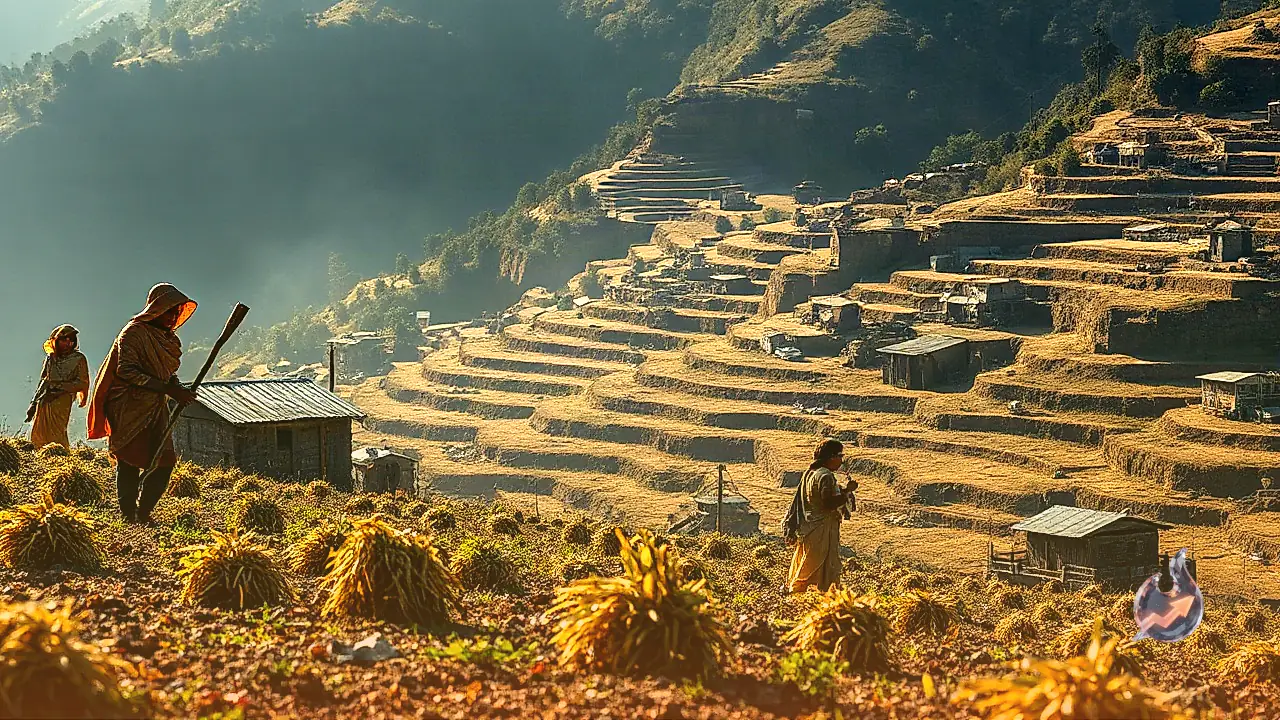

Agriculture in the mountainous villages of Uttarakhand continues to depend heavily on traditional manual methods that have been practiced for generations. Women in these rural communities have long relied on the simple sickle for harvesting crops across the region. Tools of this kind remain indispensable for gathering staple crops such as wheat, paddy, finger millet known as mandua, and barnyard millet known as jhangora. Additionally, the same cutting tool is essential for harvesting green fodder to feed livestock through the changing seasons. As dawn breaks in many villages, women set out toward the fields carrying their sickles, spending hours of intense physical labor cutting down mature crops. Although modern agricultural machinery has emerged in various farming sectors, the sickle remains an absolute necessity for farming in the mountains.
Local researcher Kishan Baldra from Bageshwar explains that agricultural land in the mountains lacks the flat expanse found in plains regions. The majority of fields are arranged in narrow terraces along slopes, and their individual plots tend to be quite small. Transporting large farming machinery to such plots and operating them effectively is simply not feasible. Narrow pathways running between fields and steep slopes create constant obstacles for machinery use. Consequently, farming households continue performing numerous agricultural tasks entirely by hand. The sickle represents an agricultural implement uniquely suited for efficient handling within these confined and sloping plots.
The role of women in mountainous villages has always been central, encompassing everything from crop cultivation to animal husbandry. Women have shouldered the responsibilities of harvesting crops, gathering grass, and managing diverse farm-related tasks for decades. Even today, women are frequently observed working in village fields while gripping their trusty sickles. After finishing household chores in the morning, many women head directly toward the agricultural terraces. There, they harvest crops manually while simultaneously gathering fodder supplies to feed their livestock. This routine makes the sickle an indispensable component of their daily working lives.
Traditional crops including mandua and jhangora continue to be cultivated extensively across the mountainous regions of Uttarakhand. The arrival of harvest season for these crops demands the consistent use of the sickle. Similarly, numerous rural families depend heavily on handheld tools for gathering wheat and paddy harvests. Because mountain fields are small and fragmented across different locations, bringing mechanized equipment to every single plot remains impossible. Farmers therefore rely on sickles to cut their crops reliably. While this labor demands significant physical effort, the sickle maintains its steadfast place in mountain agriculture.
The utility of the sickle in mountain villages extends far beyond mere crop harvesting. For families engaged in animal husbandry, the tool proves vital for cutting grass and gathering fodder. Rural women cut grass from forests, field boundaries, and surrounding areas to carry home for their animals. The need to accumulate fodder supplies intensifies significantly before the arrival of the monsoon rains and winter months. Because of its compact size, the tool is remarkably easy to carry along during daily travels. Grass can be harvested efficiently even along steep mountain slopes and narrow passages.
Awareness and utilization of modern agricultural implements are gradually increasing across rural settlements. To save time and physical labor, several farmers have begun incorporating small machinery into their routines. Despite these gradual shifts, the overall importance of the sickle across mountainous terrain has by no means vanished. One major reason lies in the distinct geographical layout of the terraced fields. Another practical factor is that acquiring or renting expensive machinery remains financially out of reach for many ordinary farmers. Manual labor using traditional hand tools often proves much more convenient on small plots.
The sickle serves as far more than a basic farming implement, functioning instead as a defining symbol of rural mountain life. The sight of women wielding sickles while toiling in the fields captures the immense dedication and self-reliance inherent to the mountains. Across generations, women have persistently supported their families through agricultural and livestock management tasks. Although younger generations increasingly migrate away from villages in search of employment and higher education, traditional farming practices endure across rural areas. When harvest seasons arrive, women operating sickles in the fields remain a common sight.
Agricultural practices in mountain districts such as Bageshwar in Uttarakhand are evolving with time, yet the reliance on traditional tools persists. While mechanized farming suits large and flat fields, manual tools remain exceptionally useful within the small and terraced plots characteristic of mountain villages. Rural households utilize sickles continuously, from the initial stages of harvesting crops to gathering fodder for their livestock. As a result, the sickle retains its established position in mountain farming despite a changing modern world.