























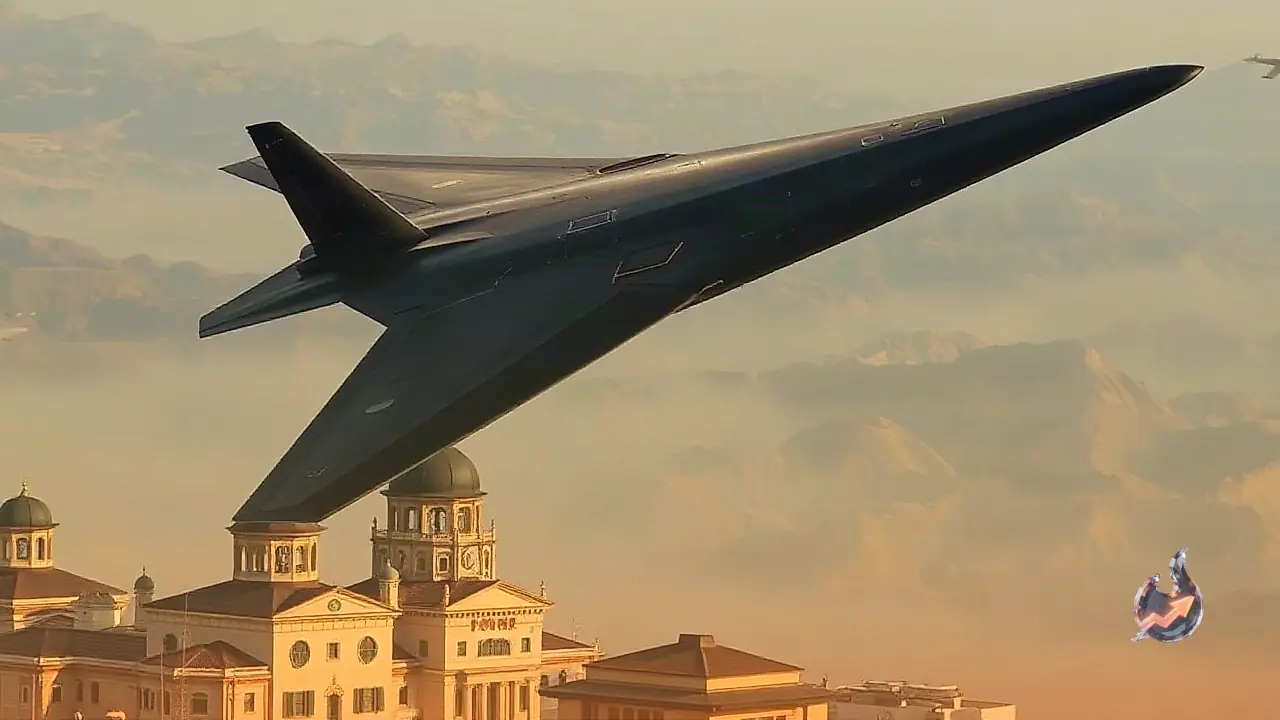

New footage has emerged of a tailless Chinese aircraft going through test flights in Xinjiang province, and defence watchers believe it is an early prototype of an unmanned bomber built for intercontinental range. If current assessments of its capability turn out to be accurate, it could mark one of the biggest leaps yet in Beijing's long range air power, giving China the reach to fly from the Pacific to the Atlantic in a single, uninterrupted mission.
Inside the New Prototype
The clips that have surfaced show a flying wing design, the same tailless shape used on the world's existing stealth bombers, which helps keep an aircraft's radar signature down by avoiding sharp edges and vertical tail surfaces. People studying the footage believe the airframe has considerable internal volume, enough to carry a heavy fuel load along with a sizeable set of weapons stored inside the fuselage rather than on external hardpoints, which would otherwise make the aircraft far easier to spot on radar.
From Satellite Images to a Test Flight
This is not the programme's first sighting. Commercial satellite images taken near an air force test facility at Malan in Xinjiang gave the first hint that China was building such an aircraft back in June 2025. It took roughly four more months before the aircraft was actually caught in the air, with footage of its first flight surfacing on October 19, 2025.
A Rival to the American B-2
In terms of size, the new aircraft is being compared directly with the United States' B-2 Spirit stealth bomber, with both estimated to have a wingspan of around 52 metres. The key difference is that China's design carries no crew, which frees up the space that would normally go to a cockpit and life-support systems for extra fuel, weapons and onboard equipment instead.
Why China Wants This Kind of Range
Right now, China's long range strike capability leans mainly on extended range variants of its H-6 bomber, long range missiles, and its newer YY-20 aerial refuelling tankers. Those platforms are considered capable in their own right, but a stealthy, unmanned aircraft with intercontinental range would let China operate at distances well beyond what that existing fleet allows. Defence experts believe an unmanned aircraft with this kind of range could give China air access stretching toward the Atlantic, the Arctic and further still, a meaningful edge given how few overseas military bases Beijing has compared with the United States.
Part of a Wider Military Build-up
The sighting comes as China pushes ahead on several fronts of military aviation at once, including its own sixth generation fighter jet programmes, with progress in engine technology said to be speeding up both fighter and bomber development. The United States' newest stealth bomber, the B-21, is comparatively smaller in size by contrast. A Chinese bomber with genuine intercontinental range would carry real strategic weight, particularly because American aircraft flying long missions typically still need aerial refuelling to finish them.
China's Bigger Military Ambitions
The bomber sighting fits into a much larger pattern. China is working to establish itself as a global superpower, and it is already doing so economically to a degree that the United States and other major economies cannot ignore. Beijing is now applying the same intent to its defence sector, and it has made rapid progress across fighter jets, drones and missiles. Reports indicate China already fields several squadrons of fifth generation stealth fighter jets.
Where This Leaves India
India, in comparison, does not currently have as many fighter jet squadrons as it is meant to field. New Delhi has been addressing the gap on two tracks at once, buying fighter aircraft from abroad while also launching a project to build a next generation fighter jet using indigenous technology. India's missile programme, on the other hand, is already seen as an established strength. Photo captions accompanying the sightings note that India's Rafale fighter jet lags well behind this new Chinese stealth aircraft in both range and how much weight it can carry, which is part of why the new bomber's emergence is being watched closely well beyond just Washington.