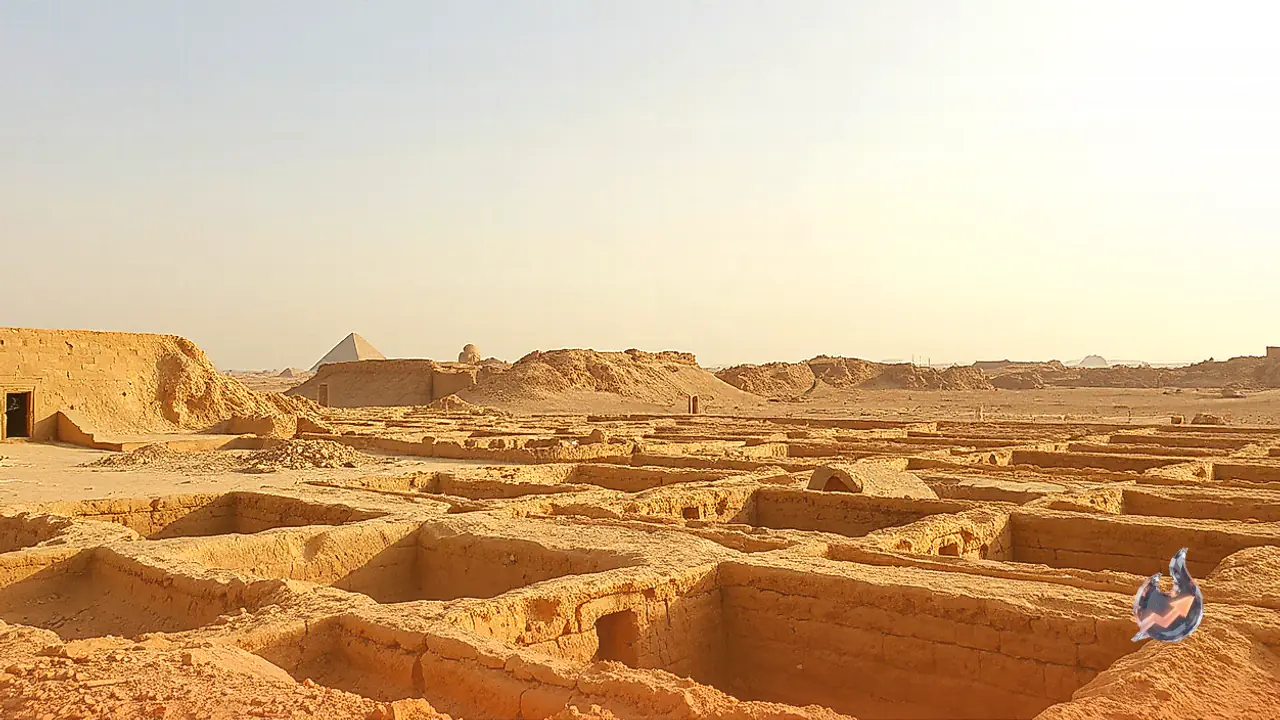

Long-buried secrets lying beneath the soil of Egypt are gradually coming to light as archaeologists uncover remarkable historical sites. In the northern Menoufiya region of the country, researchers have discovered an ancient cemetery featuring hundreds of stone coffins alongside golden tongues, precious jewelry, small statues, and the remains of falcons. This significant discovery stands out because such a large concentration of coffins has been found together in a single open courtyard, an occurrence never seen before in this specific area according to antiquities authorities. The excavation took place at a site known as Tel Kom Abu Billo, which once formed a part of the ancient city of Terenuthis. According to the Ministry of Tourism and Antiquities, the excavation yielded stone and clay coffins, remnants of wooden coffins, and mud-brick tombs, with several graves featuring distinct arched structures.
Among the most surprising finds from the site are small tongue-shaped objects crafted entirely from gold. Ancient Egyptians held the belief that even after death, a person would still need the ability to speak in the afterlife. Driven by this philosophy, a golden tongue was routinely placed inside the mouth of the deceased so they could articulate their words in the next world. In addition to these golden tongues, the excavation also uncovered thin gold sheets, earrings, necklaces, and various other ornaments. Archaeologists also recovered scarab-shaped amulets considered sacred, along with small funerary figurines, some of which feature inscriptions written in ancient Egyptian hieroglyphs.
The list of artifacts recovered from the cemetery does not end there, as researchers also found the remains of two falcons. Furthermore, fragments of small sphinx statues and broken pieces representing the god Horus, who was traditionally depicted in the form of a falcon, were also brought to light. A terracotta artifact connected to the goddess Isis-Aphrodite was discovered during the digging as well, depicting the goddess seated upon a lotus flower with the child Harpokrates resting on her lap. These items collectively demonstrate how deeply the people of that era valued the afterlife and their complex religious beliefs.
The defining characteristic of this archaeological find is the sheer volume of coffins discovered in a single location. According to Hisham el-Lethy, Secretary General of the Supreme Council of Antiquities, finding such a massive number of tombs and coffins in an open courtyard is a first for this particular site. However, not all the coffins are currently in good condition. Some have missing lids, while many others suffered damage due to ancient looting and stone-quarrying activities over the centuries. In the case of several wooden coffins, only traces and remaining fragments survived. Human remains are also in a heavily deteriorated state, though traces of resins and other substances used for mummification remain visible, alongside faint layers of yellow, red, blue, and gold paint on some of the remains.
Initial examinations suggest that a major portion of this cemetery likely dates back to the third and second centuries BCE. This period corresponds to the era when Egypt was ruled by the Ptolemaic dynasty. The tombs discovered here are believed to span from the late period of ancient Egypt well into the beginning of the Roman rule. Based on the jewelry and other objects placed inside the graves, the antiquities department infers that this cemetery was primarily utilized by the middle class. This indicates that the site was not reserved solely for royalty or the extremely wealthy, but rather served families with a stable economic standing somewhat above the common populace.