























For decades, the nations of Central Asia have maintained an extensive defense relationship with Moscow, relying heavily on Russian military hardware for their sovereign protection. Since the post-Soviet transition, Moscow had served as the undisputed provider of air defense platforms, surveillance radars, and advanced missile equipment across the region. Even today, Turkmenistan maintains ongoing defense transactions with Russian manufacturers and continues to develop existing bilateral military agreements. However, the operational burdens of the war in Ukraine alongside sweeping Western financial and technology sanctions have constrained Russia's defense industrial output. Capitalizing on this supply gap, Beijing has discreetly accelerated its footprint within the Central Asian security domain. China's central objective is to penetrate and secure market dominance across territories where Moscow's traditional hold has begun to waver. By attempting to make Turkmenistan technologically reliant on Chinese hardware, Beijing is seeking long-term leverage, though Moscow remains unwilling to cede ground in its historic sphere of influence, triggering a fresh arms race across Central Asia.
From the perspective of Turkmenistan, broadening procurement channels offers a vital opportunity to reduce total defense dependence on any single country. Nevertheless, Beijing's ambition extends far beyond acting as an alternate supplier; it aims to become the paramount military partner in the region.
Chinese Military Hardware Takes Center Stage at Ashgabat Parade
A major military parade held on September 27 in Turkmenistan's capital city of Ashgabat to celebrate the country's Independence Day delivered notable surprises for international observers. The public procession, which had traditionally showcased Russian armored vehicles and missile platforms, instead prominently featured Chinese combat systems. High-resolution footage from the event confirmed the deployment of at least 10 specialized launcher vehicles belonging to China's advanced FK-2000 mobile air defense system, underscoring how deeply Chinese systems have penetrated Turkmenistan's military doctrine.
Engineered and manufactured by the China Aerospace Science and Industry Corporation, the FK-2000 platform is designed as an integrated mobile surface-to-air defense solution. The vehicle configuration incorporates anti-aircraft missile tubes alongside twin 30mm automatic autocannons, providing layered defensive fire. The integrated battery can effectively track and engage incoming enemy combat aircraft and aerial threats at ranges extending from 1.2 kilometers to 25 kilometers. Furthermore, it possesses the precision intercept capability required to destroy guided munitions, including incoming cruise missiles, at distances of up to 10 kilometers.
The defense display in Ashgabat also featured Chinese DJI Matrice 30T drones and Sky Saker FX80 unmanned aerial vehicles configured for tactical reconnaissance missions. An advanced radar identified as the YLS-18A was also paraded alongside the DWL-002 passive electronic surveillance system, developed in China and now integrated into Turkmenistan's armed forces. The incorporation of these sensor and intercept platforms indicates the degree to which Chinese systems have assumed key responsibilities within the nation's air defense grid.
Border Tensions Near Iran Drive Accelerated Military Spending
Geopolitical turbulence along Turkmenistan's extensive land border with Iran has heightened national security concerns in Ashgabat. Across the border, Iran remains engaged in volatile direct confrontation with the United States and Israel. Regional airspace has witnessed persistent drone deployments and missile tracking operations since February. Concurrently, an active naval blockade enforced by the United States against Iran maintains intense friction, generating fears that any sudden escalation could spill over into adjacent border sectors.
Faced with immediate security volatility along its southern flank, Turkmenistan's leadership has prioritized rapid military modernization. Substantial national funds have been allocated to upgrade aging defense infrastructure, with primary emphasis placed on establishing an airtight air defense umbrella capable of intercepting airborne incursions.
Beijing has seized upon these border security anxieties to bolster its arms exports. By promising rapid delivery schedules and flexible terms, Chinese arms exporters have aggressively marketed systems to Ashgabat. The elevated security threat perception in the region has expanded the operational space for Chinese arms manufacturers, whose commercial strategy focuses on closing defense contracts quickly enough to lock out rival international vendors.
Russian Export Contraction Opens Strategic Voids Across the Region
Russia's current military priorities remain squarely centered on sustaining its domestic defense perimeter and countering long-range strikes against its own territory. With high-intensity combat ongoing against Ukrainian drone attacks and missile volleys, Russian defense manufacturers have prioritized domestic replenishment over foreign deliveries. A detailed assessment published by the Caspian Policy Center highlights this operational downturn, showing that Russian defense supplies to Central Asian countries plummeted by 23 percent between 2021 and 2023.
Supporting figures from the Stockholm International Peace Research Institute confirm a measurable contraction in Russia's global defense sales over recent years. Beijing has moved decisively to fill the resulting capability deficits. Beyond its sales to Turkmenistan, China has expanded its military partnerships into Uzbekistan, which recently procured Chinese J-10CE multirole fighter aircraft.
Similarly, Tajikistan's armed forces now operate China's HQ-17AE short-range air defense missile system, while Chinese military transport aircraft have been documented operating in Kazakh airspace. Beijing's broader diplomatic maneuver relies on pitching affordable yet technically capable military hardware to historically Russian-aligned customers, seeking to establish an uncontested supplier monopoly across the strategic corridor.
India's Akash Missile System Disrupts Chinese Regional Calculus
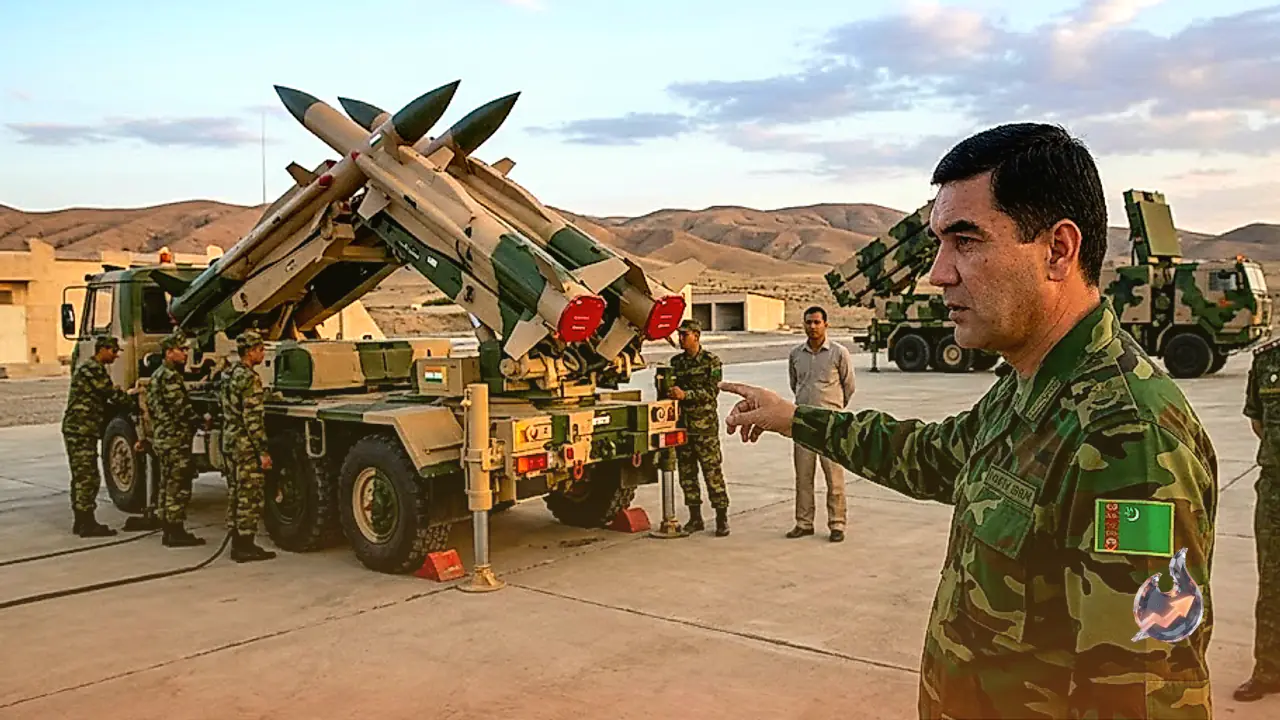
While the contest for Central Asia's defense procurement market appeared to be an exclusive duel between Russian legacy systems and Chinese newcomers, India's entry has reshaped the competitive landscape. Through the sale of its indigenous Akash surface-to-air missile platform, India has registered a significant breakthrough in Central Asia. New Delhi has successfully concluded defense export agreements covering the supply of the Akash system to both Tajikistan and Turkmenistan, presenting a direct challenge to Beijing's ambition of dominating the regional arms trade.
The Indian-developed Akash system is an agile, short-range surface-to-air missile asset capable of engaging multidirectional aerial targets. It effectively neutralizes threats flying at altitudes ranging from 100 meters up to 20 kilometers, offering an operational intercept range of up to 25 kilometers. Crucially, the platform includes dedicated electronic counter-countermeasure capabilities engineered to resist intense enemy radar jamming.
China had positioned itself to become the primary defense benefactor for Central Asian states seeking alternatives to Moscow. However, the successful deployment and export of India's indigenous Akash missile system has introduced a capable third supplier, fracturing Beijing's attempts to monopolize the regional defense market.