






















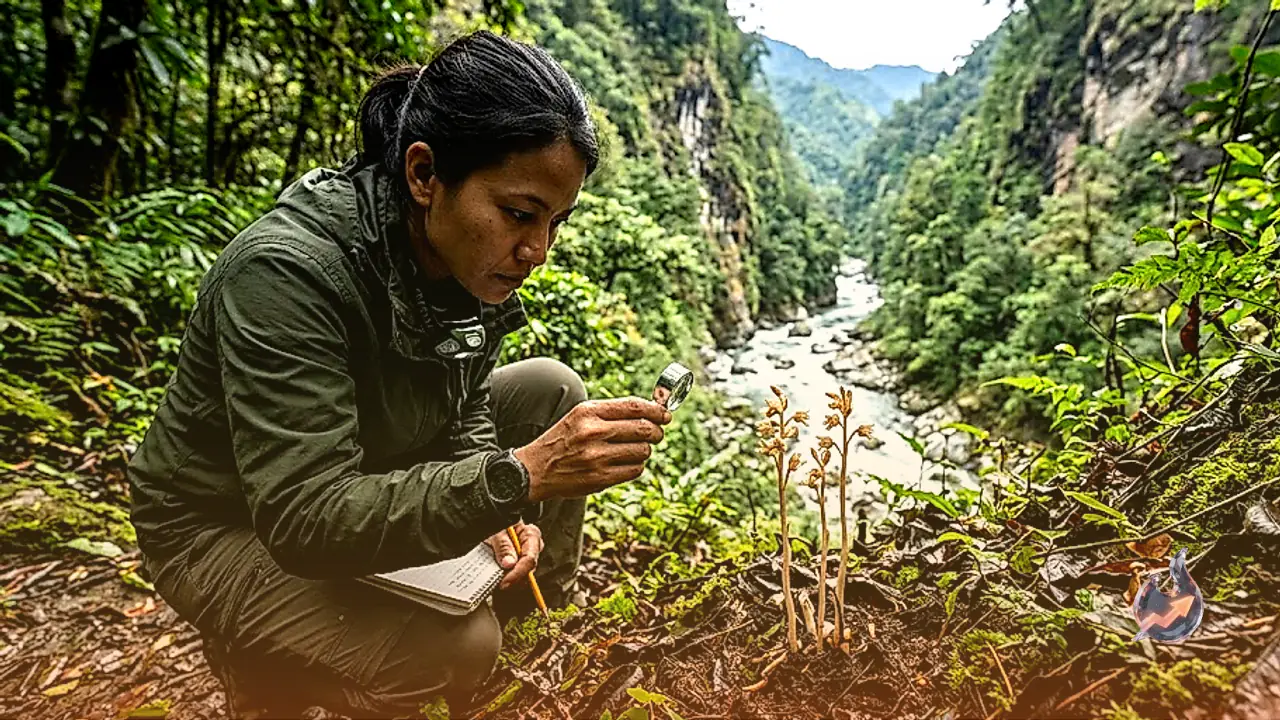

A subterranean botanical marvel that spends the vast majority of its existence buried out of sight beneath the forest floor has been identified in the secluded wilderness of Arunachal Pradesh. Designated scientifically as Gastrodia keyiensis, the leafless orchid was located during fieldwork conducted within a tucked-away river valley in Keyi Panyor district. Known in the local Nyishi dialect as Oram Opuh, which translates to Ghost Flower, the species eschews standard plant biology by growing without true leaves or chlorophyll.
Botanical Discovery Along the Keyi River Corridor
The botanical find was recorded at an altitude of roughly 1,000 metres above sea level. Field researchers encountered the plants rooted in deep shade on the right bank of the Keyi River, flourishing amid dense bamboo thickets on damp layers of decomposing forest litter. Finding the specimen proved exceptionally challenging, with only five blooming individuals encountered across the entire survey site. Formal scientific documentation was published on September 9 in the international taxonomy journal Phytotaxa.
The study represents a joint effort by researchers Madhusudhan Khanal, Dipankar Borah, Shuvadip Sarkar, Neelam Gap, Santosh Kumar Rai, and Devendra Kumar. These scientists belong to premier research bodies including the Botanical Survey of India, Sikkim University, Kaliabor College, and the G B Pant National Institute of Himalayan Environment. The specific epithet of the orchid pays tribute to the Keyi River, where the initial population was documented.
Nutritional Dependency on Fungi Rather Than Sunshine
Unlike standard flora that manufactures sugars through sunlight, members of the genus Gastrodia survive via an evolutionary adaptation known as holomycotrophy. Instead of relying on solar energy, Gastrodia keyiensis draws all its sustained nourishment directly from underground soil fungi. Because it possesses zero photosynthetic tissue, the plant remains perfectly suited for perpetually dim, damp environments beneath dense jungle canopies.
Its prolonged life cycle underground explains why botanical teams easily overlook the species during regular field inventories. When individuals finally push through the leaf litter to reproduce, the stems reach roughly 35 cm in stature, bearing between one and three blossoms. The floral petals exhibit tones shifting from white to a pale bluish tint, marked by a vivid yellow apical segment.
Morphological Traits and Official Reactions
Taxonomic evaluation highlighted several morphological markers distinguishing this orchid from allied taxa. Key among them is a broadly obovate lower section of the floral labellum, equipped with six to seven prominent longitudinal ridges, alongside a thickened, strongly hooked yellow apex.
Reflecting on the botanical development, Deputy Chief Minister Chowna Mein noted on social media platform X that the discovery adds another fascinating chapter to the state's natural heritage. He highlighted that the orchid's fleeting flowering window and narrow distribution underscore the importance of safeguarding sensitive habitats through sustained ecological inquiry.
Conservation Gaps in India's Orchid Paradise
At present, the known distribution of the plant remains restricted to its original discovery site, with an estimated area of occupancy hovering at roughly four square kilometres. Given the absence of complete demographic counts across neighboring river valleys, taxonomists have listed the plant as Data Deficient. Further intensive field explorations will be essential to establish its true survival baseline and ecological footprint.
According to state Forest Department records, Arunachal Pradesh already serves as home to approximately 600 known orchid varieties. Its dramatic elevation gradients and rich microclimates have earned the state the moniker of Orchid Paradise, a status reaffirmed by the discovery of this elusive new species.