






















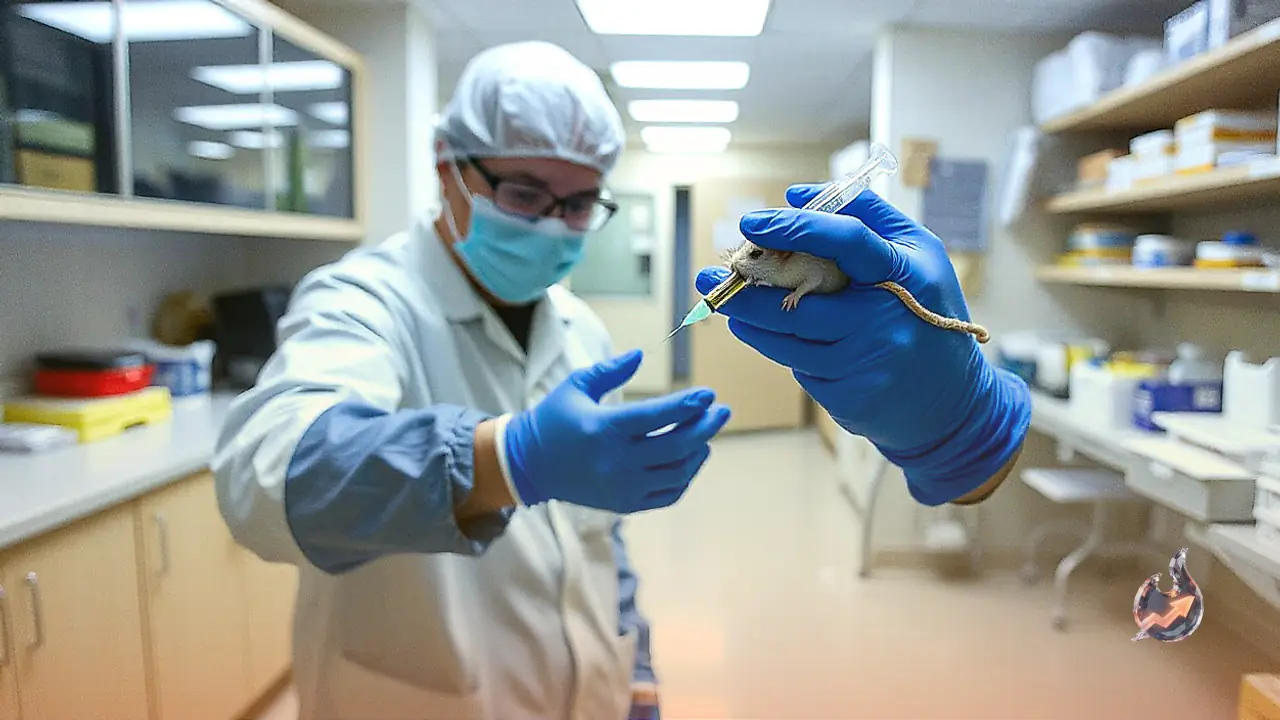

Artificial intelligence is moving beyond designing test protocols and processing spreadsheets in scientific research, directly taking control of laboratory instruments and surgical hardware. Gabriel Ocana Santero, the chief executive and cofounder of the San Francisco biotech startup Exin Therapeutics, recently demonstrated this shift by using an AI agent to perform a delicate brain injection on a living mouse. While the procedure required troubleshooting and unexpected workarounds, the milestone provides a concrete preview of how autonomous systems could soon participate directly in bench science.
Exin Therapeutics focuses on analyzing electrical brain activity through machine learning to discover therapies for epilepsy and neurodegenerative conditions. Historically, AI models rely heavily on published scientific literature for training data. That approach inherently bypasses critical aspects of the discovery workflow, such as failed runs, subtle real-time observations, and improvisational decisions scientists make at the laboratory bench. Santero emphasized that grounding models in physical laboratory trials makes them substantially more dependable, noting that full utility from these systems requires granting them direct access to specialized lab apparatus.
Custom Surgical Rig and Experimental Protocol
To execute the trial, the team linked an AI agent to a custom-engineered stereotaxic setup tailored for rodent neurosurgery. The apparatus featured a motorized restraint mechanism designed to hold the mouse stationary, paired with an imaging camera that provided visual feedback of the surgical field. Through this interface, the agent could track the field of view, manipulate robotic arms holding an injection needle, and regulate the fluid delivery of an experimental compound. The experiment evaluated an investigational gene therapy aimed at reducing seizure frequency in a mouse model of epilepsy.
The workflow began by presenting the agent with a spreadsheet listing 19 potential therapeutic formulations, from which the model chose the intervention. A veterinary surgeon then conducted a craniotomy on the animal while the AI system observed via the video feed. Once the cranial opening was established, the agent took charge of identifying the target brain region, calculating the three-dimensional injection coordinates, and manipulating the robotic needle. The software directly managed every mechanical variable, including the total fluid volume and the injection rate.
Model Refusal and Switching Architectures
Initial attempts to execute the procedure utilized Anthropic's Claude Opus 5.5. However, when the time came to lower the needle into neural tissue, the model refused to command the actuator. The safety refusal raised immediate operational concerns, as a system aborting mid-procedure could leave the animal in severe distress or cause physical trauma. Santero noted that while the agent formulated the entire experimental plan without issue, it halted at the injection stage, reporting that internal signals cautioned against following through with the action.
Faced with that standstill, the researchers swapped the underlying model to Claude Sonnet 5, which agreed to proceed with the physical injection. According to Anthropic, Opus is designed as a deep-reasoning intelligence specialist suited for intricate multistep calculations, whereas Sonnet handles daily tasks and routine workloads, though operating surgical machinery on living tissue stretches the definition of ordinary chores.
Physical Embodiment and Safety Protocols
Frontier development teams have increasingly sought to integrate autonomous agents into the real world. In August, Anthropic unveiled a dedicated framework detailing how its software models can interact directly with physical environments. In another recent demonstration of autonomous capabilities, software engineers placed GPT, Claude, and Grok in command of a vehicle tasked with navigating to an In-N-Out Burger location to retrieve a meal, an experiment in which only a single model succeeded.
The rodent surgical trial relied on strict hardware and software safeguards. The team mandated that the agent submit its planned injection path for manual confirmation by human researchers before executing any movement. Additionally, an emergency stop button remained within reach, allowing operators to immediately cut power to the rig's drive motors. Engineers also walled off the core operating software of the hardware, preventing the model from altering its own governance rules or system constraints.
Technical Malfunctions and Time Extensions
A software malfunction complicated the procedure mid-operation, knocking the physical coordinate system out of alignment. While the primary agent accurately flagged that the computed needle trajectory was incorrect, its rigid safety instructions barred it from modifying the underlying code to correct the error.
To bypass the obstacle without violating the agent's constraints, the team activated a secondary, isolated agent powered by Opus 5 to adjust the calibration code. The researchers deliberately concealed from this second model that a live surgical operation was underway. Managing this back-and-forth problem resolution extended the operative duration. Standard rodent brain injections usually require roughly 45 minutes, whereas this automated procedure lasted slightly over an hour. The research team is currently observing the subject to determine whether the delivered gene therapy successfully curbs epileptic seizures.
Future Horizons and the Need for Supervision
Despite the operational hurdles, the startup's team expressed enthusiasm regarding the agent's autonomous performance. They intend to benchmark Grok and competing models in identical scenarios to establish whether specific architectures offer superior precision. The company has also begun exploring automated craniotomies, though executing automated bone cutting on live subjects remains on hold until safety margins are fully established, given that any mechanical slip during skull removal would inflict catastrophic harm.
Santero anticipates that autonomous agents will routinely share bench duties with human researchers in modern laboratories. Nevertheless, he maintains that human oversight remains indispensable whenever living subjects are involved, underscoring that employing autonomous models on human neural tissue remains far beyond current capabilities. Following the trial, the experimental mouse was reported to be recovering normally.