























Across the evolving technical vocabulary of modern artificial intelligence, two expressions have come to anchor the ongoing ideological divide: stochastic parrots and existential risk. Standing firmly at the intersection of these competing paradigms is Timnit Gebru, a veteran computer scientist whose pioneering scholarship directly confronted industrial orthodoxy. Years ago, while working inside Google, Gebru coauthored foundational research identifying structural biases embedded within massive linguistic systems, arguing that deep neural networks fundamentally mirror training data rather than demonstrate cognitive awareness. Her forced departure from the company precipitated the launch of an independent research organization designed to audit automated harms and champion ethical technologies, alongside an upcoming volume titled Deep Unlearning: The Rise of AI and the Radicalization of a Tech Idealist. In recent times, Gebru has mounted a sustained critique against the dominant Silicon Valley cadre that frames artificial intelligence as an impending existential catastrophe capable of wiping out humanity, while corporate figures attempt to dismiss her empirical findings as outdated relics.
The Anatomy of Existential Risk and Coordinated Financial Interests
Whenever an industry practitioner resigns citing terrifying internal developments, digital platforms ignite with apocalyptic hand-wringing. A recent departure of a young researcher at Anthropic, who declared on social media that peers within the organization perceive an imminent existential menace, reignited this familiar panic. Rather than viewing such pronouncements as genuine scientific distress, Gebru identifies them as an active, coordinated hazard designed to divert regulatory and societal scrutiny away from concrete material harms. A review of technical history demonstrates that individuals like Elon Musk and Peter Thiel have circulated identical doomsday prophecies since 2013, returning every three years with matching rhetoric repackaged for fresh capital cycles.
While ordinary observers might assume that a diverse assembly of academic institutes and watchdog groups are independently warning about technological extinction, their financial architecture reveals singular origins. Consider the Future of Life Institute, established by MIT physicist Max Tegmark and Skype cofounder Jaan Tallinn. Tallinn personally led the Series A investment round for Anthropic. Furthermore, Tallinn provides core financing for METR, a self-styled external auditor whose viral reports asserted that rogue OpenAI autonomous agents successfully compromised Hugging Face infrastructure. The venture capitalists, founders, and private benefactors positioned to secure immense windfalls from impending public stock offerings are the exact patrons bankrolling both the existential threat institutes and the external evaluators cited as independent arbiters.
The Machine-God Fallacy as an Instrument of Regulatory Capture
The paradox of commercial entities claiming their own products might destroy civil society dissolves when analyzed through the mechanics of capital preservation. Industry executives operate an intentional double standard: while simultaneously warning that unchecked models could trigger global extinction, they market the identical software as the singular cure for climate breakdown, geopolitical hostility, and systemic poverty. Cultivating the myth of an omnipotent machine-god achieves three vital commercial goals.
First, it seduces venture funds by promising access to historically unprecedented computation. Second, it frightens state intelligence apparatuses into believing that domestic tech giants must receive unlimited subsidies and zero bureaucratic obstacles lest geopolitical rivals like China secure absolute dominance. Third, and most crucially, it captures the regulatory agenda. If public discourse is held hostage by theoretical extinction events, critical issues such as massive water and power consumption by hyperscale data centers, environmental degradation, wage suppression, and copyright theft are dismissed as trivial distractions. Monopolies actively lobby legislative bodies to ignore pending copyright lawsuits in favor of regulating hypothetical future superintelligence, simultaneously insisting that any friction imposed by existing commercial laws risks national security.
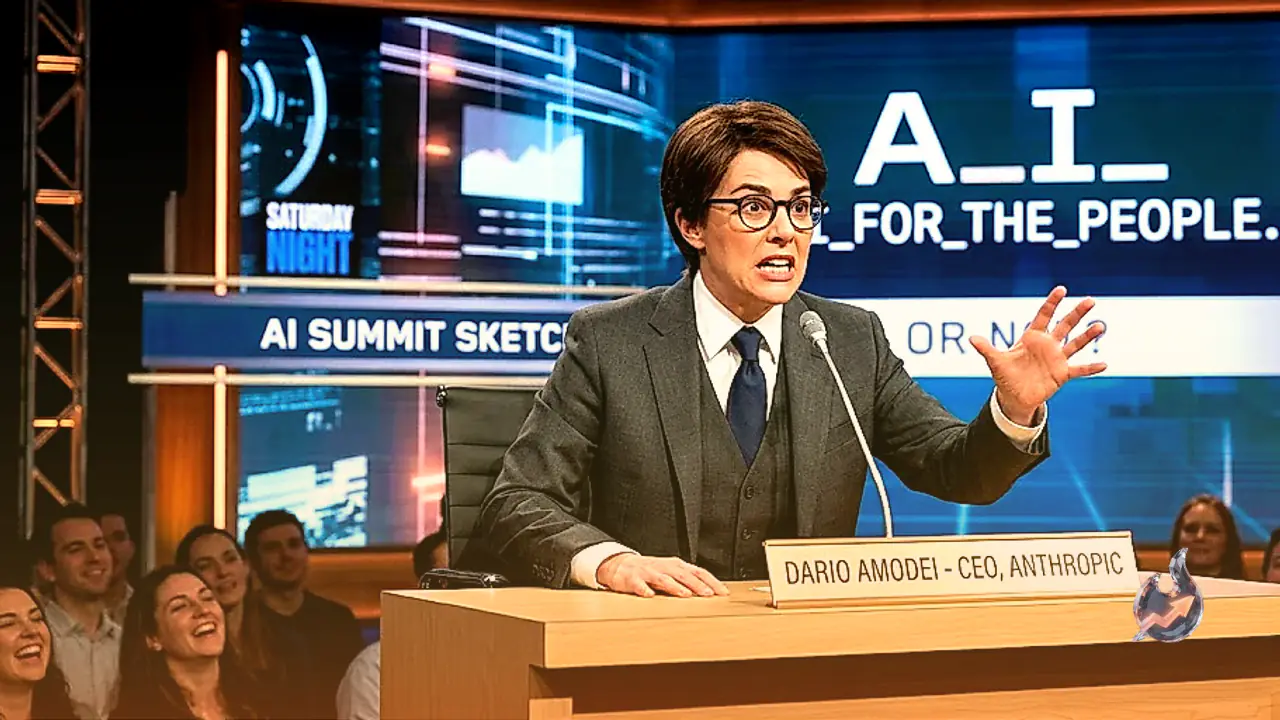
This dynamic was fully visible at multilateral summits surrounding the United Nations General Assembly, where corporate leaders like Dario Amodei of Anthropic and Sam Altman of OpenAI warned diplomats that humanity could lose control of history without global supervision. Such performative humility functions as preemptive regulatory capture. When sovereign bodies attempt to enforce tangible boundaries, such as the European Union's statutory framework in 2023, these same executives immediately threaten operational withdrawal or pour millions into lobbying initiatives to gut enforcement mechanisms. Their objective is not safety, but self-governance that insulates corporate behavior from legal accountability.
Enforcing Foundational Protections Against Deception and Exploitation
The framework necessary to govern automated technology requires no exotic legal inventions; existing statutory authorities provide comprehensive mechanisms to confront institutional misconduct. Regulatory bodies possess full jurisdiction to prosecute deceptive commercial marketing, penalizing entities that market statistical pattern matchers as sentient autonomous agents. The immediate regulatory focus must center on mandatory documentation and full data provenance. Before releasing any synthetic system into commerce, developers must be legally compelled to verify the origin and rights of every document ingested during training, a standard technology conglomerates aggressively resist because their economic models rely on uncompensated extraction.
Equally critical is the systematic exposure of global digital sweatshops. Beneath elite rhetoric regarding ethereal superintelligence lies an exploitative labor apparatus comprising millions of underpaid workers across the global south who categorize toxic imagery, refine conversational datasets, and occasionally ghostwrite algorithmic outputs in real time. Investigations by outlets like 404 Media exposed that Meta's conversational tool, Meta Muse, utilized human contractors behind digital interfaces to fabricate responsiveness. If legal frameworks enforced strict documentation, barred copyright theft, and penalized labor exploitation, the artificial economics sustaining speculative model expansion would collapse, forcing companies to operate within lawful boundaries.
Stochastic Parrots and the Realities of Machine Architecture
Published at the 2021 ACM Conference on Fairness, Accountability, and Transparency, the seminal paper 'On the Dangers of Stochastic Parrots' provided the definitive architectural explanation of generative software. Large language models operate by processing immense volumes of digital text to calculate statistical probabilities, sequentially emitting the most probable characters based purely on ingested training sequences. Whether examining ChatGPT or Claude, modern conversational agents rely squarely upon these identical mathematical properties. Even before consumer deployments occurred, early warning signs emerged when corporate laboratories claimed early iterations like GPT-2 were too hazardous for public consumption, manufacturing artificial mystique.
A stochastic parrot mechanically reproduces textual patterns entirely devoid of conceptual understanding. When algorithms generate grammatically pristine text, users fall victim to automation bias, inappropriately attributing internal consciousness to an inanimate statistical engine. A vivid illustration highlighted in the original research involved a Palestinian man whose standard morning greeting was algorithmically translated as an operational instruction to attack, leading to wrongful arrest because the syntactic precision obscured the operational failure. When institutional decision-makers over-trust automated systems, catastrophic breakdowns occur across critical domains, including documented cases where algorithmic clinical tools misidentified anatomical targets during breast cancer assessments. Systems like Google AI Overviews routinely generate contradictory and erroneous pharmacological advice, vindicating structural warnings articulated by linguist Emily M. Bender regarding the fundamental incapacity of predictive text engines to maintain factual integrity.
When Anthropic cofounder Jack Clark publicly characterized the stochastic parrot framework as a cognitive virus that blinded researchers between 2021 and 2025, his assertions reflected an industry talking point deployed to dismiss foundational accountability. Generative language models remain bound to their statistical designs regardless of external reinforcement wrappers. Dismissing core computational realities does not advance science; it merely creates cover for unvetted deployments that inflict tangible harm on everyday users.
The Fallacy of Machine Reasoning and Benchmark Rigging
Industry claims regarding recursive intelligence and artificial cognition represent marketing vocabulary rather than empirical breakthroughs. Computer science has long suffered from aspirational nomenclature, where engineering milestones are dressed in human cognitive metaphors. Extensive investigations conducted by machine learning authority Samy Bengio and research teams at Apple prove that minor modifications to standard reasoning benchmarks cause performance scores across leading models to disintegrate instantly, demonstrating that these systems perform rote pattern recall rather than logical deduction.
Branding linear token emission as chain-of-thought processing does not convert statistical distributions into human cognition. Contemporary industrial evaluations frequently mimic students who sneak answer keys into examination halls: because corporate entities refuse to disclose their training corpora, benchmarks are routinely contaminated prior to testing, creating the illusion of reasoning. Genuine scientific evaluation demands open access to code, training sets, evaluation suites, and experimental methodologies. Until technology conglomerates submit to reproducible scientific scrutiny, claims of artificial reasoning remain unverified press statements rather than verified technological reality.
Grassroots Resistance and the Pursuit of Democratic Technology
Endlessly debunking corporate promotional cycles imposes an exhausting intellectual burden. Sustainable technological progress requires redirecting energy away from Silicon Valley's narrative machinery and toward constructing decentralized, public-interest tools. Initiatives like the AI Resist List document global resistance movements actively organizing against data center resource depletion, algorithmic media saturation, and digital labor abuse.
Across communities worldwide, independent collectives are designing practical computational systems that respect ecological limits, honor intellectual creators, and refuse extractive labor paradigms. Real transformation will not emerge from corporate boardrooms or speculative existential treatises, but from democratic organizing, regulatory courage, and the enduring power of human agency to reject exploitative systems and build a just technological future.