






















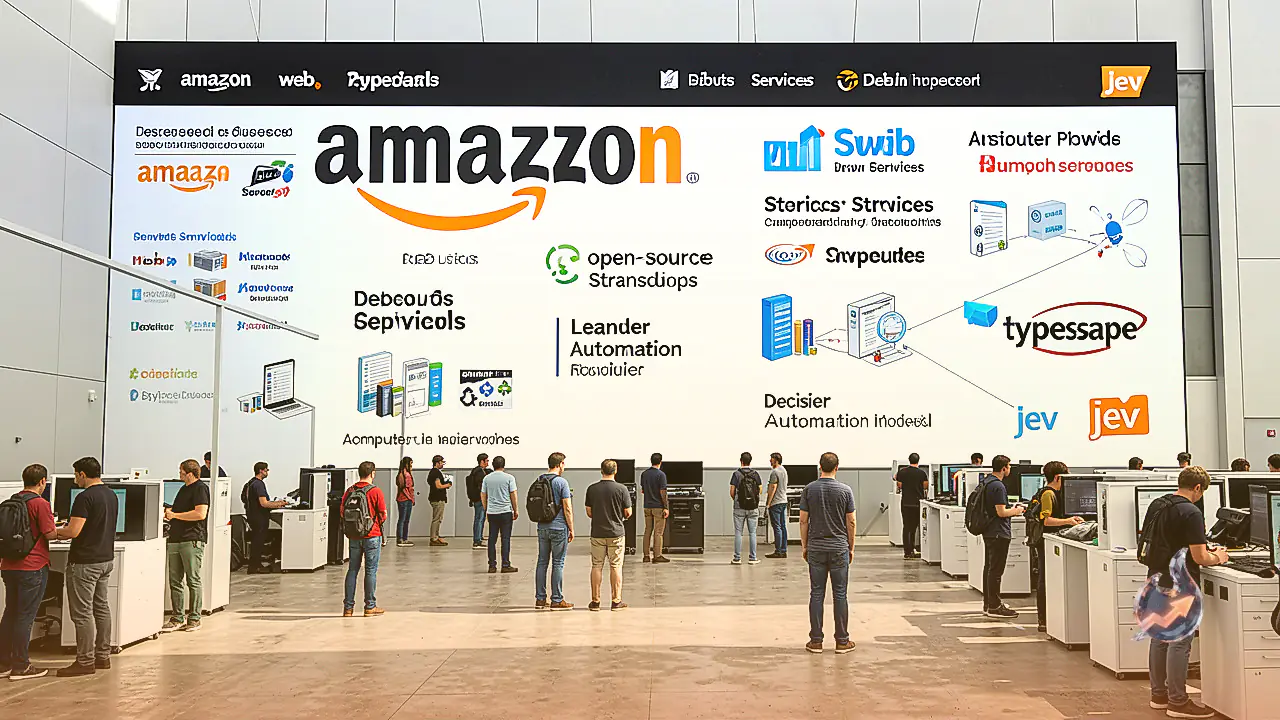

Across the software development and artificial intelligence landscape, engineers are increasingly hunting for streamlined machine intelligence tailored specifically for computer automation rather than relying solely on massive frontier language engines. Moving directly into this rapidly expanding domain, Amazon Web Services has unveiled Strands Decider 2B, an open-source decision model built to navigate complex workflow steps with high efficiency. Taking conceptual inspiration from TypeSafe's pioneering Jev architecture, the system prioritizes selecting the optimal action among predefined parameters rather than generating broad conversational text.
Amazon Enters the Fray Alongside OpenAI
The rollout of Strands Decider 2B lands during the exact same week OpenAI unveiled a comparable decision-oriented system. Amazon's offering is completely open-sourced, readily accessible to the developer community, and compact enough to execute locally on everyday hardware. Rather than producing narrative paragraphs, it focuses entirely on evaluating closed sets of predetermined choices while attaching an explicit confidence score to each recommendation it delivers.
The initiative originated as an experimental project by Marc Brooker, a distinguished engineer at Amazon. After studying the capabilities of Jev, Brooker built his own working iteration of a targeted decision engine. The prototype demonstrated remarkable performance, briefly climbing to the number one position on the Jevbench benchmark for models within its parameter category. Following that early validation, engineering teams refined the software and published it through Strands Labs, an Amazon group dedicated to engineering specialized deployment frameworks and protocols for AI agents.
Addressing the Real Demands of Agent Workflows
Brooker explained that the underlying motivation for developing Strands Decider crystallized during direct consultations with AWS enterprise clients. Many organizations discovered that coordinating multi-step agentic pipelines rarely required the vast overhead, high latency, or heavy financial expenses associated with enterprise-scale LLMs at every single operational crossroad.
Brooker observed that this class of software functions as a seamless decision-maker inside multi-tier automation loops, resolving what immediate action should follow based on the current state of an application. He noted that configuring workflows around deterministic options and verified confidence metrics provides enterprise customers with dependable reliability, reduced execution latency, and considerably smaller compute budgets.
The Jevons Paradox and Architectural Trade-Offs
From an architectural standpoint, Strands Decider utilizes the foundational torso of Qen3.5-2B. Instead of outputting freeform language, the model processes inputs to output calibrated decisions. TypeSafe originally coined the name Jev in honor of English economist William Stanley Jevons, whose classic economic paradox posits that increasing the efficiency and dropping the cost of a vital resource can counterintuitively cause aggregate consumption to surge dramatically. As intelligence becomes cheaper to run, automated workloads proliferate.
Following TypeSafe's conceptual debut, independent researchers and commercial labs produced dozens of equivalent decision engines. However, this surge raises critical questions about how developers will balance rapid execution against foundational capabilities. Brooker pointed out that optimizing a model's operational velocity without degrading its linguistic comprehension or core analytical knowledge requires navigating a very delicate technical threshold.
Frontier Labs Face Lean Competition
Brooker does not anticipate that massive frontier research labs will automatically monopolize the decision model sector. Because targeted models in smaller markets can be developed with infrastructure investments ranging from hundreds to a few thousand dollars, smaller teams can iterate rapidly without astronomical budgets.
Meanwhile, leadership at TypeSafe remains focused on refining upcoming generations of their proprietary models. Diogo Almeida, founder and chief executive officer of TypeSafe, remarked that while industry observers view the segment as an overnight rush, constructing genuinely intelligent systems remains formidable. Almeida asserted that he does not yet perceive genuine competition emerging against TypeSafe, noting that many current projects represent engineers implementing intriguing model structures rather than teams fundamentally dedicated to transforming intelligence into practical utility.