





















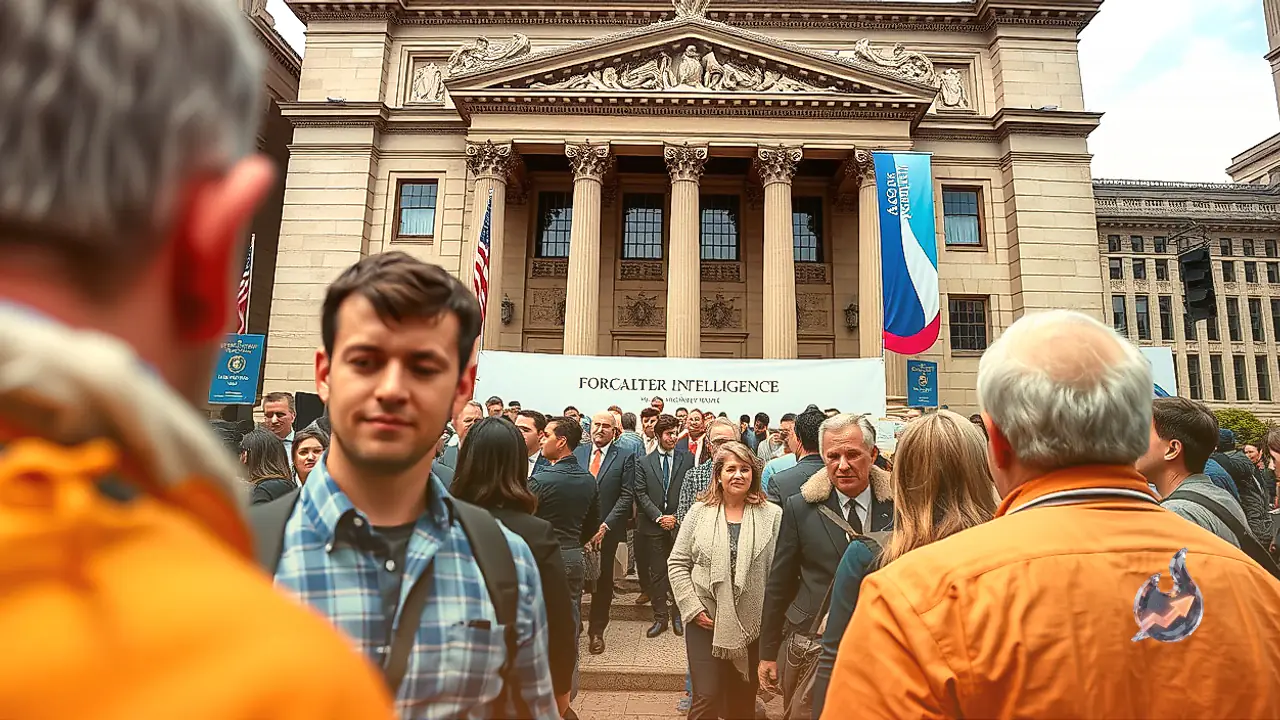

At a public gathering held at Webster Hall in Manhattan on Monday evening, New York City Mayor Zohran Mamdani and activist and actor Ilana Glazer tackled the accelerating influence of artificial intelligence on civic life. During their exchange, Mamdani urged residents to push back against the widespread perception that automation is destined to seize their livelihoods, shape their children's minds, or erode personal autonomy. He stressed that communities must reclaim authority over technological deployment rather than passively submitting to the aggressive rollouts orchestrated by private corporations.
The discussion took place at The People's AI Assembly, an event hosted by the AI Now Institute, an organization dedicated to examining the structural and social consequences of emerging technologies. The mayor argued that the rapid adoption of computational models across public life is not a predetermined reality, demanding that elected leaders enforce direct accountability on commercial developers who currently operate with minimal state supervision.
Local Restrictions Across Public Classrooms and Housing Markets
Seeking to insulate municipal institutions from unchecked digital tools, Mayor Mamdani recently instituted a formal ban on AI use throughout elementary and middle schools across the city. Glazer expressed significant apprehension about automated systems entering learning spaces, noting that the introduction of such software lacks fundamental parental consent. She observed that educational environments operated effectively without these computational mechanisms just two years ago, questioning why their integration is now framed as an immediate necessity.
In a related municipal action introduced over the summer, the mayoral administration established guidelines requiring brokers, property managers, and online housing platforms to explicitly state whether real estate photos or marketing videos are generated by algorithmic tools. The directive seeks to shield apartment seekers from deceptive practices, commonly referred to as house-phishing, where synthetic media misrepresents physical residences. Both measures reflect an administrative determination to demonstrate that technological integration is a policy choice rather than an unavoidable condition.
Military Tragedies and the Myth of Infallible Software
Addressing the broader ideological defense mounted by software developers, Mamdani challenged the narrative that algorithmic models are infallible or immune to critical evaluation. He cited the reckless deployment of automated tools that neglect real operational limitations, highlighting the catastrophic military airstrike carried out on an Iranian school in February. That military operation resulted in more than 150 civilian deaths, including at least 123 children. An internal inquiry conducted within the Pentagon indicated that overreliance on predictive artificial intelligence software for military target selection was a contributing cause of the disaster.
Mamdani argued that the tech sector's present messaging replicates the defensive rhetoric used by platforms like Facebook around 2008, where developers claimed that outside oversight was impossible because only software engineers could comprehend the code. The mayor stated that this insistence on internal oversight serves primarily to shield corporations from liability while safeguarding multi-billion dollar valuations ahead of public offerings. Commercial pressure remains intense, with Anthropic preparing for a stock market debut this year and OpenAI scheduling its initial public offering for 2027.
Federal Retreat and the Pretext of Global Geopolitical Competition
The mayor expressed sharp disappointment regarding federal policy, pointing to an abdication of national regulatory authority. Discussions in Washington, he explained, treat computer science primarily as a geopolitical weapons contest against China, pushing basic humanitarian protections to the periphery under the rationale of international competitiveness.
Earlier this month, President Donald Trump announced the creation of the Superintelligence Task Force, an initiative oriented toward corporate self-policing rather than enforceable statutory limitations. This laissez-faire approach continues despite dire cautions issued by whistleblowers formerly associated with major developers such as Anthropic, Google DeepMind, and OpenAI, who have warned that unrestricted algorithmic capabilities present an existential risk to human survival. Mamdani concluded that once the current federal posture concludes, the nation must adopt an entirely different governing framework that places human dignity and public oversight ahead of corporate expansion.