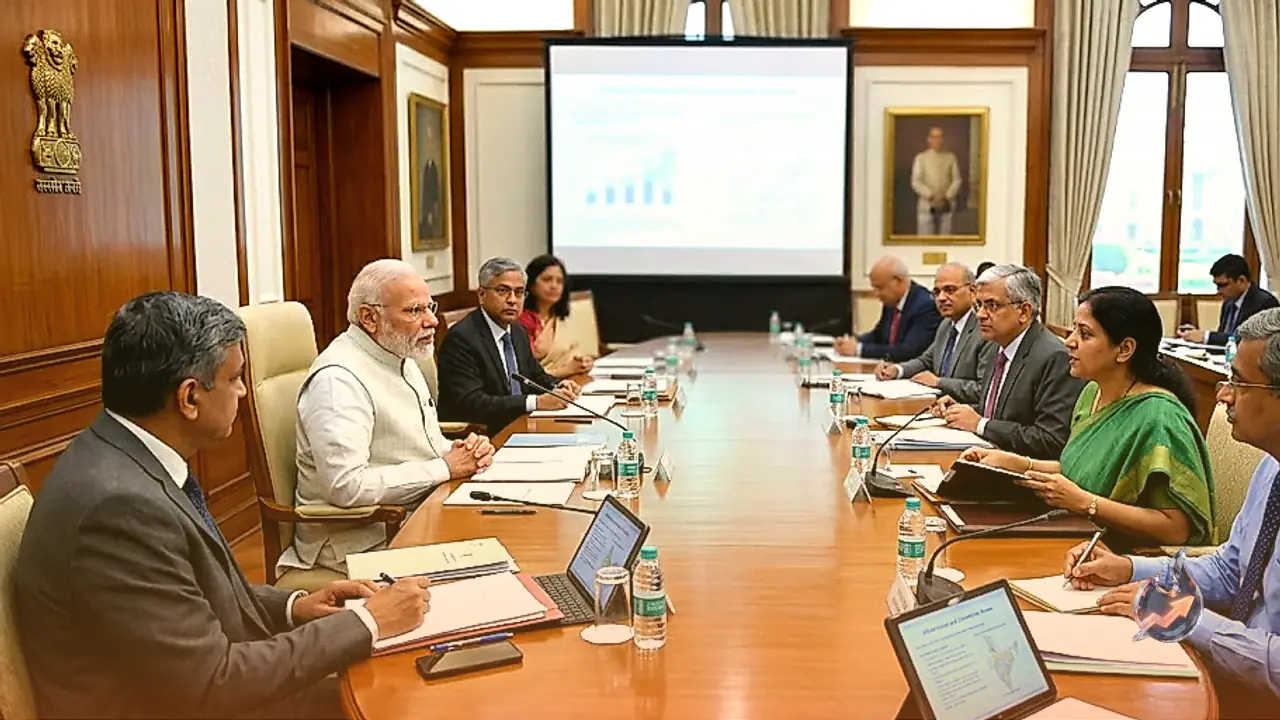


















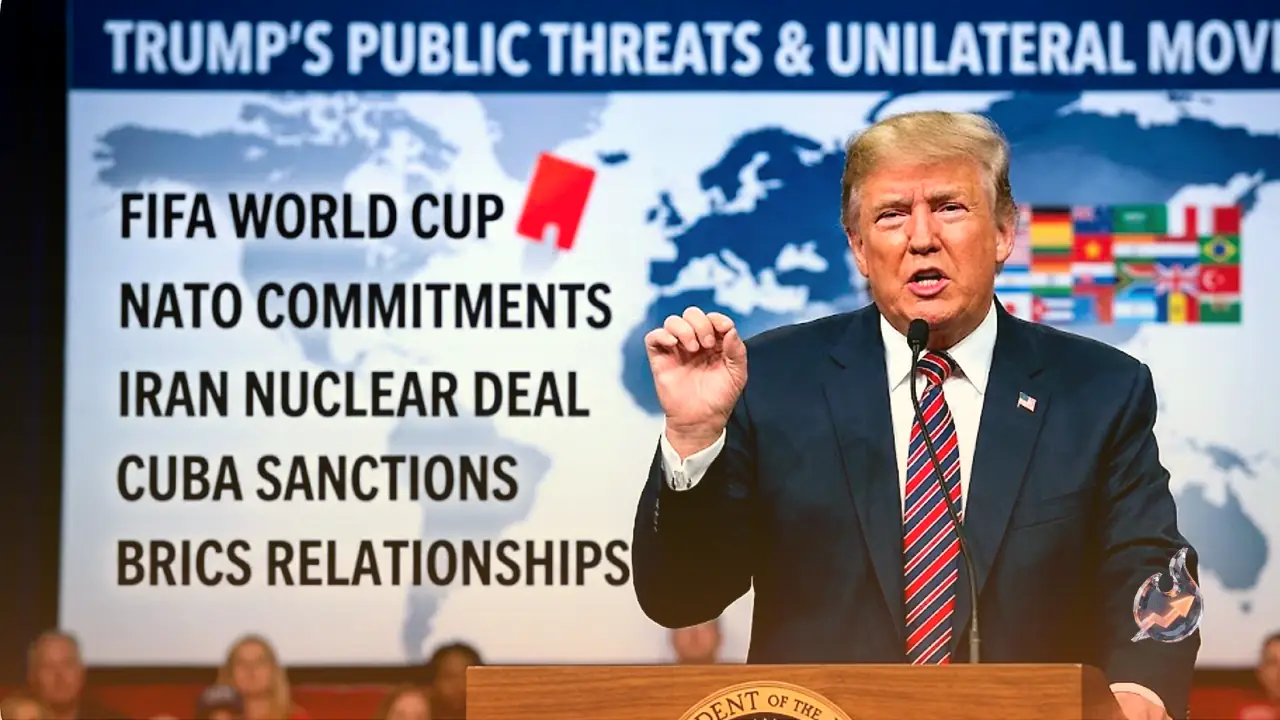

US President Donald Trump has built a reputation around one repeated tactic, pile on so much pressure early that the other side is forced onto the back foot. Despite leading the world's most powerful nation, his style frequently crosses ordinary diplomatic boundaries and tips into open pressure tactics and unilateral moves. Threatening some country, institution or leader every other day has practically become a habit for him. Having already thrown around threats over trade and war, Trump recently pushed his way into the FIFA World Cup and got his way, a move that has triggered sharp criticism across Europe. Here is where, when and whom Trump has targeted with his threats.
Stepping straight into the FIFA World Cup
The latest and most talked about example involves the FIFA World Cup. American forward Folarin Balogun was shown a red card in the 64th minute of the United States' round of 32 match, which the US won 2-0 against Bosnia and Herzegovina. Under FIFA's rules, a red card automatically rules a player out of the following match, meaning Balogun was set to sit out the game against Belgium. But FIFA's disciplinary committee suddenly reversed its own decision, clearing Balogun to keep playing through the tournament, with the suspension now set to apply only once the World Cup ends, so Balogun will only face the consequences after the tournament is over. Reports say Trump was directly behind the reversal, personally speaking with FIFA president Gianni Infantino before the ruling flipped. UEFA, European football's top governing body, has strongly objected to the intervention, arguing it raises questions about the fairness of FIFA's own disciplinary process.
"We could wipe everyone out in one shot"
During the Iran war, Trump repeatedly made provocative remarks in statements and on social media. When millions gathered in Iran for Ayatollah Khamenei's funeral, Trump said, in a controversial tone, "We could get rid of everybody in one shot if we wanted to, but then who would be left to negotiate with?" Watching Iranians weep at Khamenei's funeral left Trump surprised, he said he had thought people "hated" Khamenei, which is why the crowds and the tears caught him off guard. He then remarked sarcastically, "Maybe those are fake tears."
"Tonight, a civilization is going to die"
During the Iran war, Trump had announced plans to flatten the country's entire infrastructure. He also set a clear ceasefire deadline for Iran, warning that if Iran did not comply, it would be destroyed. Around the same time, Trump posted on his social media account that a civilization was going to die that night. He wrote, "Tonight, an entire civilization will die, one that can never be brought back. I don't want this to happen, but it probably will. God protect the great people of Iran!" The post came at a moment when fears of a direct clash between Iran and the United States were at their peak.
A warning to NATO, and "remember Greenland"
Trump also had no kind words for America's NATO allies. During the Iran war, he said bluntly, "NATO wasn't there for us when we needed them, and if we need them again, they won't be there then either." He followed that with a pointed warning, "Remember Greenland!" He has previously told European nations that if they don't spend 2 percent of their GDP on defence, the US will not defend them. He also made clear that in such a case, he would give Russia a free hand to do "whatever it wants" with them, offering Europe no real security guarantee.
An ultimatum for Cuba
Trump has also threatened Cuba, telling it in no uncertain terms to reach a deal soon. In a post on his social media platform, Truth Social, he announced that Cuba will no longer receive any oil or money. He wrote that Cuba had long relied on Venezuela's oil and financial support, but that the situation has now completely changed. Trump issued a direct warning to Cuban leaders that now is the time to make a deal, before it's too late.
Tariffs slam BRICS and India
As soon as he returned to power for a second term, Trump shook up the trade landscape as well. He issued an open threat to BRICS nations, warning that if member countries adopt any policy against the United States, they should be ready to face the consequences. Along with that, Trump slapped heavy tariffs on a total of 11 countries, including India and China. On India specifically, he said the country has traditionally been among the world's highest tariff-imposing nations and that doing business there is extremely difficult. He also announced tariffs on Mexico and Canada, adding fresh strain to trade relationships across North America.
Calling Kim Jong Un "Little Rocket Man"
The standoff between Trump and North Korean dictator Kim Jong Un is also recorded in history. It dates back to 2017, during Trump's first term. He issued what was called history's biggest warning to North Korea, saying that if it tried to threaten the United States, it would face "fire and fury" like the world had never seen. He also publicly called Kim Jong Un "Little Rocket Man" from public platforms, a jab that further fanned tensions between the two countries at the time.
H-1B visa fee struck down by a US court
Trump's unilateral streak has extended to the domestic front too. His decision on H-1B visas drew heavy criticism. He had proposed a hefty $100,000 (about ₹85 lakh) fee on new H-1B visa applications. A US federal court completely struck down that decision, calling it fully unconstitutional and an "illegal tax." That ruling put a brake on this particular unilateral move, offering relief to both foreign professionals and the companies that employ them.
Birthright citizenship upheld by the Supreme Court
Trump also acted unilaterally on birthright citizenship, but the US Supreme Court upheld the broad principle that citizenship is granted based on birth. The court rejected Trump's executive order, which had stated that children of people living in the US illegally or temporarily would not receive American citizenship, that is, would not get birthright citizenship. The judges ruled that anyone born in the country, barring a few limited exceptions, is a citizen of the country, meaning Trump's executive order never actually took effect.
Threat to bar people from "third world" countries
In November 2025, a shooting near the White House targeted two National Guard soldiers, killing one and critically injuring the other. The attack was carried out by an Afghan national. Following the incident, Trump announced that he would not allow people from third world countries to enter the United States, meaning his immigration stance hardened further after that single attack.