

















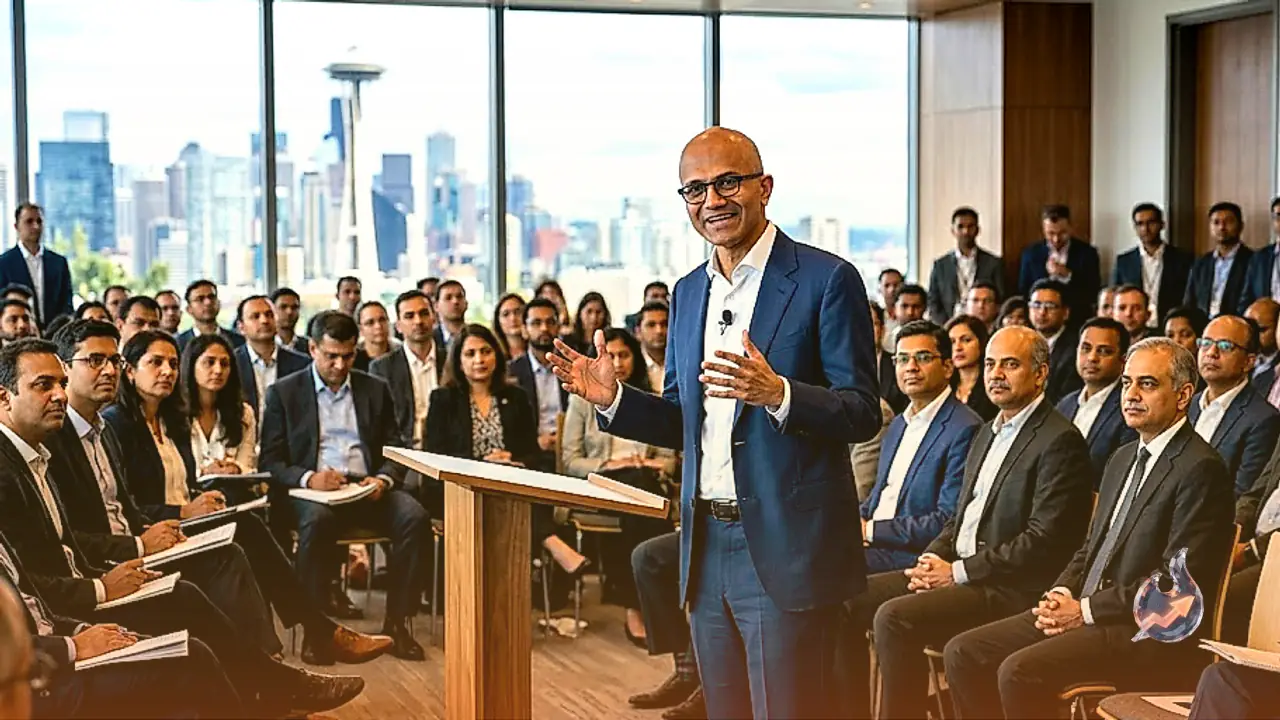

A high-level gathering of more than 40 premier technology executives from India and the United States converged in Seattle under the auspices of the IDEAS4INDIA platform. Organized by the Embassy of India in the United States, the Indian American Tech CEO Forum followed closely on the heels of the India AI Impact Summit 2026. The principal objective behind this assembly was to harness the deep expertise and institutional insights accumulated by the vibrant Indian-American tech community across the Greater Seattle ecosystem. The forum featured enterprise leaders steering groundbreaking developments in artificial intelligence, quantum computing, semiconductor engineering, cloud infrastructure, aerospace operations, and sophisticated enterprise software systems.
Satya Nadella Advocates for Broad-Based Artificial Intelligence Adoption
Microsoft Chairman and CEO Satya Nadella joined the forum as a distinguished guest, reflecting on his longstanding personal and professional association with the local technology landscape. He observed that he has witnessed the steady evolution and expansion of the Seattle technology ecosystem over approximately 35 years with immense pride. Nadella expressed deep satisfaction at the increasingly interconnected relationship being forged between this Pacific Northwest innovation hub and India.
Focusing on the trajectory of artificial intelligence, Satya Nadella characterized AI as a versatile general-purpose technology capable of touching multiple sectors. He explained that the ultimate efficacy and value of artificial intelligence will depend entirely on how broadly and democratically it is deployed across varied geographies, diverse social communities, and distinct industry verticals. In his view, real technological breakthroughs demonstrate their true worth only when their benefits filter down to every layer of global society.
Ambassador Vinay Kwatra Details Principles Guiding India's Tech Mission
India's Ambassador to the United States, Vinay Kwatra, participated extensively in the proceedings and delivered an address to the assembled technology leaders. He welcomed the evident collective intent to deepen technology linkages between the two nations. The ambassador underscored that the Government of India remains steadfast in its dedication to collaborating closely with commercial partners, researchers, and global stakeholders.
Vinay Kwatra pointed out that the strategic foundation of the India AI Mission is deliberately anchored in core values. These foundational pillars comprise inclusivity, absolute openness, technological sovereignty, universal accessibility, comprehensive digital security, and enduring trust. By prioritizing these elements, the policy framework aims to ensure that emerging technological frameworks remain dependable, transparent, and aligned with public welfare.
Honoring Tech Pioneers and Celebrating Key Innovators
The proceedings commenced with solemnity as attendees observed a minute of silence to pay tribute to two prominent Indian-American corporate leaders from the Seattle tech sphere who recently passed away. The assembly remembered Samir Bodas, co-founder and Chief Executive Officer of Icertis, alongside S. Somasegar, Managing Director at Madrona Venture Group and former corporate vice president at Microsoft. Forum participants lauded their decades of mentorship, their role in scaling Seattle into a premier tech destination, and their generous backing of Indian-origin startup founders.
Padma Shri recipient Ajay Bhatt was also an active participant in the forum's strategic sessions. Renowned as the inventor of the ubiquitous USB-C standard, Bhatt previously had a distinguished tenure with Intel. His presence served as an inspiring reminder of the generational contributions made by Indian engineers to hardware architecture and everyday computing across the globe.
Multibillion-Dollar Capital Commitments Reshape Digital Capabilities
Discussions throughout the forum brought into sharp relief the truly reciprocal nature of the India-US technological corridor. An overwhelming majority of the enterprises represented maintain substantial research divisions, engineering centers, and commercial hubs spread across India. Concrete financial allocations underscored this mutual reliance and long-term commitment.
Microsoft announced a major investment program amounting to $17.5 billion across India spanning the four-year window from 2026 through 2029. This represents the enterprise's largest capital allocation within Asia to date. The targeted capital injection will be directed toward constructing cutting-edge cloud facilities, scaling specialized AI hardware infrastructure, running nationwide skilling curricula, and expanding overall regional operations.
In parallel, Amazon confirmed an extensive investment package totaling $48 billion scheduled between 2026 and 2030. A primary component of this deployment involves significantly enlarging the footprint and capacity of AWS data center clusters situated in Mumbai and Hyderabad. Complementing these enterprise software allocations, retail powerhouse Costco is actively launching its first Global Capability Center in Hyderabad, which will generate specialized high-value technical roles within the domestic market.
Strategic Alignment Through the Bilateral TRUST Framework
The Seattle assembly represented the inaugural congregation of this scale for Indian-American technology leadership in the region. Observers anticipate that the IDEAS4INDIA platform will establish itself as an indispensable continuous vehicle for expanding cross-border technological cooperation in the coming years.
Furthermore, the initiative is positioned to catalyze tangible milestones under the bilateral TRUST mechanism, which stands for Transforming the Relationship Utilizing Strategic Technology. Through this joint program, both democracies are systematically linking their domestic innovation ecosystems. The collaborative framework spans mission-critical domains, including artificial intelligence, quantum systems, semiconductor fabrication, space exploration, next-generation telecommunications, and biotechnology, ensuring strategic technological autonomy and shared competitive resilience.