



















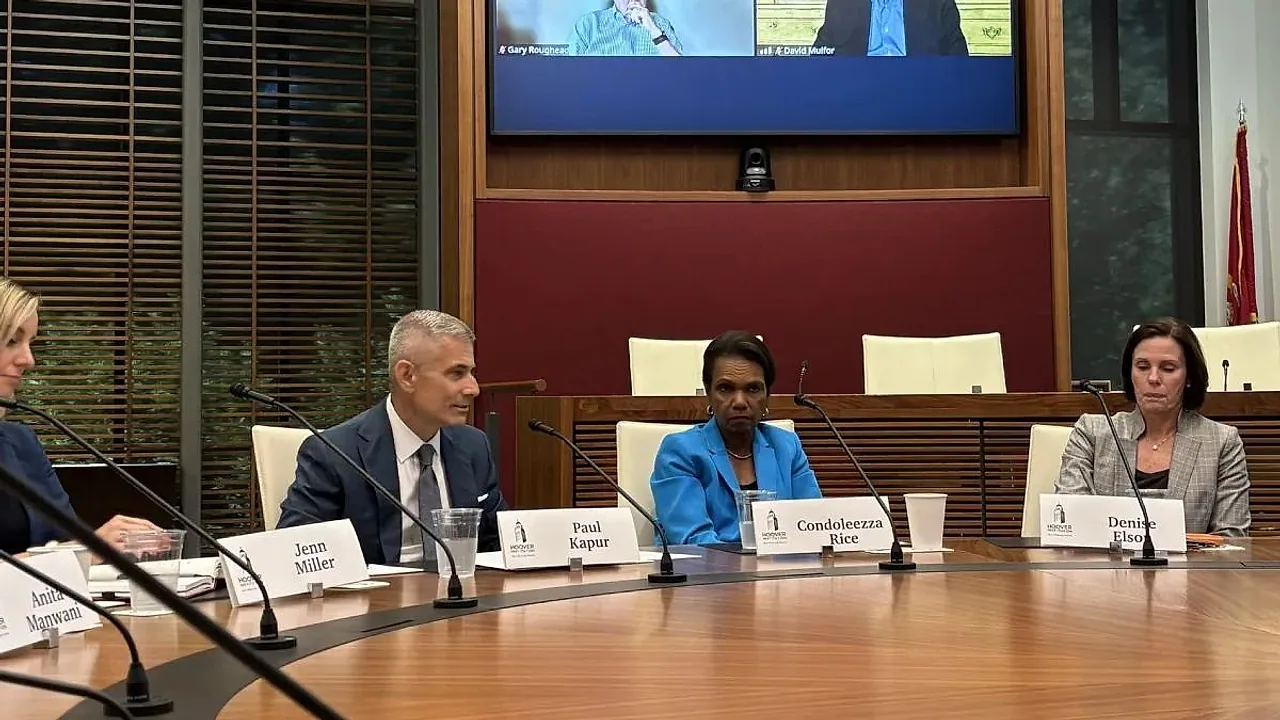

The bilateral relationship between India and the United States is witnessing a substantial expansion across several high-stakes domains, including defense capabilities, civil nuclear energy, and trusted artificial intelligence. During a recent roundtable discussion centered on India held at the Hoover Institution, senior American diplomatic officials highlighted the strategic imperative of accelerating mutual engagement. The event brought together prominent foreign policy figures, including Assistant Secretary of State S. Paul Kapur, former Secretary of State Condoleezza Rice, and former United States Ambassador to India David C. Mulford, to evaluate the trajectory of trade and security ties between both nations.
Expanding Civil Nuclear Cooperation and Technology Sharing
Deliberations at the summit emphasized how closer economic and technological alignment under the Trump administration is yielding concrete economic outcomes. In a message sharing details on X, Assistant Secretary S. Paul Kapur noted that American engagement with India is actively generating employment opportunities within the United States while fortifying supply chains that are vital for both the domestic economy and the broader Indo-Pacific region. Strategic efforts are currently focused on scaling up joint initiatives in civil nuclear energy alongside the integration of trusted artificial intelligence and other emerging technologies aimed at driving long-term economic growth.
American commercial nuclear entities have expressed growing interest in establishing a deeper footprint within India's expanding energy market. Earlier this year, a high-level delegation composed of top executives from the United States nuclear power industry undertook a comprehensive visit to India. Their primary goal was to explore potential avenues for private-sector partnership and investment. This commercial push follows landmark regulatory shifts in New Delhi, where authorities eased civil nuclear liability provisions through the enactment of the SHANTI law, creating a more favorable environment for foreign enterprise participation.
Comprehensive Defense Framework and Historical Military Procurement
Defense cooperation remains a cornerstone of the expanding partnership. Last year, India and the United States formalized a comprehensive defense framework designed to elevate operational synergy across multiple warfare domains, including land, sea, air, space, and cyberspace. This agreement seeks to streamline joint capabilities and enhance seamless interoperability between the armed forces of both countries.
The institutional backing for this military relationship builds upon two decades of extensive hardware acquisition. Since 2002, India has procured a wide spectrum of advanced defense assets from American manufacturers to modernize its defense apparatus. Key acquisitions include Apache attack helicopters, heavy-lift Chinook helicopters, C-17 Globemaster III strategic airlift aircraft, and C-130J Super Hercules tactical transport planes. Furthermore, the Indian military has integrated P-8I long-range maritime patrol aircraft for ocean surveillance and deployed M777 ultra-light howitzers for high-altitude artillery operations.
Trade Tariff Adjustments and Foreign Trade Policy Alignment
Parallel to expanding strategic cooperation, trade dynamics have also seen significant policy adjustments. On July 24, United States President Donald Trump announced the imposition of a 10 percent import tariff targeting goods from India alongside 16 other countries. The administrative action was framed as part of a broader global initiative against products manufactured using forced labor practices.
Initial regulatory proposals had slated India for a higher levy rate of 12.5 percent. However, officials in Washington subsequently lowered the applied tariff to 10 percent after evaluating structural revisions introduced in New Delhi's updated foreign trade policy. The revised Indian regulations incorporated an explicit statutory prohibition against the importation and trade of goods produced through forced or compulsory labor, demonstrating regulatory compliance that led to the tariff reduction.