























In contemporary warfare, conflicts do not always begin with the launch of traditional missiles. To cripple an adversary nation's armed forces, targeting their orbiting satellite network can prove entirely sufficient. This reality stems from the fact that modern militaries rely heavily on space-based infrastructure for nearly every critical operation. Consequently, future military engagements will extend far beyond terrestrial battlefields into the vast expanse of outer space.
A striking demonstration of this evolving dynamic occurred in September 2025, capturing global attention. Space forces from the United States and the United Kingdom conducted a joint operation in orbit, bringing their spacecraft into extremely close proximity to China's Shiyan 12-01 satellite. The distance between the spacecraft was narrow enough to signal something far more serious than a routine surveillance mission. The underlying message was unmistakable: outer space is no longer solely a domain for scientific exploration, but an active testing ground for national military power.
From global positioning systems to secure military communications, and from tactical reconnaissance to guiding precision missiles toward their targets, satellites operate continuously. If these orbiting eyes were blinded, their connectivity severed, or fed deceptive information, ground-based military units would face catastrophic vulnerabilities. This critical dependency explains why competition between the United States and China for dominance in space is accelerating at a rapid pace.
American scrutiny of Chinese space capabilities
Defense officials in the United States harbor growing concerns that China is rapidly developing advanced technologies and weaponry designed to undermine American satellite networks during the opening moments of a conflict. These potential capabilities include electronic jamming systems, high-energy lasers, and robotic spacecraft capable of grappling or disabling other satellites.
China possesses the capability to neutralize a satellite without resorting to physical destruction by jamming its communications, thereby severely degrading its reconnaissance effectiveness. The most perilous scenario involves an unannounced Chinese satellite quietly shadowing an American spacecraft in orbit.
While Beijing consistently denies these allegations, maintaining that its space initiatives serve strictly peaceful scientific and civilian purposes, China frequently accuses the United States of militarizing the space domain. Nevertheless, public records concerning Chinese military patents and defense acquisitions suggest a different reality.
These official documents reveal active development in technologies that enable satellites to actively track designated targets and coordinate multiple spacecraft simultaneously. This implies that future warfare in orbit will not rely solely on long-range missile strikes, but could involve spacecraft maneuvering within touching distance of one another to initiate interference or disruption.
The advent of orbital warfare
Defense experts define this emerging form of conflict as orbital warfare, which essentially involves the tactical use of spacecraft against other orbiting assets. This domain encompasses pursuits, close approaches, operational disruptions, orbital alterations, and potential captures. In this celestial arena, holding a numerical advantage in satellites will no longer suffice; the agility and speed of those assets will dictate survival.
Traditional legacy satellites were deployed into fixed orbits where they performed static duties throughout their lifespans. Future military satellites, however, will exhibit a much higher degree of active maneuverability. They will possess the capacity to alter their trajectories, pursue adversary assets, approach targets dynamically, and in some cases, make autonomous decisions based on immediate situational awareness.
This operational agility makes them exceptionally potent, as ground commanders will not need to issue manual commands for every tactical maneuver; instead, the satellites themselves will close in on their objectives autonomously.
Beyond satellites: the entire military network at stake
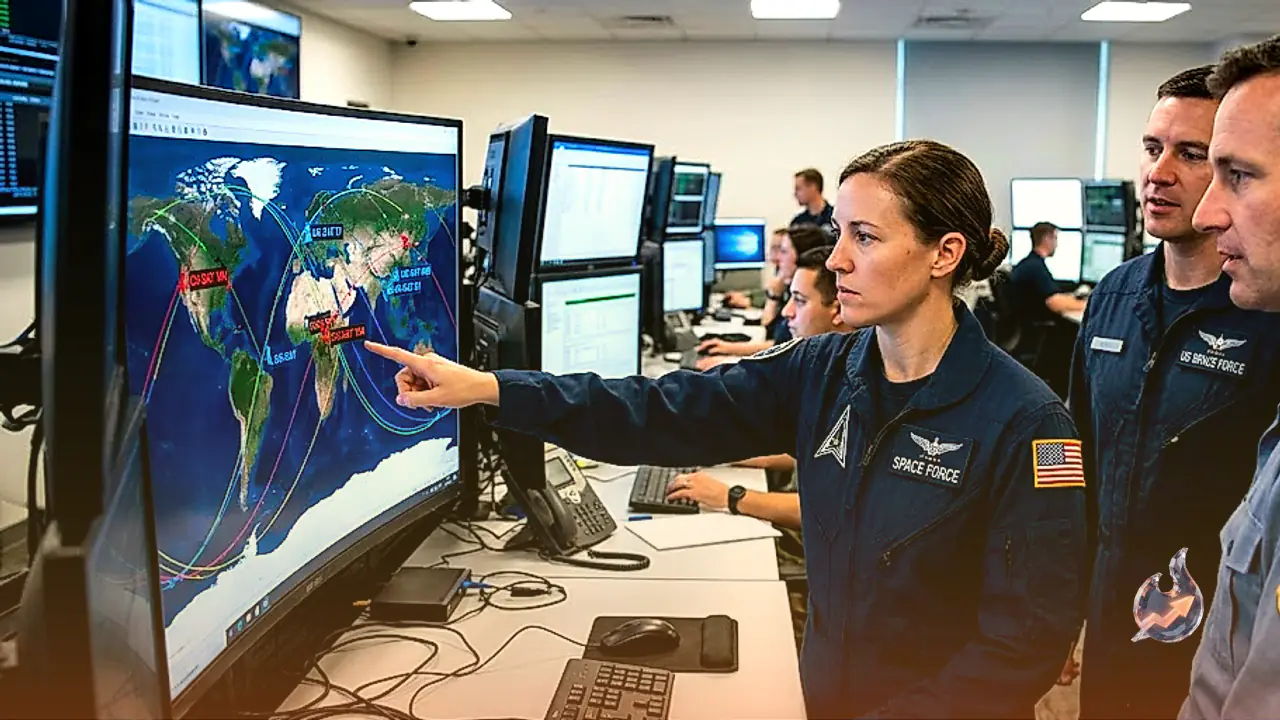
In modern military strategy, satellites do not function in isolation; they form the absolute backbone of the entire defense architecture. Reconnaissance satellites capture vital imagery, communication relays transmit secure data, navigation units provide exact coordinates, and intelligence platforms monitor adversarial movements around the clock.
Interconnecting these disparate assets creates a comprehensive military network that powers artificial intelligence-based defense systems. If this overarching network collapses, advanced AI processing units will lack accurate, real-time data, forcing them to rely on outdated metrics. Consequently, the ultimate weapon in future conflicts may not be a kinetic missile, but accurate information itself, the key to which resides in orbiting satellites.
Potential flashpoints like Taiwan illustrate these stakes vividly. Assuming a conflict were to erupt between the United States and China over Taiwan, China's inventory of over one thousand satellites, heavily weighted toward reconnaissance and intelligence gathering, would play a central role. Washington would similarly rely on its satellite architecture to track Chinese naval deployments, warship movements, mobile missile launchers, and troop concentrations. Because these tactical insights originate from space, an invisible orbital conflict could erupt long before the first physical shot is fired on the ground.
Determining victory in future conflicts
Ultimately, victory in upcoming orbital conflicts may not belong to the nation possessing the greatest number of satellites, but rather to the power capable of replacing damaged assets most rapidly and disabling adversary networks with superior speed. The next frontier of warfare will transcend conventional weaponry, turning instead into an intense contest of velocity, intelligence, technology, and strategic adaptability.