






















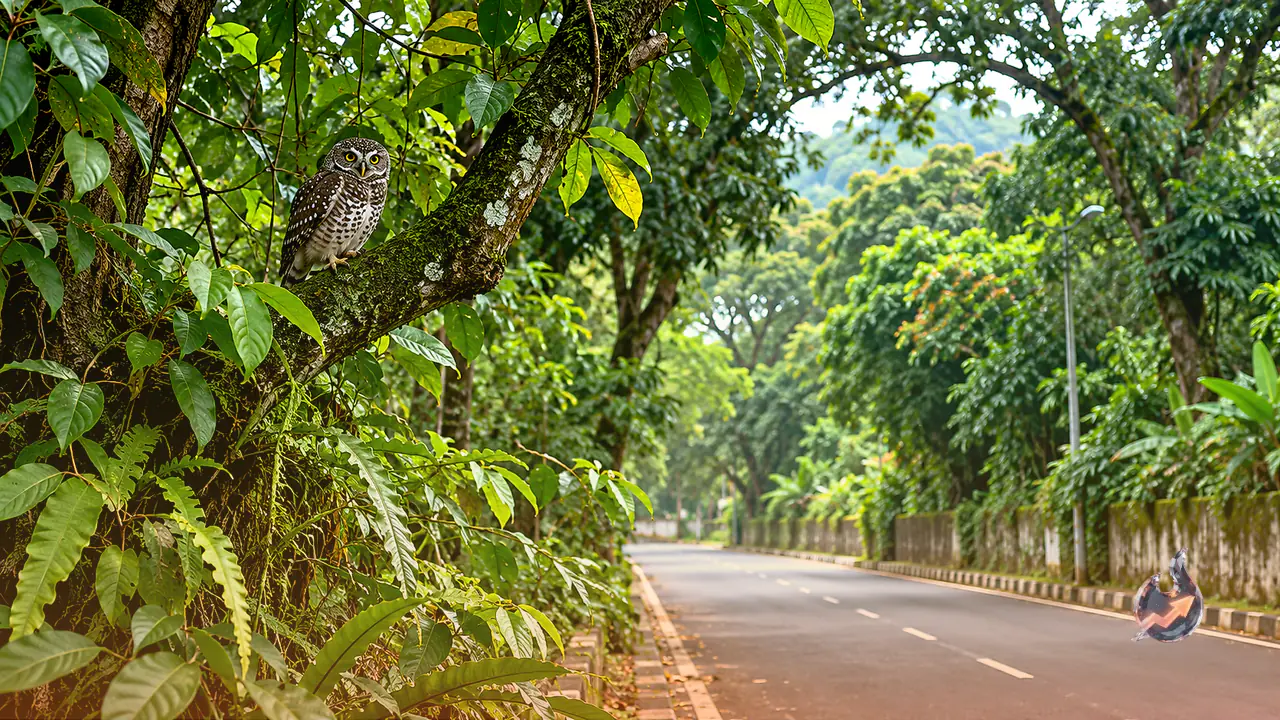

A recent scientific assessment across the expanding cityscape of Guwahati has unveiled a remarkably resilient population of nocturnal raptors. Conducted between November 2023 and July 2025, the field study tracked owl activity across 33 designated one-square-kilometre spatial grids, confirming their presence in 24 of those sectors. The detailed findings, documenting eight distinct species surviving alongside urban human settlements, have been officially published in the scientific journal Urban Ecosystems.
Traffic Sounds Masking Natural Bird Calls
The research brought to light a significant complication in studying urban wildlife: widespread acoustic interference from city streets. Heavy vehicular movements generate sustained background noise that frequently muffles the mating and territorial vocalizations of nocturnal birds. Because these auditory signals get drowned out by road traffic, field researchers cautioned that failing to register a call in a specific sector does not reliably prove the creatures have abandoned the zone. Consequently, standard biodiversity monitoring protocols must be modified to account for detection discrepancies induced by urban noise.
Dominant Raptors and Recorded Varieties
Among the documented raptors, the Barn Owl and the Spotted Owlet emerged as the two most pervasive varieties residing throughout the city limits. Field investigators also recorded six additional species: the Brown Hawk Owl, the Brown Fish Owl, the Collared Scops Owl, the Mountain Scops Owl, the Oriental Scops Owl, and the Asian Barred Owlet. These predatory birds serve an indispensable function within local ecosystems by acting as an organic check on urban rodent populations, helping keep pest numbers under control without artificial extermination methods.
State Leadership Highlights Ecological Value
Assam Forest and Climate Change Minister Jayanta Malla Baruah presented the investigation outcomes on Wednesday, underscoring how urban sprawls quietly sustain diverse animal populations hidden from the public eye. Writing about the ecological findings on social media platform X, the minister remarked that conserving existing habitats delivers mutual advantages to both urban residents and local wildlife. He noted that protecting these living spaces creates a healthier environment across densely settled municipal sectors.
Balancing Metropolitan Growth with Habitat Preservation
As construction and municipal growth accelerate across Guwahati, urban planners face mounting pressure to safeguard the remaining ecological corridors. Conservation specialists emphasize that retaining mature canopy trees, wetland networks, and pockets of native vegetation is vital to prevent habitat fragmentation. Addressing excessive sound levels within city zoning guidelines and establishing systematic long-term surveillance programmes will be essential to ensure that indigenous birds continue to survive alongside ongoing modernization.