






















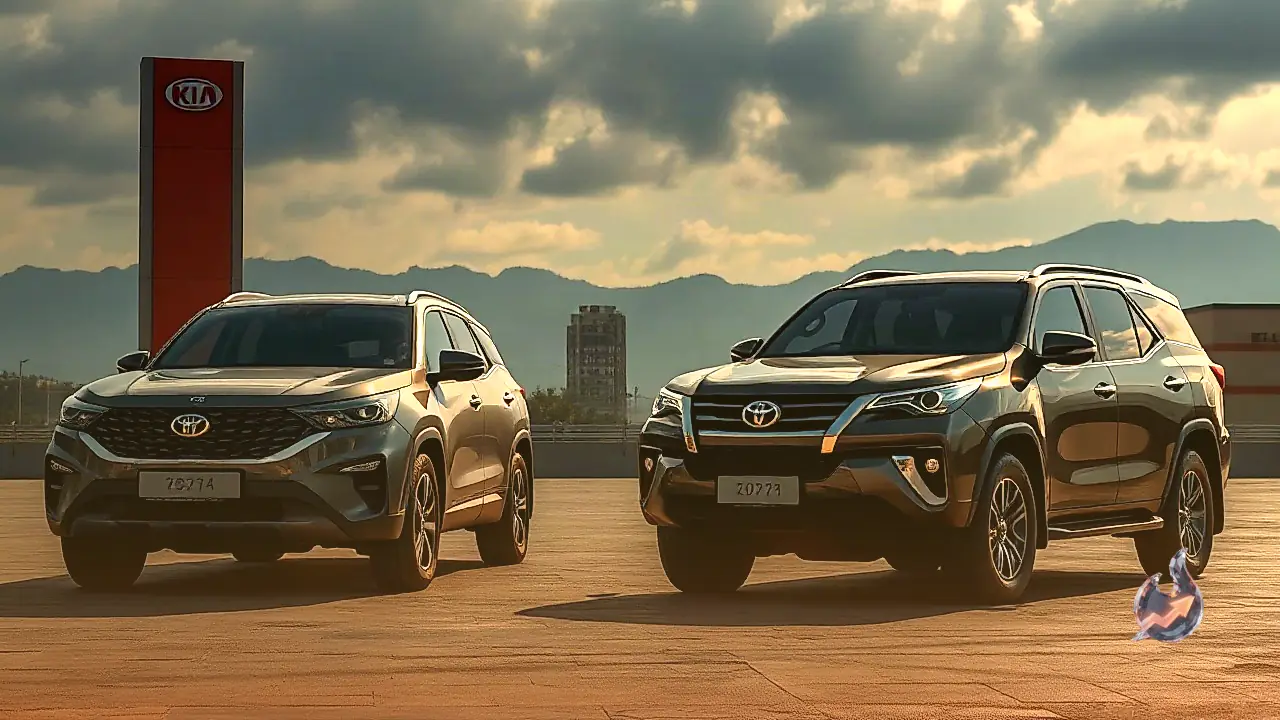

The premium 7-seater SUV landscape in India, long dominated by the Toyota Fortuner, faces fresh competition with the arrival of the Kia Sorento. Designed to target buyers seeking modern cabin technology, superior ride comfort, and electrified powertrains, the Sorento presents a stark contrast to the Fortuner's rugged, body-on-frame build. While the Fortuner has built a formidable reputation around heavy-duty off-roading capability and strong resale value, the Sorento brings a contemporary feature-packed approach to the segment, available in both 6-seater and 7-seater configurations.
Price Comparison: Value vs Dominance
Pricing plays a central role in this comparison. The Kia Sorento enters the market with a diesel base price starting at Rs 27.99 lakh (ex-showroom), while its strong hybrid variant opens at Rs 29.49 lakh, scaling up to Rs 40.39 lakh for the top-tier trim. In contrast, the Toyota Fortuner starts higher, with its petrol base model priced around Rs 34.76 lakh, stretching up to Rs 50.46 lakh for the flagship 4×4 GR-S model. The Sorento offers a notable cost advantage, delivering advanced tech features at a lower entry price point.
Dimensions and Exterior Styling
In terms of proportions and road stance, both vehicles project distinct personalities. The Sorento measures 4,815 mm in length, 1,900 mm in width, and sits on a 2,815 mm wheelbase, making it longer and wider than the Fortuner, which comes in at 4,795 mm long, 1,855 mm wide, and has a 2,745 mm wheelbase. However, the Fortuner holds a height advantage at approximately 1,835 mm, giving it a taller, more traditional SUV commanding stance. Visually, the Sorento sports Kia's signature tiger-nose grille, vertical LED DRLs, ice-cube LED headlights, and 19-inch alloy wheels for an urban, sophisticated look. The Fortuner maintains its muscular, boxy aesthetic built for tough terrain.
Cabin Features and Passenger Comfort
Stepping inside reveals a generation gap in cabin philosophy. The Kia Sorento features a modern dual 12.3-inch curved display setup housing the infotainment system and digital instrument cluster. It includes a 12-speaker Bose audio system, a panoramic sunroof, a powered tailgate, a digital IRVM, and an AI voice assistant. Comfort highlights include ventilated seats for both the front and second rows, with the 6-seater layout offering plush captain seats. The extended wheelbase also translates to improved third-row legroom.
The Toyota Fortuner takes a more functional approach to interior design. It features an 8-inch touchscreen infotainment unit, a basic instrument cluster, and front ventilated seats on higher trims. While its second-row seats slide and recline, they lack ventilation. The Fortuner provides durable materials and good overall utility, but lags behind the Sorento in terms of luxury aesthetics and connected vehicle technology.
Safety Suite and Technology
Safety equipment strongly favors the Sorento. Kia has equipped the SUV with 10 airbags, TPMS, multi-collision braking, a 360-degree camera system, and Level 2+ ADAS capability. The ADAS suite encompasses around 29 to 30 features, including adaptive cruise control, lane keep assist, blind-spot monitoring, autonomous emergency braking, and rear cross-traffic alert. Tech additions like digital key functionality, wireless charging, remote parking assist, and multiple drive/terrain modes (Snow, Sand, Mud) enhance daily convenience.
The Fortuner comes equipped with standard safety gear including 7 airbags, Vehicle Stability Control (VSC), hill-start assist, and traction control. However, it lacks advanced driver assistance systems (ADAS) and high-end tech features found on the Sorento.
Engine Performance and Capability
Under the hood, the two SUVs serve different driving demands. The Kia Sorento offers two powertrain choices: a 2.2-litre diesel engine delivering approximately 190-193 PS and 442 Nm of torque paired with an 8-speed DCT, and a 1.6-litre turbo petrol strong hybrid combining a 180 PS petrol engine with a 65 PS electric motor mated to a 6-speed AT. Both engines offer FWD and AWD options with terrain modes, though without a dedicated low-range transfer case.
The Toyota Fortuner relies on larger displacement engines: a 2.7-litre petrol engine generating roughly 164-166 PS and 245 Nm, and a heavy-duty 2.8-litre diesel motor producing between 201-204 PS and up to 500 Nm of torque. Available with manual and automatic transmissions in 4×2 and 4×4 setups, the Fortuner diesel 4×4 features a mechanical low-range transfer case and locking differential, making it superior for extreme off-road environments. While the Fortuner dominates in raw diesel torque, the Sorento hybrid offers smoother performance and superior fuel economy in urban driving.
Verdict: Which SUV Should You Pick?
Choosing between these two SUVs comes down to usage requirements. If you seek a feature-loaded family SUV with modern electronics, smooth hybrid efficiency, advanced ADAS safety, and better price-to-value positioning, the Kia Sorento stands out as a compelling choice. If your priority lies in extreme off-road durability, heavy towing, long-term reliability, and high resale value, the Toyota Fortuner remains the established leader in the segment.