




















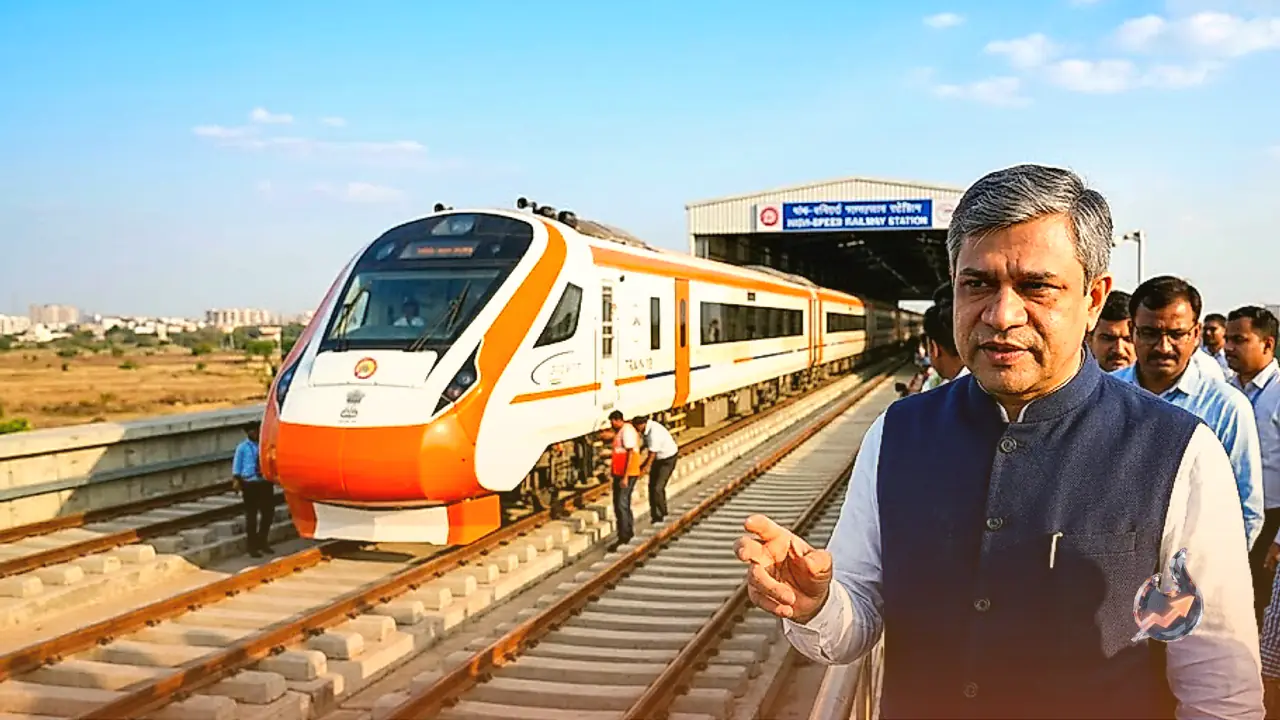

India's ambitious high-speed rail initiative has reached a major milestone with trials for the country's first indigenous bullet train scheduled to begin by May or June 2027. Speaking at the 'Namo for Viksit Bharat' program in Vadodara on Tuesday, Union Railways Minister Ashwini Vaishnaw outlined the detailed roadmap for track testing and the subsequent launch of commercial passenger services. He emphasized that the overarching focus of the government remains firmly anchored in the 'Aatmanirbhar Bharat' vision, aiming to establish domestic expertise in cutting-edge rail engineering and high-speed transit technology.
Comprehensive Testing Process and Service Launch Timeline
The development process has reached a critical structural phase. According to the Railways Minister, the train's initial body frame was recently manufactured and has been dispatched for rigorous 'squeeze testing.' Following the completion of this essential structural evaluation and several other mandatory technical checks, the train set will be placed on the physical track to assess its performance under diverse operational conditions. Consequently, the year 2027 is slated to be a pivotal benchmark for India's high-speed railway infrastructure development.
Addressing the timeline for public accessibility, the minister clarified that track testing and trial runs will extend for approximately two to four months once initiated. Upon successful completion of these trial parameters, the bullet train service is planned to be officially inaugurated by the Prime Minister. If the trial phase commences as scheduled in May or June 2027 and achieves all technical certifications within the projected timeframe, passenger operations will commence shortly thereafter.
Significant Reduction in Travel Duration Across Major Hubs
The commencement of the bullet train operation is expected to transform regional connectivity between key financial and industrial hubs in Gujarat and Maharashtra. Railways Minister Ashwini Vaishnaw highlighted that the transit time between Vadodara and Mumbai will be drastically cut to around 1.5 hours. Currently, traveling between these two cities requires a substantial amount of time, posing challenges for daily commuters, corporate professionals, and business travelers. The dramatic compression of travel duration will facilitate seamless daily mobility and foster stronger economic integration across the corridor.
Surat-Vapi Section Progress and Domestic Tech Capabilities
Providing an update on ongoing construction activities, the minister stated that civil and structural work on the Surat-Vapi section is targeted for completion by December 2026. Concurrently, construction across other segments of the high-speed corridor is progressing at a rapid pace. He stressed that the initiative extends far beyond deploying a fast train; it represents a decisive step toward establishing robust domestic manufacturing capabilities, advanced rail technological know-how, and self-reliance in executing high-speed rail infrastructure within India.