



















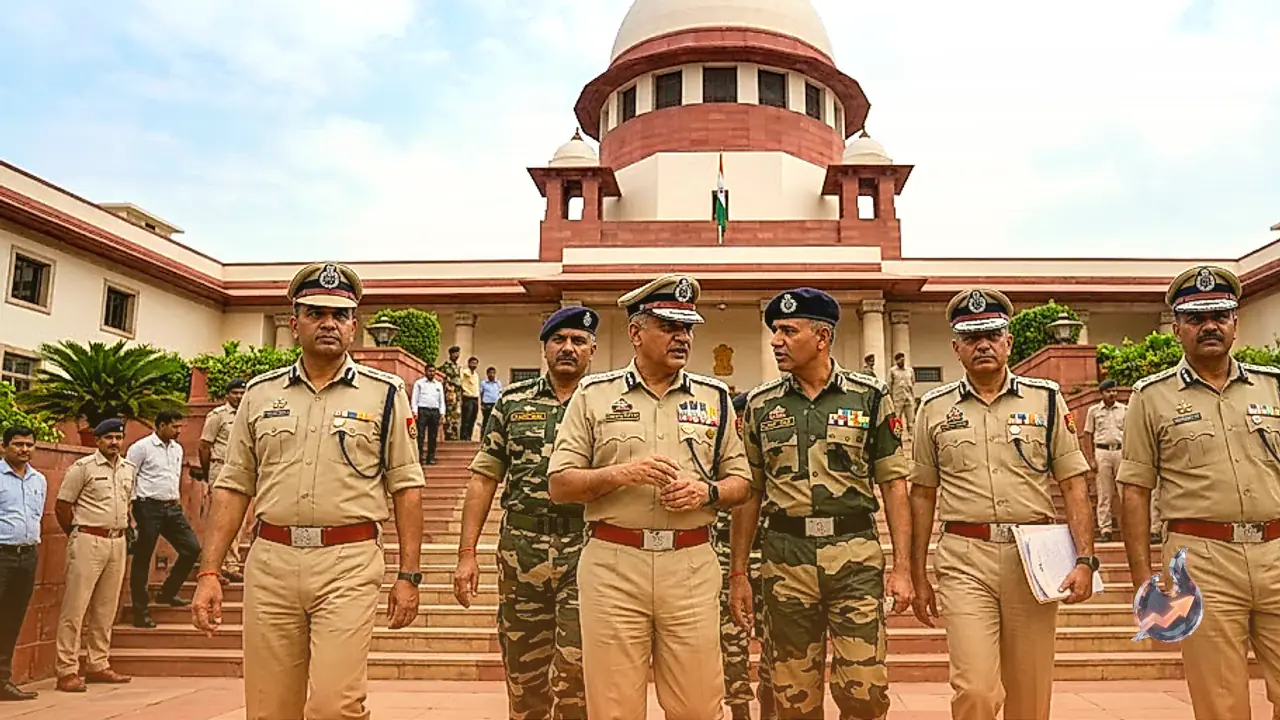

The long-standing operational and career progression friction between Indian Police Service officers and cadre officers of the Central Armed Police Forces has reached the apex court once again. A group of 34 senior CAPF officers has approached the Supreme Court to challenge the constitutional validity of the newly enacted Central Armed Police Forces (General Administration) Act, 2026. Taking up the matter, the top court issued a formal notice to the Central Government, asking it to respond to the allegations raised in the petition. The court has scheduled the next detailed hearing on the matter for August 20, 2026.
Core Legal Arguments Raised by Petitioners
The petition came up for hearing before a bench comprising Justice Manoj Mishra and Justice Vijay Bishnoi. According to the petition filed by the 34 officers, the primary intent behind the new legislation is to neutralize a binding Supreme Court ruling that sought to phase out IPS deputation at senior administrative levels within the forces. The petitioners contend that while Parliament undoubtedly possesses the authority to amend statutes with retrospective effect, it cannot simply pass a fresh law to nullify a judicial directive. For a judicial decision to be superseded legislatively, Parliament must cure or remove the fundamental legal flaw upon which the court based its original verdict.
Constitutional Mandate and Separation of Powers
The officers have asserted that the CAPF (General Administration) Act, 2026 infringes upon the doctrine of separation of powers, which forms a vital part of the constitutional structure. Furthermore, the petition highlights that the provisions of the new Act violate fundamental rights guaranteed under Article 14 (equality before law), Article 16 (equality of opportunity in public employment), and Article 21 (protection of life and personal liberty). The petitioners argue that reserving top leadership slots almost exclusively for IPS officers severely curtails promotion avenues for permanent cadre officers who spend their entire careers within these specialized forces.
The Precedent Set by the 2025 Supreme Court Judgment
This legal challenge stems directly from a major judgment delivered by the Supreme Court on May 23, 2025, in the case of Sanjay Prakash vs Union of India. In that ruling, a bench consisting of Justice AS Oka and Justice Ujjal Bhuyan instructed the Central Government to systematically reduce IPS deputation posts up to the Senior Administrative Grade (SAG) level in a phased manner within two years. Crucially, the bench reaffirmed that CAPF services ought to be treated as part of Organized Group-A Services (OGAS). That verdict was seen as a decisive step toward enabling cadre officers to ascend to top administrative positions without being blocked by deputations.
Key Provisions of the 2026 CAPF Act
The petition outlines specific clauses of the new legislation that override judicial mandates. Under the CAPF Act of 2026, the Central Government retains full authority to formulate rules governing recruitment, promotion, deputation, and service conditions, regardless of any court judgment to the contrary. Statutorily, the Act mandates that 50% of Inspector General (IG) level posts will be filled through IPS deputation. At the Additional Director General (ADG) level, a minimum of 67% of posts are reserved for IPS officers. Moreover, all posts at the Special DG and Director General (DG) levels are designated to be filled exclusively via IPS deputation. All eyes will now be on August 20, 2026, when the Centre presents its counter-arguments before the Supreme Court.