




















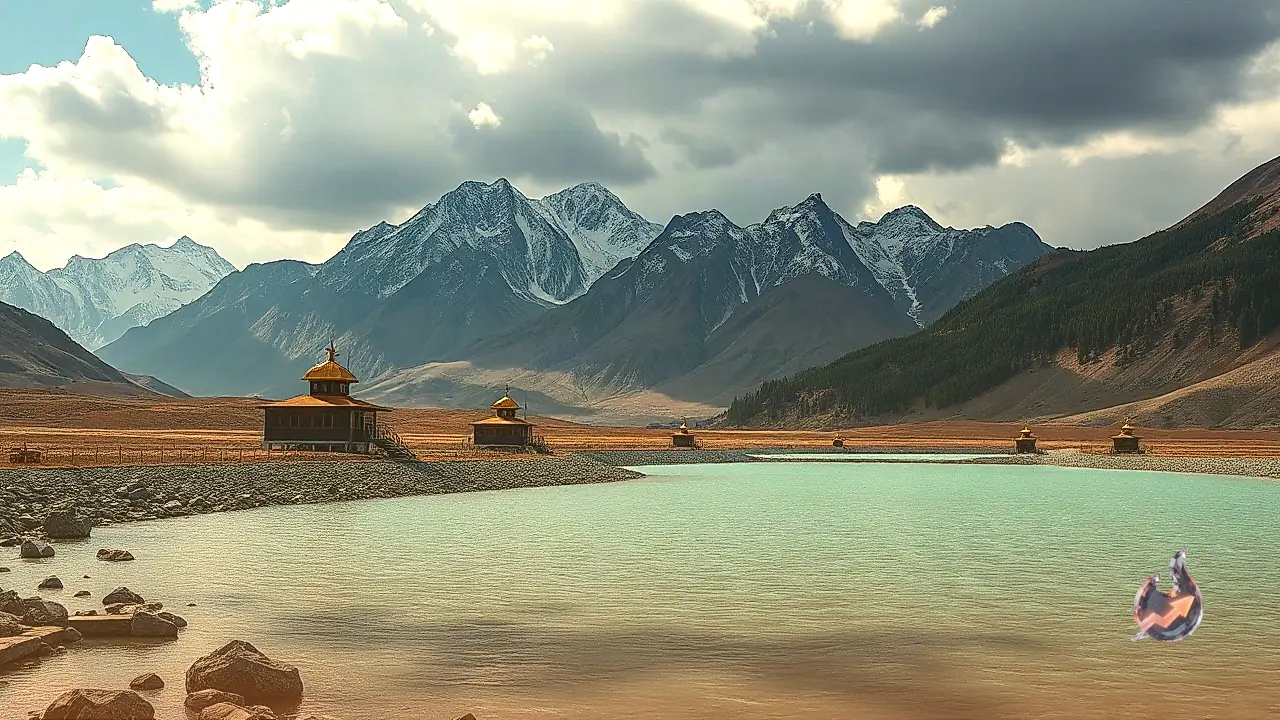

Following successful efforts to green the arid regions of Leh, the administration in Ladakh has initiated a major project to rescue the historic Tso Kar Lake, located at an altitude of nearly 15,000 feet in the Himalayas. Earlier, the administration successfully resolved irrigation shortages by diverting 90 million liters of water from the Stok Glacier into the Igu-Phey and Chuchot canals. Building on that success, a massive revival project has now been launched to channel the waters of the Rupshu Kharnak glacier stream in the Changthang district into the rapidly drying Tso Kar Lake.
Shrinking Water Body Threatening Migratory Birds
Over the past decade, this prominent lake has shrunk by nearly 70 percent. Once sprawling across roughly 11,000 acres, this massive glacial lake has now reduced to a mere 3,200 acres. The receding water levels have pushed the natural habitats of migratory birds and rare black-necked cranes to the brink of destruction, causing a steep decline in the avian population visiting the region.
Utilizing Glacial Water Flowing Into the Indus
Under this new revival scheme, an average of 132 cusecs, translating to roughly 320 million liters of unused glacier water daily from the Rupshu Kharnak stream, will be diverted toward Tso Kar Lake. Currently, this invaluable glacial water flows wastefully into the Indus River. Diverting this water into the basin will not only raise the water levels but also fully revive Changthang's unique high-altitude wetland and its fragile ecosystem. By utilizing this volume of water, experts hope the lake will return to its original form within a single year.
Extreme Sub-Zero Winter Conditions
This is the first and only effort of its kind in India to revive a dying lake at such an extreme altitude and under such harsh conditions. Even during summers, temperatures here mostly remain below 10 degrees Celsius, while winters see the mercury plunge between minus 20 and minus 30 degrees. The idea for this water management initiative struck the administration during a maiden visit to Tso Kar Lake on August 10, when local villagers reported that the magnificent lake was drying up rapidly and bird numbers were plummeting.
A Multi-Depression Cascading System
The core objective of this massive project is to recharge Tso Kar Lake by drawing glacial meltwater from the Rupshu Kharnak stream, located roughly 11 kilometers away and at an elevation of 18,000 feet. During the summer months, peak water discharge from this stream is estimated at approximately 132 cusecs or 320 million liters per day. The engineering plan utilizes three natural depressions along the route between the glacier and the lake.
Glacial water from the stream is initially being diverted into the first depression, which spans 270 acres. From there, water flows into a second depression covering 24 acres, and subsequently into a third depression spanning 10 acres. To control the water levels and manage downstream flow, check dams equipped with three RCC pipes have been constructed at the outlet of each of these three depressions.
Environmental Benefits and Clean Water Flow
Finally, water from the third depression is channeled directly into Tso Kar Lake, situated just 400 meters away. Without constructing any concrete channels, the diversion relies purely on simple earthwork and gravity flow. Starting September 9, about 20 cusecs of water from the Rupshu Kharnak stream were successfully diverted into the first depression, which has begun filling up rapidly. The water is being fed through both earthen channels and a concrete canal that had remained defunct since 1995. Within just four days, roughly 20 percent of the first depression filled up.
Crucially, this cascading system yields dual environmental benefits. Before reaching Tso Kar Lake, the filling of these three natural depressions will create three brand-new freshwater wetlands. Furthermore, all silt and sediment will settle within these newly formed reservoirs, ensuring that only crystal-clear water enters the main lake. These new reservoirs span 270 acres, 24 acres, and 10 acres respectively, and can collectively store around 1,230 million liters of water.
Boosting Tourism and Ecological Strength
Visible from the Leh-Manali Highway, these new water bodies will not only serve as tourist attractions but also provide essential habitats for migratory birds, thereby strengthening regional ecology and increasing the main lake's water levels. Highlighting the initiative, officials noted that the success of the Stok Glacier project proved that large-scale sustainable water management using simple engineering techniques is entirely feasible in cold desert regions. By rerouting the Rupshu Kharnak stream, the goal is to breathe new life into Tso Kar Lake, serving as a vital model for ecological restoration at high altitudes.
Field Surveys and Administrative Planning
During the August 10 visit, local villagers and community leaders informed officials that the lake was once a vast and prosperous source of glacial water that sustained local salt trade and ecological balance for centuries. However, recent years saw the lake shrink by nearly 70 percent, destroying pastures and diminishing bird populations, leaving large dry barren flats where deep water once stood. Consequently, the public health engineering department was instructed to conduct a detailed survey.
Following 15 days of intense groundwork and surveys, the department submitted a report on August 30 proposing an 11-kilometer-long RCC channel. However, keeping ecological concerns in mind, authorities advised against constructing any new concrete channels, opting instead to bring water to the first basin solely via simple earthen channels. With approaching winter conditions threatening to freeze water supplies, work began on a war footing starting September 2.
Restoring Livelihoods for Local Herders
Reviving Tso Kar Lake will have a profound impact on the livelihoods of local communities. Most residents living around the lake are traditional Pashmina goat herders. As the lake receded, grazing grounds vanished, forcing herders to travel 50 to 75 kilometers away from their homes in search of fodder. The restoration of this water body will generate lush grasslands, create new local employment opportunities, and allow herders to return closer to their homes.