




















Prime Minister Narendra Modi and his administration frequently introduce strategic policy shifts that keep the political landscape in constant motion. Following a strong international display at the summit, the central government has now introduced an agenda that has unsettled opposition parties, Asaduddin Owaisi, and various political adversaries. While the opposition was previously preoccupied with speculating about the timing of the women reservation bill or delimitation measures, a fresh and major issue has entirely shifted the political focus. The government has laid out its grand agenda well ahead of 2029, centering entirely on the Uniform Civil Code, with plans to implement it nationwide on a massive scale through a structured timeline that has caused widespread alarm among political rivals.
Leaders ranging from Congress representatives to Akhilesh Yadav, Tejashwi Yadav, and Asaduddin Owaisi have all taken to the political arena to contest the move. The moment the uniform code was announced, panic rippled through the anti-Modi camp. Questions are now being raised as to why Akhilesh Yadav has emerged as such a vocal opponent of the code and what severe political complications this legislation could pose for the electoral futures of Rahul Gandhi and Akhilesh Yadav. This political upheaval is not confined solely to the opposition alliance; ripples of uncertainty are being felt within the NDA as well. Amidst the ongoing anxiety over the civil code, Mamata Banerjee in West Bengal is also navigating a distinct set of political pressures.
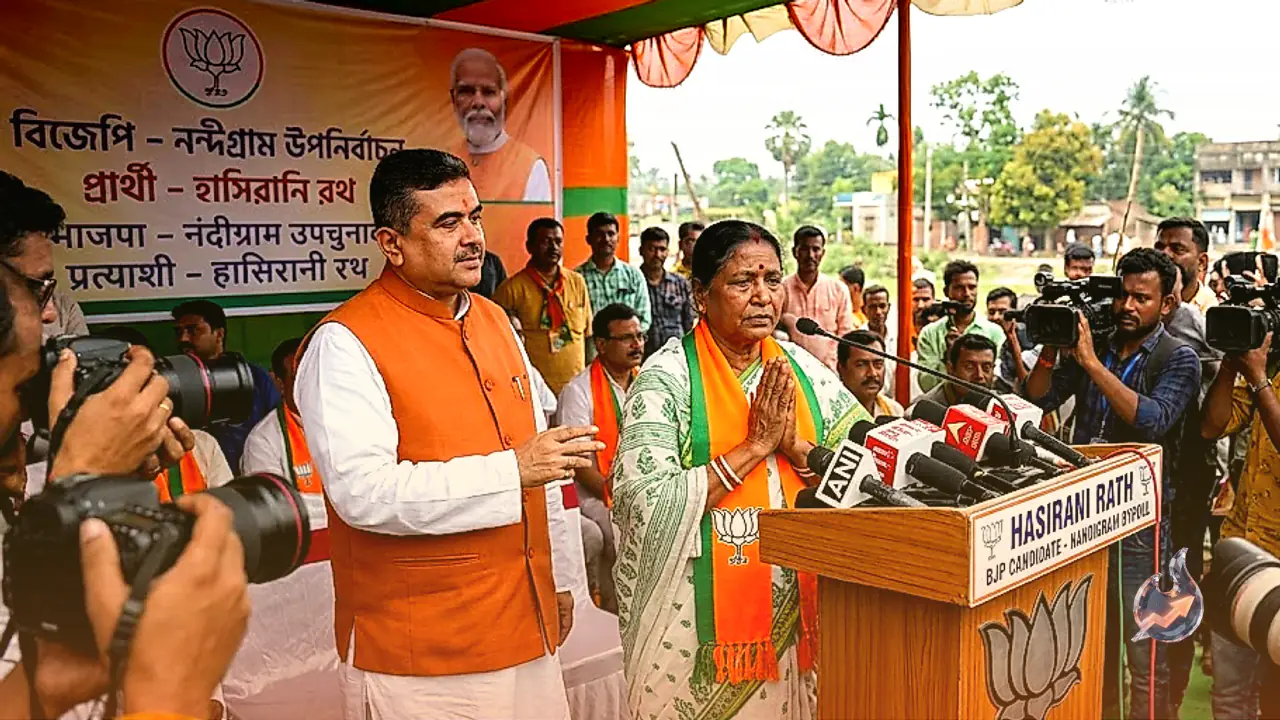
Political circles are abuzz with discussions regarding the Bharatiya Janata Party leadership sharpening its strategy to tackle high-profile political seats in West Bengal. Ever since the party unveiled its roadmap for the Uniform Civil Code, intense agitation has gripped the opposition. This is primarily because a common civil code has remained a longstanding core promise of the party. Given how systematically the Prime Minister has fulfilled past foundational commitments, the opposition harbors deep anxiety that this pledge will also be driven through to completion.
Historical precedents show that the party successfully delivered on its promise to construct the Ram Mandir and removed Article 370 from Jammu and Kashmir to establish a unified constitutional framework. The Uniform Civil Code now stands as the next major objective. Under this proposed code, separate personal laws governed by religious beliefs regarding marriage, divorce, and familial civil disputes would be replaced by a uniform legal framework. The governing leadership aims to settle this commitment well before the year 2029. Consequently, Amit Shah established a firm timeline to fulfill this goal, explicitly stating that the code will be enforced across all 21 NDA-governed states.
This declaration by Amit Shah triggered immediate uproar, dealing its most direct initial blow to Akhilesh Yadav in Uttar Pradesh. Yadav had been attempting to corner the ruling party by positioning himself as a prominent champion of Hindu interests over recent controversies such as the temple donations dispute. However, with the introduction of this new legislative pivot, he has found it difficult to conceal his unease, emerging as the very first among major opposition leaders to openly oppose the civil code.
Akhilesh Yadav expressed his discontent through a social media post, suggesting that the public is well aware that the acronym UCC carries a very different implication in practice. He labeled it as an underground communal conspiracy. He further argued that the government should first fulfill its past promises before introducing any new code, dismissing the initiative as a political gimmick meant to mislead voters. He challenged the administration to deposit fifteen lakh rupees into bank accounts, generate two crore jobs, and truly practice inclusive governance before pursuing a uniform code.
Following this extensive critique from Yadav, the underlying reasons for his anxiety have become a focal point of discussion, echoed by Samajwadi Party leader Abu Azmi. Since the announcement targets all 21 NDA-ruled states, the epicenter of political friction is clearly visible in Uttar Pradesh, where state elections are approaching. Should the ruling party aggressively push the civil code in the state, Yadav risks getting caught in a complex political trap.
Several compounding factors explain this vulnerability. Muslim clerics and community leaders are fiercely vocal in their opposition to the proposed code, and the Muslim demographic serves as the core voting base for the Samajwadi Party. Consequently, Yadav is compelled to adopt a much more aggressive stance on the issue. At the same time, he aims to maintain a coalition of upper castes, Dalits, and backward classes under his PDA framework. However, if the debate over the civil code triggers severe religious polarization, his political difficulties will multiply significantly. Furthermore, a large segment of the Hindu population in Uttar Pradesh harbors no objections to the code. With Asaduddin Owaisi also actively challenging the narrative and speaking out forcefully, Yadav faces a grave threat of polarization and division within his traditional support base.
Amidst these political tensions for the opposition, the government led by Yogi Adityanath delivered a counter-blow by declaring that the state administration is fully prepared to implement the Uniform Civil Code. Although the code has not yet been formally enacted in the state, merely discussing its implementation has sent political temperatures soaring. Religious authorities have similarly found themselves at loggerheads. While Muslim clerics have taken to the streets in protest, members of the saint community have openly welcomed the initiative.
As the debate intensifies in Uttar Pradesh, the All India Muslim Personal Law Board is also preparing to enter the fray. Scheduled for September 17, the board is set to launch a Save Constitution and Save Sharia movement at Jantar Mantar to protest against the civil code and related matters. The active entry of Asaduddin Owaisi into this controversy is expected to further compound the difficulties for the opposition alliance as he continues to voice strong opposition to the measure.