


















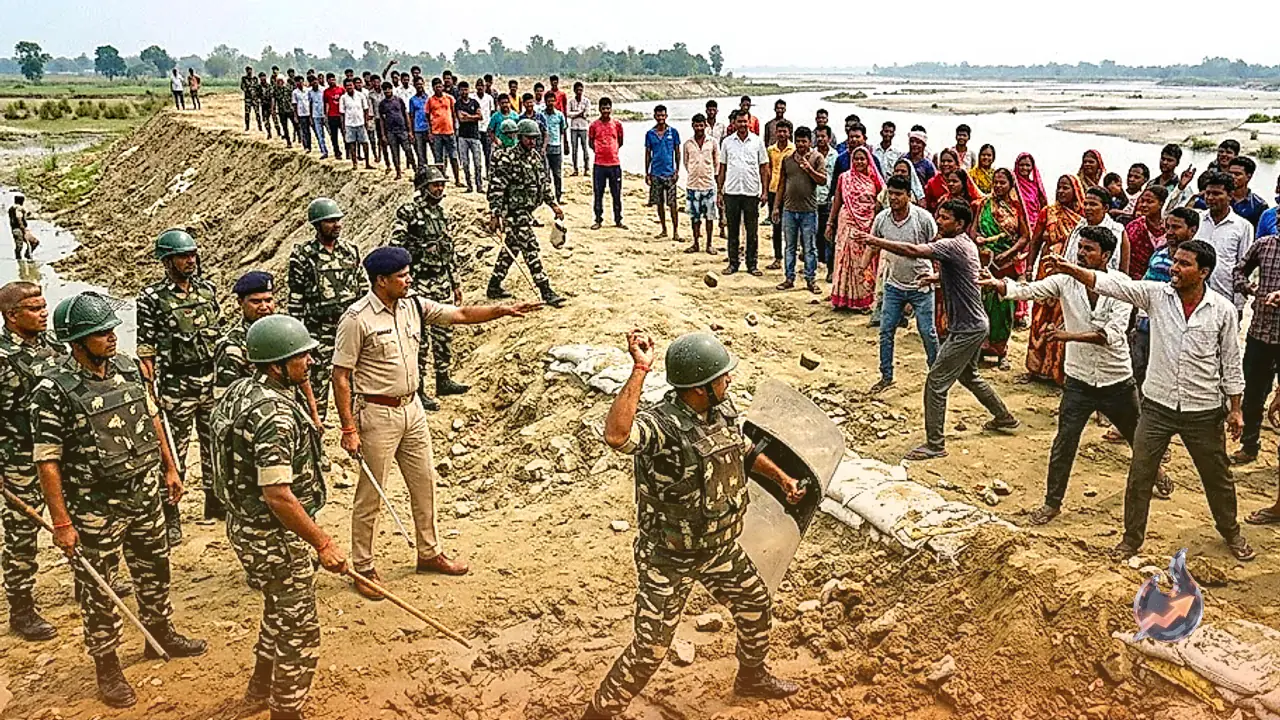

Fresh diplomatic and security tensions have flared along the Indo-Nepal international border in the sensitive Susta region of Paschim Champaran district, Bihar. An aggressive mob of approximately 150 to 200 Nepalese residents from Susta village breached established border protocols by initiating unauthorized construction of an earthen embankment inside Indian territory and subsequently pelting stones at patrolling Sashastra Seema Bal (SSB) personnel. Following the violent confrontation, local police registered a formal criminal case to initiate a thorough investigation into the border incident.
Unauthorized Embankment Construction Detected During Border Patrol
According to the official complaint lodged with the police by Awadhesh Kumar, camp in-charge of the SSB 21st Battalion stationed at Rampurwa in Bagaha, an SSB team was carrying out routine border vigilance and intelligence-gathering operations on August 2, 2026. The patrolling party was commanded by Deputy Commandant Vishal Kumar, accompanied by Head Constable Tridev Prasad, Constable Gopal Kumar, and several other security personnel.
At approximately 2:15 PM, as the patrol team approached the vicinity of a Pakad tree situated within Indian territory adjacent to the Susta border sector, they identified unlawful activity along the boundary line. A substantial group of villagers from Nepal's Susta village was actively engaged in constructing an earthen dam extending directly into Indian land. Recognizing the territorial intrusion, the SSB patrol immediately intervened to halt the unauthorized construction work.
Violation of Bilateral Agreement to Preserve Border Status Quo
The SSB complaint highlighted that the sudden construction activity took place in direct defiance of a bilateral consensus reached just three days prior. On July 31, 2026, security commanders from both India and Nepal had convened a joint coordination meeting specifically to address long-standing territorial sensitivities in the Susta zone.
During the July 31 discussions, officials from both nations explicitly agreed to maintain the strict status quo along the un-demarcated boundary line until high-level diplomatic mechanisms could finalize a permanent resolution. Both sides pledged to prohibit any new infrastructure projects, earthworks, or physical alterations in the disputed zone. However, the unexpected attempt by Nepalese villagers on August 2 to erect an embankment inside Indian territory marked a clear breach of the bilateral agreement.
Escalation, Verbal Abuse, and Stone-Pelting at Security Forces
In an effort to resolve the dispute peacefully, SSB officials immediately initiated dialogue with local officers from Nepal's Armed Police Force (APF). However, while official discussions were underway, a crowd of nearly 150 to 200 villagers from Susta rapidly mobilized and descended upon the site.
The mob displayed immediate hostility, disrupting official security duties, shouting abusive slogans, and arming themselves with wooden sticks and stones. To prevent further confrontation and safeguard the personnel, the SSB commander ordered a tactical withdrawal to the area near a Semal tree, located well within Indian territory.
Undeterred by the retreat, members of the aggressive crowd crossed the international boundary line into Indian territory and launched a heavy barrage of stones targeting the SSB team. The sudden stone-pelting caused brief chaos and triggered severe security tension across the border zone before the mob dispersed.
FIR Registered at Valmikinagar Police Station and Current Investigation
Treating the incident as a major breach of border security, public order, and official duty, the SSB submitted a detailed written report requesting strict legal action against the perpetrators. Based on this official submission, the Valmikinagar Police Station registered Case No. 119/26 against 150 to 200 unidentified Nepalese citizens under relevant provisions of law.
Valmikinagar Station House Officer (SHO) Manoj Kumar confirmed the registration of the FIR and stated that police personnel have commenced formal investigative procedures to establish the facts and take appropriate legal steps. Meanwhile, official administrative or military representatives from Nepal have not issued any public response or formal statement regarding the border clash.
Geographical Context of Susta Dispute and Regional Security Concerns
The Susta area has long remained one of the most volatile segments along the 1,751-kilometer India-Nepal border. The primary catalyst for the dispute stems from historical shifts in the natural course of the Gandak river, known as the Narayani river in Nepal. Over decades, riverbed erosion and channel changes have created conflicting territorial claims, prompting continuous surveillance by security agencies on both sides of the border.
The recent clash comes amidst heightened security concerns in the broader border district. In a separate incident recently, violent clashes erupted between two community groups near the Nepal border over a Bolbam Yatra procession, resulting in gunfire that claimed 2 lives. The convergence of these incidents has prompted border security forces to maintain enhanced vigilance along the frontier.