






















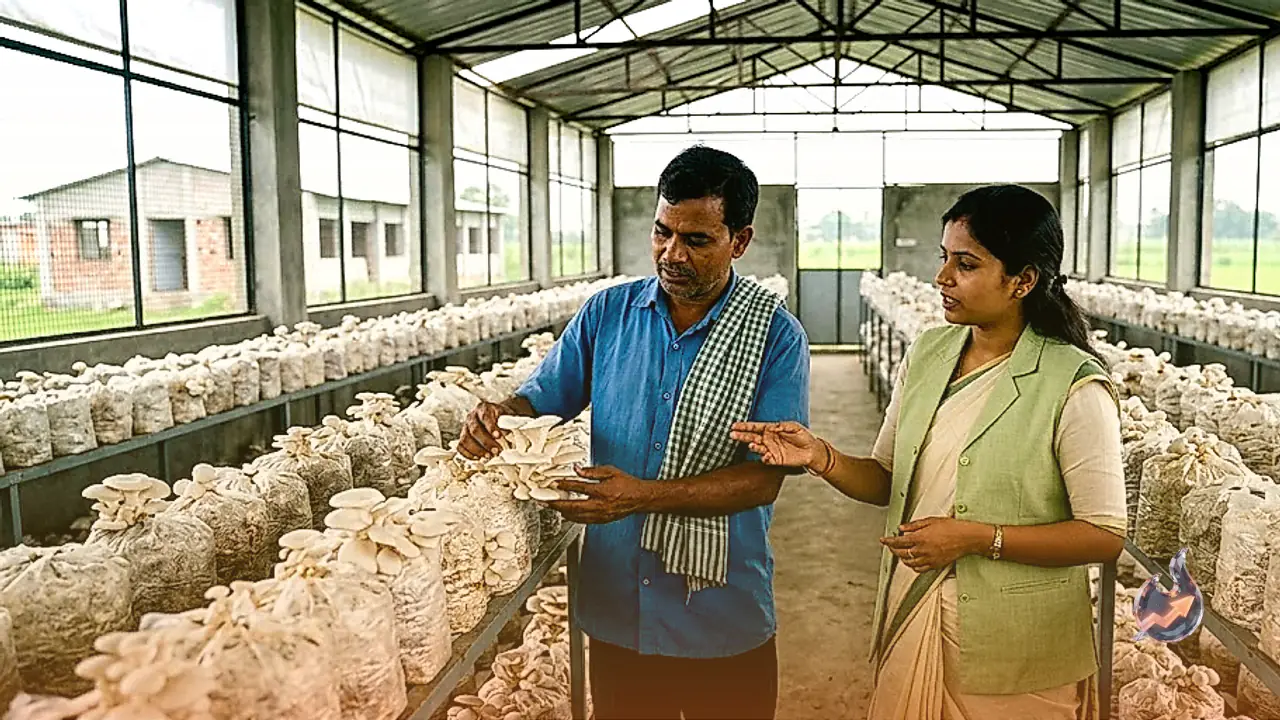

Mushroom cultivation has rapidly emerged as a lucrative commercial avenue for farmers and rural entrepreneurs looking to diversify beyond conventional cropping systems. According to agricultural experts based in Samastipur, adopting structured mushroom farming inside a modest bamboo and thatch enclosure can generate an annual net income ranging between 10 lakh and 12 lakh rupees. To accelerate this transition, the state administration is extending structured financial assistance alongside technical capacity building initiatives.
Government Subsidy Framework and Mandatory Training
To incentivize enterprise creation in the horticulture segment, the Bihar state government administers a dedicated assistance scheme. Under this initiative, the approved baseline cost for constructing a standard 1,600 square foot cultivation shed is fixed at 1 lakh 89 thousand 900 rupees, with the state providing a 50 percent financial subsidy. However, eligibility for this financial aid requires farmers to undergo a mandatory one-week training course at Dr. Rajendra Prasad Central Agricultural University in Pusa. During this seven-day institutional program, participants receive comprehensive instruction regarding spawn selection, substrate preparation, crop maintenance, climate monitoring, and direct market linkage strategies. The institutional completion certificate issued after training serves as the prerequisite document for submitting grant applications to state authorities.
Capital Investment and Infrastructure Lifespan
Elaborating on the financial outlay, Dr. Dayaram Singh, Senior Scientist at the university's mushroom department, indicated that while the baseline shed cost is partially subsidized, bringing an operational facility to functional status requires an aggregate capital investment of approximately 5 lakh rupees. This initial outlay covers physical construction, straw substrate procurement, spawn seeds, protective polythene, sanitation materials, and operational labor. A single sheltered unit spanning 1,500 to 1,600 square feet allows year-round rotation of different mushroom species suited to seasonal conditions. Crucially, a properly built thatch and bamboo structure remains durable for nearly three full years, ensuring that growers do not incur recurring structural expenditure during initial harvest cycles.
Yield Dynamics, Market Rates, and Profit Margins
Dr. Dayaram Singh emphasized that standard scientific management within a 1,600 square foot shed yields between 10 and 12 tonnes of mushrooms annually. Under optimal environmental control and intensive management practices, annual harvest volumes can rise up to 15 tonnes per unit. With prevailing market prices ranging from 120 to 150 rupees per kilogram, total revenues easily cover operational expenses and yield a net profit of 10 to 12 lakh rupees per annum. Dr. Dayaram Singh noted that numerous trained growers have already validated this high-density production model, demonstrating that smallholder farmers can achieve significantly higher financial returns compared to traditional cereal farming.