























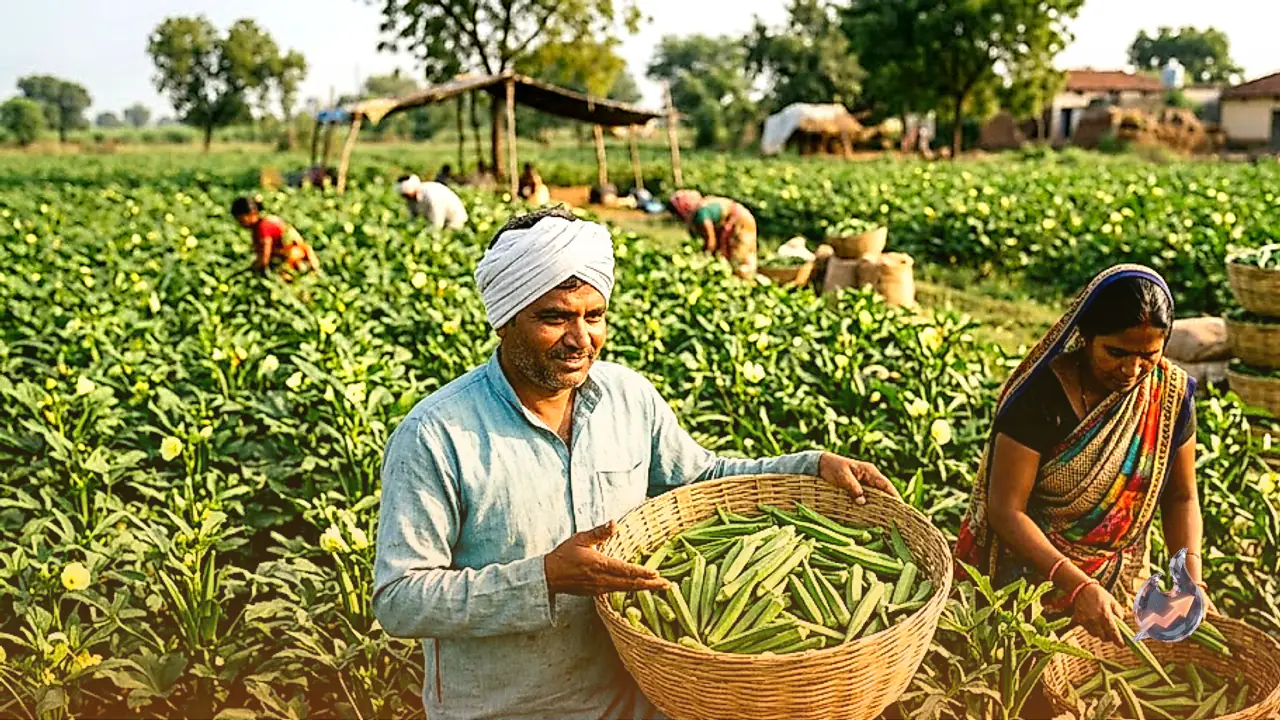

Vegetable cultivation can be a highly lucrative venture, and growing okra stands out as a low-cost option that yields substantial returns for growers. According to progressive farmers and agricultural experts, selecting the right crop variety and managing production efficiently can significantly boost earnings within a short span of time.
Cost and Sowing Dynamics
Progressive farmer Salim Khan from Nowgong in the Chhatarpur district notes that okra is a profitable crop that generates returns well above the initial investment. For farmers cultivating an acre of land, the primary expense incurred is on the seeds. If drip irrigation and mulch setups are already installed, the total production cost for an acre remains restricted between 10,000 to 15,000 rupees, factoring in the seed costs.
Timing and Cropping Season
Okra can practically be grown throughout the year, with the exception of December and January when severe winter conditions hinder growth. Farmers can proceed with sowing during October, though plants require diligent care as winter intensifies in December. The crop begins yielding production in about 50 days, and the harvesting phase continues smoothly for roughly two and a half months.
Yield and Harvesting Schedule
Proper field arrangement plays a critical role in managing the output. A single 300-foot bed in the field yields around 6 to 7 kilograms of okra during one picking session. Harvesting can be conducted by leaving a one-day gap between each picking. Strategic planning dictates that seeds should be sown precisely when market supplies dry up or when the harvest hits the market ahead of others.
Wholesale Market Prices and Revenue
The current wholesale market rate for okra stands at 30 rupees per kilogram. However, the produce is expected to fetch around 40 rupees per kilogram when it reaches the market due to a subsequent drop in overall supply. Generally, the wholesale price baseline for okra hovers around 10 rupees per kilogram.
Choosing High-Yield Hybrid Varieties
Choosing the correct seed variety remains a crucial step before commencing any agricultural activity. The market currently offers numerous hybrid seeds designed to maximize output. Progressive farming practices in the region feature specialized varieties such as the Janvi variety from VNR company and Radhika F1 hybrids from Advanta.